


Voice search has shifted from a futuristic concept to an essential part of modern digital marketing. With over 20.5% of people globally using voice search and 153.5 million voice assistant users in the United States alone, optimizing your website for voice queries is no longer optional—it’s critical for visibility and traffic growth.
Unlike traditional typed searches, voice search optimization requires a fundamentally different approach. People speak differently than they type. They use longer phrases, ask complete questions, and expect immediate answers. Search engines have evolved to recognize these conversational patterns through advanced natural language processing and artificial intelligence.
This comprehensive guide covers everything you need to know about voice search optimization 2025. You’ll discover proven strategies to capture voice search traffic, rank for featured snippets, and position your content to be read aloud by Alexa, Siri, and Google Assistant. Whether you’re optimizing for local searches or informational queries, these tactics will help your business stay competitive in the voice-first future.
Understanding the Voice Search Revolution

How Voice Search Works in 2025
Voice search technology operates through sophisticated artificial intelligence systems that process spoken language differently than written text. When a user speaks a query to their device, several steps occur instantly.
First, the device converts speech to text using automatic speech recognition technology. Then, natural language processing (NLP) algorithms analyze the query to understand intent, context, and meaning. Finally, the search engine retrieves and ranks results based on how well content answers the spoken question.
The advancement in AI and machine learning has dramatically improved voice assistant accuracy. Voice search assistants now answer 93.7% of queries correctly, up from just 65% a few years ago. This increased reliability has driven rapid adoption across consumers of all ages.
Key voice assistants dominating 2025:
- Google Assistant (46% usage increase since 2020)
- Siri (40% usage increase since 2020)
- Alexa (26% usage increase since 2020)
Why Voice Search Optimization Matters Now
Over 1 billion voice searches occur every month globally. More than 30% of all web browsing sessions now involve voice queries. This explosive growth reflects a fundamental shift in consumer behavior toward convenience and hands-free interaction.
The financial impact is staggering. Voice commerce was worth $164 billion in global transaction value, with projections reaching $45 billion in consumer spending by 2028. Businesses ignoring voice search optimization are leaving significant revenue on the table.
Local businesses especially benefit from voice optimization. Research shows 76% of consumers use voice search to find local businesses, and 58% of voice searches target local business information. If you’re not optimizing for voice, your competitors are capturing your customers.
The Differences Between Voice Search and Traditional SEO
Conversational Language vs. Typed Keywords
The most fundamental difference between voice search and traditional SEO lies in query structure. When typing, users enter short keyword phrases like “best pizza near me.” When speaking, they ask complete questions: “What’s the best pizza restaurant within walking distance of my location?”
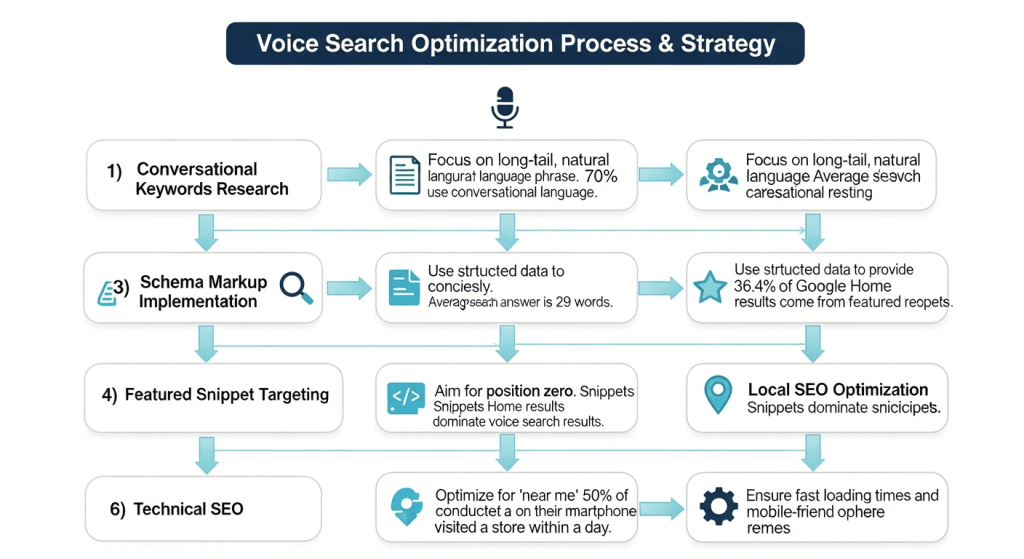
Voice queries average 29 words in search results but can extend much longer. They incorporate natural language patterns including fillers, context, and clarification. This means your optimization strategy must account for how people actually speak, not how they search in Google’s text box.
Long-tail keywords and conversational phrases become your primary focus. Instead of targeting “voice search optimization,” you’d optimize for “how can I optimize my website for voice search” or “what are the best practices for voice search in 2025?”
Mobile and Smart Speaker Focus
Traditional SEO evolved around desktop and mobile web optimization. Voice search primarily occurs on mobile devices (56% of voice searches) and smart speakers (approximately 103 million households in the U.S. have smart speakers).
This shift demands mobile-first optimization that wasn’t as critical in traditional SEO. Page speed becomes non-negotiable. Voice search results load in 4.6 seconds on average—52% faster than typical web pages. Slow websites simply won’t appear in voice search results.
Featured Snippets Become Position Zero
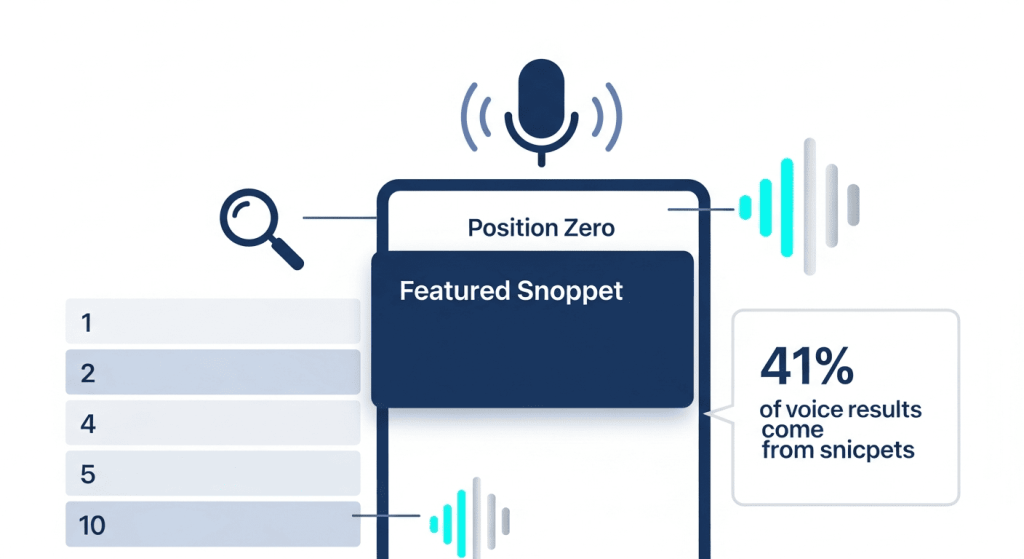
In traditional SEO, ranking in the top three positions represented success. For voice search, featured snippets—often called “Position Zero”—are where real success begins. Approximately 41% of voice search results come directly from featured snippets.To master this crucial ranking factor, our comprehensive featured snippets strategy guide provides advanced tactics for capturing Position Zero across all content types.
Voice assistants don’t present multiple result options. They read a single answer aloud. If your content appears in a featured snippet, you have a dramatically higher chance of being that voice-read answer.
Local SEO Takes Center Stage
Voice search has intensified the importance of local SEO. While local optimization has always mattered, voice search has made it essential. The majority of voice searches include local intent, whether searching for nearby businesses, services, or information about specific locations.
Mastering Conversational Keywords for Voice Search
Identifying Question-Based Search Queries
Voice search optimization begins with keyword research focused on questions. Unlike traditional keywords, voice search keywords follow predictable patterns based on how people naturally ask questions.
The most common voice search question types include:
- “How do I…?” (process or instruction-based)
- “What is…?” (informational queries)
- “Where can I find…?” (local business queries)
- “Why does…?” (explanatory content)
- “When should I…?” (timing-based questions)
- “Can I…?” (capability-based queries)
Tools like Google’s “People Also Ask” section reveal actual questions people ask about your topics. Answer the Public provides visual maps of question-based keywords. SEMrush and Ahrefs include voice search query analysis features that identify conversational search opportunities.
Research strategy for voice keywords:
- Search your primary keywords on Google and examine the “People Also Ask” box
- Note all expanded questions and variations
- Look for patterns in how questions are phrased
- Identify question-based long-tail keywords specific to your industry
- Document the user intent behind each question
Incorporating Long-Tail Keywords Naturally
Long-tail keywords form the backbone of voice search optimization. These are longer, more specific keyword phrases that typically have lower search volume but higher conversion intent. Our AI-powered long-tail keyword research guide shows you exactly how to identify and prioritize these high-converting phrases.
Rather than targeting “restaurants,” optimize for “best family-friendly Italian restaurants in downtown Austin that serve wine.” Rather than “SEO tips,” target “what are the most important SEO tips for e-commerce websites in 2025?”
Integrate these long-tail keywords naturally throughout your content. Keyword stuffing destroys readability and violates search engine guidelines. Instead, write for humans first. Conversational language will naturally incorporate these longer phrases as you answer user questions.
Best practices for long-tail keyword integration:
- Use keywords in your opening paragraph and conclusion
- Include keyword variations in subheadings
- Weave keywords into transitional sentences
- Place keywords in list items and bullet points
- Mention keywords when they naturally fit the topic flow
Building Content Around User Intent
Voice search optimization requires deep understanding of user intent. The same words can mean different things depending on context. Someone asking “voice search optimization” might want a definition, best practices, tools, or local services.
Match your content to the specific intent. If you’re targeting informational voice queries, create comprehensive guides and answer common questions. For commercial intent (shopping-related), highlight products, pricing, and purchase options. For local intent, emphasize location, hours, directions, and local relevance.
Analyze the featured snippets currently appearing for your target keywords. These reveal what Google considers the best answer to that specific question. Your content should provide equal or better answers to rank for these positions.
Optimizing Content Structure for Voice Search Success
Creating Content That Answers Questions Directly
Voice search content must answer questions immediately and clearly. Users asking voice questions expect instant, direct answers—not lengthy introductions or background information.
Structure your content with the answer at the top, followed by supporting details and explanations. A proven formula involves:
- Opening with a concise, complete answer (1-2 sentences)
- Providing context and supporting information
- Offering examples or case studies
- Explaining related concepts
- Addressing related questions
This structure helps Google’s algorithms extract featured snippets from your content. It also improves user experience whether visitors come from voice results or traditional search.
Using Clear, Scannable Formatting
Voice search optimization requires excellent formatting that helps both users and search engines understand your content structure.
Formatting best practices:
- Use H2 and H3 subheadings formatted as questions when possible
- Keep paragraphs to 3-4 sentences maximum
- Use bullet points and numbered lists for complex information
- Break up text with white space to improve readability
- Use bold text to emphasize key terms and concepts
- Include short summary boxes or callouts for key information
Google’s algorithms analyze formatting patterns to identify main topics, subtopics, and important content sections. Proper formatting increases your chances of being selected for featured snippets and voice search results.
Creating FAQ Sections That Capture Voice Queries
FAQ sections are among the highest-performing content types for voice search. Voice assistants frequently pull answers from FAQ pages because the format directly matches question-and-answer voice patterns.
Create an FAQ section addressing the 10-15 most common questions your audience asks about your products, services, or topics. Each answer should be concise (40-60 words), directly addressing the question without unnecessary preamble.
FAQ section structure:
- Place FAQ sections toward the end of articles or as dedicated pages
- Use clear question headings formatted as actual user questions
- Provide direct, complete answers without filler
- Use FAQ schema markup to help search engines understand the format
- Answer 7-15 questions minimum for better voice search performance
FAQ pages perform exceptionally well because they match exactly how voice assistants prefer content formatted. Consumers asking voice questions receive FAQ answers more frequently than any other content type.
Writing at an 8th-Grade Reading Level
Voice search optimization requires clear, simple language that sounds natural when read aloud. Complex sentences, industry jargon, and technical terminology reduce the likelihood of your content being selected for voice answers.
Aim for an 8th to 9th-grade reading level. This doesn’t mean dumbing down content—it means communicating clearly and directly. Use short words over long ones (“use” instead of “utilize,” “help” instead of “facilitate”).
Tools like Hemingway Editor and Grammarly Pro help identify complex sentences and overly technical language. Read your content aloud. Does it sound natural? Would you speak this way in conversation? If not, simplify it.
Readability optimization checklist:
- Average sentence length: 15-20 words
- Avoid sentences longer than 25 words
- Replace technical terms with common alternatives
- Eliminate unnecessary jargon and acronyms
- Use contractions (they’re, you’re) for conversational tone
- Include transition words that guide readers smoothly
Winning Featured Snippets for Voice Search Position Zero
Understanding Featured Snippet Types
Google displays featured snippets in four primary formats, each requiring different content optimization approaches.
Paragraph snippets extract a 40-60 word passage directly answering a question. These are most common and work well for “how,” “what,” and “why” questions. Structure your answer as a clear, concise paragraph that stands alone.
List snippets display bullet points or numbered steps. Voice assistants read these sequentially, making them perfect for “how-to” questions and step-by-step processes. Keep each list item brief and clear.
Table snippets compare data across multiple dimensions. These work for comparison questions and work well for specifications, pricing, or feature comparisons. Keep tables simple and clearly labeled.
Definition snippets provide brief definitions followed by longer explanations. These appear for definitional queries and work well for new concepts or industry terminology.
Creating Content That Captures Position Zero
Winning featured snippets involves strategic content formatting combined with comprehensive, high-quality information.
Paragraph snippet strategy:
- Answer the question in your opening sentence
- Keep the complete answer to 40-60 words
- Place this answer immediately below your H2 heading
- Follow with more detailed explanation for context
- Ensure your answer is self-contained and understandable without other text
List snippet strategy:
- Structure how-to content with clear, numbered steps
- Keep each step brief (one sentence or short phrase)
- Use the same format and structure throughout
- Place lists prominently in your content
- Make the first list item compelling and directly relevant
Table snippet strategy:
- Create comparison tables for relevant topics
- Use clear headers and logical organization
- Include 3-4 rows and 2-3 columns
- Format tables for mobile readability
- Ensure data is accurate and current
Research your target keywords in Google Search. Note which featured snippet format currently appears. Match or exceed this format while providing superior information.
Technical Implementation with Schema Markup
Schema markup tells search engines exactly what your content means, increasing featured snippet chances. Implement multiple schema types to boost voice search visibility.
Essential schema types for voice search:
- FAQPage schema for FAQ sections
- HowTo schema for step-by-step guides
- Article schema for blog posts and articles
- LocalBusiness schema for location-based businesses
- Product schema for product pages
- Review schema for customer reviews
- Speakable schema (Google’s new markup) to mark content for voice reading
Use AIOSEO, Yoast SEO, or other SEO plugins to add schema markup without coding knowledge. Many plugins include “no-code” schema builders that simplify the process.
Websites with proper schema markup are 4x more likely to appear in voice search results. This technical investment yields significant returns in voice search visibility.
Local Voice Search Optimization Strategies
Optimizing Your Google Business Profile
Local voice searches dominate usage patterns, making Google Business Profile optimization critical. Over 76% of voice searches have local intent, and a properly optimized profile directly impacts visibility.
Google Business Profile optimization checklist:
- Verify your business information in Google Business Profile
- Keep all information accurate and current (address, phone, hours)
- Add high-quality photos (exterior, interior, team, products)
- Write a compelling business description (160-250 words)
- Respond to customer reviews promptly and professionally
- Keep business hours and seasonal closures updated
- Add service areas if you’re service-based
- Include appointment scheduling if applicable
Voice assistants rely heavily on Google Business Profile information when answering local queries. When someone asks “what are the hours for the coffee shop near me?”, Google Assistant pulls directly from Business Profile data.
Targeting Location-Based Keywords
Location-based keywords are where voice search and local SEO intersect powerfully. Most voice queries include location references because people are looking for immediate, nearby solutions.
Target keywords that include specific neighborhoods, cities, regions, and landmarks. Instead of general keywords, optimize for “best Italian restaurants in downtown Seattle” or “affordable plumbers serving the Eastside neighborhoods.”
Create location-specific content pages, especially for multi-location businesses. Each page should:
- Include the location in the H1 title
- Mention the location naturally throughout the content
- Include specific local landmarks and area information
- Address neighborhood-specific questions and concerns
- Feature location-specific images
- Implement LocalBusiness schema with location details
Building Local Authority Through Reviews
Online reviews dramatically impact local voice search rankings. Positive reviews signal trust and authority to voice assistants. Encourage customers to leave reviews on Google, Yelp, and industry-specific platforms.
More important than volume, review recency matters. Recent positive reviews demonstrate ongoing customer satisfaction. Voice search algorithms prioritize businesses with consistent positive reviews rather than those with many older reviews.
Respond to all reviews—both positive and negative. Professional responses demonstrate active business management and customer commitment. This engagement signals to search algorithms that your business is actively managed and trustworthy.
Technical SEO Foundations for Voice Search
Page Speed Optimization
Page speed represents one of the most important voice search ranking factors. Voice search results average 4.6 seconds load time compared to 8.8 seconds for typical web pages.
This 52% speed advantage isn’t coincidental—Google deliberately prioritizes fast-loading pages for voice results. Slow websites simply won’t appear in voice search results, regardless of content quality.
Page speed optimization strategies:
- Compress images without quality loss (use TinyPNG or similar tools)
- Minimize CSS and JavaScript files
- Enable browser caching
- Use content delivery networks (CDNs)
- Remove render-blocking resources
- Implement lazy loading for images
- Choose quality web hosting
- Use Google PageSpeed Insights and GTmetrix to identify issues
Test your site speed using Google PageSpeed Insights. It provides specific recommendations for improvement. Aim for a target load time of 2-3 seconds. Mobile pages should load even faster given voice search’s mobile focus.
Mobile-First Optimization
With 56% of voice searches occurring on mobile devices, mobile-first optimization has become fundamental to voice search strategy.
Mobile optimization essentials:
- Use responsive design that adapts to all screen sizes
- Ensure tap targets are large enough for easy interaction
- Avoid pop-ups and interstitials that interrupt user experience
- Format text for mobile readability (font size, line spacing)
- Use mobile-friendly navigation with hamburger menus
- Test on various devices and screen sizes
- Prioritize mobile experience over desktop
Google’s mobile-first indexing means your mobile version determines rankings. Voice assistants accessing your content through mobile devices experience what mobile users see first.
Implementing HTTPS and Security
HTTPS (SSL/TLS encryption) is no longer optional for voice search ranking. Security has become a basic ranking factor that Google heavily weights.
Converting to HTTPS involves obtaining an SSL certificate and updating your site configuration. Most hosting providers offer free SSL certificates through Let’s Encrypt.
After implementation, update all internal links to use HTTPS, set up 301 redirects from HTTP to HTTPS, and update XML sitemaps and Google Search Console. Monitor for mixed content warnings that indicate some resources still load over insecure connections.
Creating XML Sitemaps and Robots.txt
Voice search algorithms rely on proper site architecture and crawlability to discover and understand your content.
Create an XML sitemap including all important pages, images, and videos. Include update dates and priority levels. Submit your sitemap through Google Search Console to facilitate discovery.
Your robots.txt file should allow voice search crawlers to access all important content. Avoid blocking important resources or entire directories that contain voice-search-optimized content.
Leveraging Schema Markup for Voice Search
Essential Schema Types for 2025
Different content types require specific schema markup implementations that help search engines understand and display your content for voice queries.
FAQ Schema works perfectly for FAQ pages and Q&A content. It directly matches voice search patterns and frequently appears in voice results. Each question-answer pair should be marked with appropriate schema code.
HowTo Schema structures step-by-step guides. Voice assistants read HowTo content sequentially, making this schema type ideal for instructional content. Include preparation time, total time, and supply lists for comprehensive howtos.
LocalBusiness Schema signals location-based information critical for local voice searches. Include your business name, address, phone number, service areas, and business hours.
Article Schema marks blog posts, news articles, and editorials. Include headline, publication date, author information, and article body.
Product Schema displays pricing, availability, reviews, and product details. Critical for voice commerce optimization as consumers use voice to research products.
Review Schema highlights customer testimonials and ratings. Voice results often include review information for local businesses.
Speakable Schema (Google’s new addition for 2024-2025) specifically marks content designed for voice reading. This newest schema type helps Google identify which portions of your content sound best when read aloud.
Implementation Methods and Best Practices
Implementing schema markup no longer requires technical coding knowledge. Most SEO plugins provide visual builders for schema implementation.
AIOSEO’s Next-Gen Schema Generator, available in the plugin, lets you select schema types and fill in information through simple forms. The plugin generates proper schema code automatically.
After implementation, test your schema using Google’s Rich Results Test. This tool validates schema correctness and shows how rich snippets appear. Errors prevent featured snippets and voice search results, so ensure clean validation.
Update schema information regularly. Outdated business hours, incorrect phone numbers, or stale product pricing in schema markup confuses voice assistants and damages your rankings.
Voice Search Content Strategy and Best Practices
Writing Naturally for Voice Assistance
Voice search content reads differently than traditional web content. When you read your content aloud (literally), it should sound like natural conversation, not written English.
This means avoiding complex sentence structures, technical jargon, and overly formal language. Contractions sound more natural—use “you’re,” “we’ve,” “it’s” instead of formal equivalents.
Include natural conversation patterns like:
- “Here’s what you need to know about…”
- “Let me explain how voice search works…”
- “You might be wondering about…”
- “This brings us to an important point…”
Read your entire article aloud. Does it flow naturally? Would you speak this way in actual conversation? If not, revise it.
Addressing Search Intent Comprehensively
Voice searchers expect immediate answers to specific questions. Your content must address the complete intent behind each query.
If someone asks “how long does it take to learn voice search optimization?” your content should include:
- Realistic timeframe expectations
- Factors affecting learning speed
- Practical steps to accelerate learning
- Resources and tools needed
- Common obstacles and solutions
- Real-world examples
Comprehensive coverage of search intent increases featured snippet chances and reduces bounce rates as users find complete answers on your page. For advanced content optimization strategies that align with both AI algorithms and voice search requirements, explore our complete AI content optimization framework.
Integrating Synonyms and Related Concepts
Voice search algorithms understand synonyms and related concepts through advanced NLP. You don’t need to repeat keywords endlessly—natural language variation is preferred. By leveraging semantic relationships through keyword clustering, you can create topically comprehensive content that ranks for hundreds of related voice queries simultaneously.
Use synonyms and related terms throughout your content:
- “Optimize for voice search” / “voice search optimization” / “voice SEO”
- “Featured snippets” / “Position Zero” / “top result box”
- “Voice assistants” / “smart speakers” / “voice-activated devices”
This natural variation helps search engines understand your comprehensive topic coverage while avoiding keyword stuffing that harms readability.
Creating Multi-Format Content
Voice search users often access your content through different devices and formats. A single article might be read aloud by a voice assistant, accessed on mobile, viewed on desktop, or listened to as a podcast.
Create your core article, then repurpose it across formats:
- Audio version: Convert articles to audio for podcast distribution
- Video summary: Create a 2-3 minute video summarizing key points
- Infographic: Visualize data and process steps
- Social media snippets: Share key quotes and insights on social platforms
- Email newsletter: Distribute key insights to email subscribers
Multi-format content extends reach, improves engagement, and creates more opportunities for voice discovery.
Voice Search Analytics and Performance Monitoring
Tracking Voice Search Traffic
Most analytics tools don’t explicitly identify voice search traffic. However, you can recognize voice search patterns through indirect signals.
Voice search users typically:
- Have longer average sessions (they found what they needed quickly)
- Have lower bounce rates (direct answers satisfied their needs)
- Show higher conversion rates (qualified traffic)
- Come primarily from mobile devices
- Use branded and local search terms
Use Google Search Console to identify queries driving traffic. Voice search queries typically use longer phrases and question formats. Filter for these patterns to identify voice search traffic.
Monitor featured snippet rankings separately. A featured snippet appearance usually correlates with voice search traffic increases. Track which pages capture featured snippets and monitor their performance over time.
Using Voice Search Analytics Tools
Several tools now include voice search-specific analytics:
Google Search Console remains essential. Filter queries by length (longer queries suggest voice), device (mobile-heavy for voice), and position (featured snippets). Track changes in voice-related metrics over time.
AIOSEO includes voice search optimization features within their WordPress plugin, helping identify voice search opportunities and monitor progress.
SEMrush provides voice search keyword analysis and tracking. Monitor your rankings for voice-focused keywords and compare against competitors.
Moz offers keyword difficulty scores and question-based keyword identification useful for voice search strategy.
Most importantly, track conversions tied to voice search traffic. Monitor phone calls, form submissions, online purchases, and other conversions from voice-driven users. This reveals voice search’s actual business impact.
Adjusting Strategy Based on Performance Data
Voice search optimization isn’t one-time implementation—it requires ongoing adjustment based on performance data.
Monitor metrics monthly:
- Traffic from voice search queries
- Featured snippet rankings for target keywords
- Mobile traffic and engagement metrics
- Conversion rates from voice search users
- Rankings for long-tail question-based keywords
If certain pages aren’t capturing featured snippets, analyze top-ranking competitors. What format do they use? How do they structure their answers? Optimize your content to match or exceed what currently ranks.
If voice search traffic increases but conversions don’t, examine the user experience. Are visitors finding what they need? Can they easily contact you or complete desired actions?
Advanced Voice Search Optimization Techniques
Multi-Language and Multilingual Voice Search
With voice assistants now supporting multiple languages, optimizing for multilingual voice search creates competitive advantages.
Different languages present unique voice search challenges:
- Accents and regional pronunciation variations
- Different question phrasing conventions
- Cultural differences in search behavior
- Language-specific keyword variations
For businesses serving multilingual communities, create content pages for each language rather than relying on auto-translation. Native speakers understand language nuances and natural phrasing that auto-translation misses.
Implement hreflang tags to signal language versions to search engines. Use language-specific schema markup. Test voice search performance in each language to identify optimization gaps.
Voice Search for E-Commerce and Shopping
Voice commerce is rapidly growing, with online purchases through voice now totaling $164 billion globally. E-commerce businesses need specific voice optimization strategies.
Voice commerce optimization:
- Optimize product pages for voice queries like “find blue running shoes size 10”
- Implement product schema with pricing, availability, reviews
- Enable voice shopping on your site (integrate with Alexa, Google Shopping)
- Create FAQ content addressing common product questions
- Optimize for “local pickup” and same-day delivery queries
- Include customer reviews prominently
- Test voice checkout experience
- Create voice-optimized product comparison content
Voice shoppers often search like “cheapest wireless headphones with noise cancellation” or “best-rated coffee makers under $100.” Optimize product pages and categories for these specific voice queries.
Optimizing for Different Voice Assistants
Each voice assistant uses different data sources and ranking algorithms. While general optimization helps all platforms, understanding platform-specific factors improves results.
Google Assistant optimization:
- Focus on Google Business Profile optimization
- Implement Google-preferred schema types
- Optimize for Google’s featured snippets
- Ensure mobile-first performance
Siri optimization:
- Optimize content for Bing SEO (Siri uses Bing)
- Ensure accurate Apple Maps information
- Build presence on Apple-friendly platforms
- Focus on local business information accuracy
Alexa optimization:
- Ensure presence in Yelp listings
- Optimize for Yelp reviews and ratings
- Implement relevant schema markup
- Create voice app compatibility
While only 1% answer overlap occurs across platforms, fundamental voice search optimization benefits all assistants. Strong content, proper markup, and local optimization help across all platforms.
Voice Search SEO Tools and Resources
Essential Tools for Implementation
Google Search Console (Free) – Identify voice search queries, monitor rankings, submit sitemaps, check mobile usability
Google PageSpeed Insights (Free) – Test page speed and identify mobile optimization issues
Semrush (Paid) – Voice search keyword research, competitor analysis, position tracking. Discover how AI is transforming keyword research methodology and which tools provide the most accurate voice search data in our comprehensive AI keyword research tools guide.
Ahrefs (Paid) – Question-based keyword identification, backlink analysis, content gap discovery
Answer the Public (Free/Paid) – Visual maps of question-based keywords your audience asks
AIOSEO (WordPress Plugin) – Schema markup, voice search optimization features, readability analysis
Hemingway Editor (Free/Paid) – Readability analysis, sentence structure suggestions
Google My Business (Free) – Local business profile optimization critical for voice search
GTmetrix (Free/Paid) – Detailed page speed analysis and recommendations
Screaming Frog SEO Spider (Free/Paid) – Website crawling, structured data analysis, technical SEO audit
FAQ Section: Voice Search Optimization Questions
Q: How long does it take to rank in voice search?
A: Voice search ranking timelines vary based on competition, content quality, and existing domain authority. New websites typically see voice search results within 3-6 months of optimization. Established websites with authority may see improvements within 4-8 weeks. Consistent optimization, quality content, and technical SEO improvements accelerate results.
Q: What’s the difference between voice search and regular SEO?
A: Voice search differs fundamentally in how people search. Voice queries use conversational language and full questions (like “what’s the best coffee near me?”) versus typed keywords. Voice prioritizes featured snippets, local intent, and fast-loading pages. Voice search uses different ranking algorithms optimized for conversational content and direct answers.
Q: Do I need a voice app or skill for voice search?
A: No. You can optimize your website for voice search without creating apps or Alexa skills. Optimizing your website’s content, technical SEO, and local information makes your site discoverable through voice assistants. Creating apps and skills is optional for advanced voice commerce and interactions.
Q: How do I know if voice search is driving my traffic?
A: Analyze Google Search Console for longer query phrases with question formats. Monitor featured snippet rankings. Check mobile traffic patterns—voice searches are predominantly mobile. Examine landing page patterns; voice usually sends users directly to specific answers rather than homepages. Track conversions from mobile and local searches separately.
Q: Is mobile optimization the same as voice search optimization?
A: While related, they’re distinct. Mobile optimization focuses on responsive design and touch interaction. Voice search optimization emphasizes conversational keywords, featured snippets, fast load times, and natural language. Strong mobile optimization supports voice search, but comprehensive voice optimization requires additional strategies like featured snippet targeting and NLP-friendly content.
Q: Should I target featured snippets or organic rankings first?
A: Target both simultaneously. Featured snippets and organic rankings often go together—pages ranking in the top 3 capture most featured snippets. Optimize your top-ranking pages for featured snippet formats. Create content specifically designed for snippet capture. As you climb rankings, featured snippet opportunities increase automatically.
Q: How important is schema markup for voice search?
A: Schema markup significantly impacts voice search visibility. Websites with proper schema markup are 4x more likely to appear in voice search results. However, schema alone doesn’t guarantee rankings—content quality, relevance, and technical SEO matter too. Schema markup amplifies the impact of quality content.
Key Takeaways: Voice Search Optimization 2025 Strategy
Voice search optimization 2025 demands a strategic approach combining content, technical, and local SEO elements. Success requires understanding how people speak their searches and structuring your online presence to answer those spoken questions immediately and authoritatively.
The fundamentals remain consistent: quality content, fast performance, mobile optimization, and proper technical implementation. However, voice search adds specific requirements like conversational keywords, featured snippet optimization, and local SEO emphasis that make voice search optimization unique.
Start with a voice search audit. Identify your current voice search visibility, existing featured snippet rankings, and opportunities. Research question-based keywords your audience asks. Optimize your top-performing pages for featured snippets first, then expand optimization across your entire site.
Implement schema markup to help search engines understand your content structure. Optimize local information across Google Business Profile and local directories. Test your site speed and mobile experience. Monitor results monthly and adjust strategies based on performance data.
Businesses prioritizing voice search optimization now will capture significant competitive advantages as voice search continues its rapid growth. The future of search is conversational, and optimizing for voice positions your business at the forefront of this transformation.
Conclusion: Master Voice Search Optimization 2025

Voice search optimization 2025 is essential for digital visibility and business growth. With 20.5% of global users searching by voice and 1 billion voice searches occurring monthly, ignoring voice search means missing significant traffic and revenue opportunities.
The strategies outlined in this comprehensive guide provide everything needed to rank in voice search results. Focus on conversational keywords, optimize for featured snippets, ensure fast mobile performance, and implement proper technical SEO. Local businesses should emphasize local optimization and Google Business Profile optimization.
Start today. Implement voice search optimization progressively across your site. Monitor results monthly. Adjust strategies based on performance data. Consistency and quality content drive long-term voice search success.
The businesses dominating voice search 2025 are those that understand how people speak their searches and structure their content accordingly. That could be your business. Take action now.