

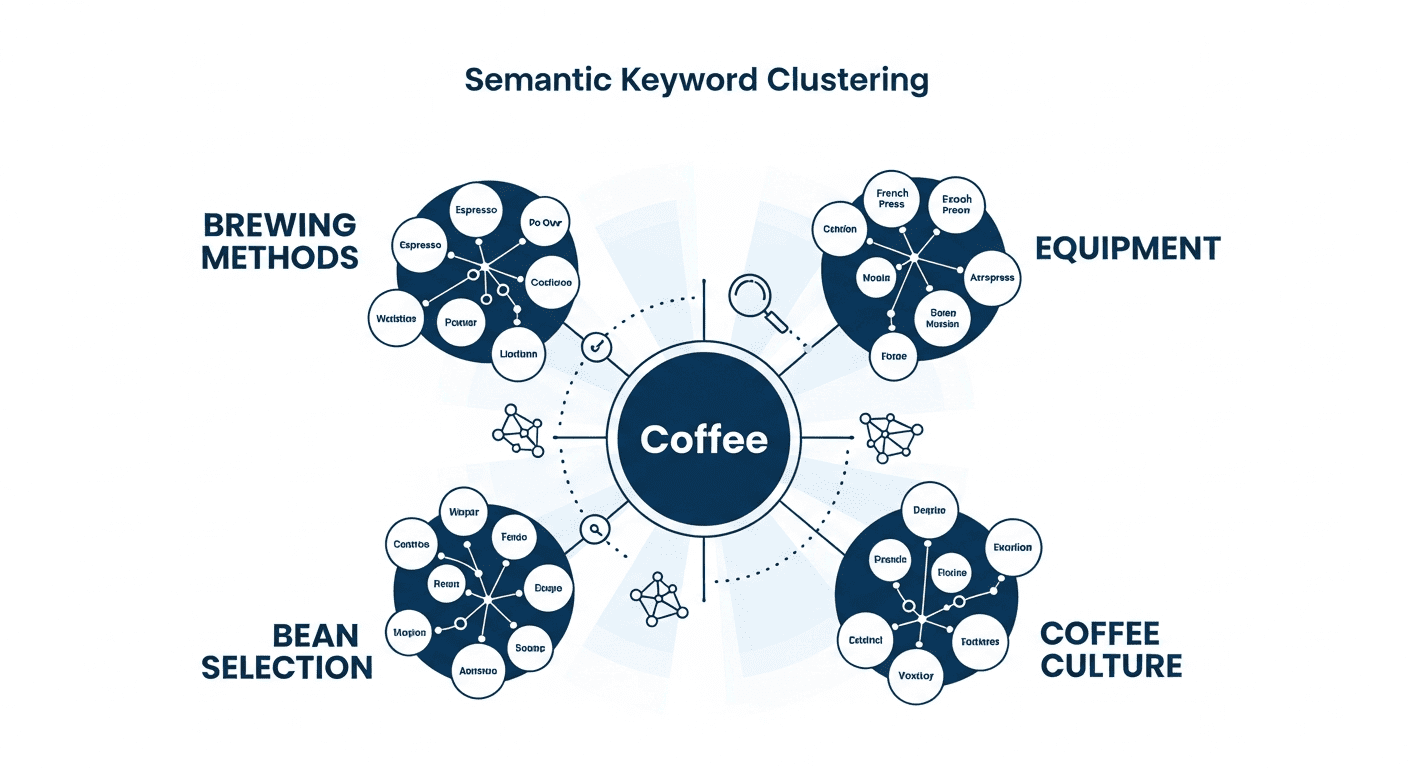
In the constantly evolving landscape of search engine optimization, one strategy stands out for its ability to transform how content ranks: semantic keyword clustering. Rather than targeting individual keywords on separate pages, semantic keyword clustering groups related search terms with similar user intent onto a single, comprehensive page. This modern approach doesn’t just improve rankings for one keyword—it positions your content to rank for dozens of related terms simultaneously.
The shift from traditional keyword targeting to semantic clustering represents a fundamental change in how search engines, particularly Google, understand and rank content. Instead of keyword matching alone, today’s algorithms prioritize meaning, context, and user intent. A website that implements semantic keyword clustering effectively can see dramatic improvements in organic traffic, user engagement, and conversion rates. Studies show that pages organized around semantic clusters outperform traditional keyword-clustered content by an average of 23% for informational and question-based searches. This comprehensive guide walks you through everything you need to know about semantic keyword clustering, why it matters for your SEO strategy, and how to implement it successfully.
What Is Semantic Keyword Clustering?

Semantic keyword clustering is the strategic practice of organizing related keywords based on shared user intent and contextual relevance rather than simple topic similarity. Unlike traditional keyword clustering, which often merely groups synonyms or topically related terms, semantic clustering digs deeper into what the searcher actually wants to achieve.
Here’s the key distinction: Traditional keyword clustering might group “running shoes,” “athletic footwear,” and “sports sneakers” together simply because they’re related topics. Semantic keyword clustering, however, recognizes that someone searching “best running shoes for marathons” has a different intent than someone searching “affordable running shoes for beginners.” The searcher’s goal, not just the topic, determines the cluster.
How Semantic Clustering Differs from Traditional Keyword Clustering
Traditional keyword clustering relies on lexical matching—grouping words that look or sound similar. It’s surface-level organization that typically results in synonyms being grouped together. While this approach works for basic content planning, it misses the nuanced intentions driving actual search behavior.
Semantic keyword clustering takes context into account. It examines the actual meaning behind search queries and groups keywords that indicate similar user objectives, even if the wording differs significantly. This approach reflects how modern search engines actually work, understanding not just words but the intentions and context surrounding them.
An example illustrates this well: A coffee enthusiast might search “how to roast coffee beans at home,” “DIY coffee roasting techniques,” or “home coffee roasting equipment.” A semantically-aware clustering system recognizes these all share the same core intent—someone wanting to roast coffee themselves at home. Traditional clustering might separate them, focusing instead on shared words like “coffee” or “roasting.”
Why Search Engines Prefer Semantic Clustering
Google’s algorithms have evolved significantly beyond simple keyword matching. The search engine now uses natural language processing (NLP), entity recognition, and contextual analysis to understand what content truly addresses. When you implement semantic keyword clustering, you’re aligning with how Google actually processes and ranks content.
Modern search engines reward comprehensive topical coverage. By clustering semantically related keywords on a single page, you demonstrate deep expertise on a topic. This sends strong signals to search algorithms that your content deserves higher visibility for the entire cluster of related queries.
The Four Core Types of Search Intent

Effective semantic keyword clustering begins with understanding search intent. Every search query falls into one of four primary intent categories, and clustering keywords by intent ensures your content truly satisfies what users are seeking.
1. Informational Intent
Users with informational intent want to learn something. They’re researching, gathering knowledge, or seeking answers. Keywords like “how to optimize content for SEO,” “what is semantic search,” or “benefits of keyword clustering” all signal informational intent.
Content targeting informational intent should educate thoroughly, answer common questions, and provide comprehensive explanations. These pages often serve as awareness-stage content in the buyer’s journey.
2. Navigational Intent
Navigational keywords indicate that someone is trying to find a specific website, page, or brand. Searches like “Facebook login,” “YouTube home,” or “Nike official store” are navigational. While important for brand protection, navigational intent keywords are less commonly targeted through content marketing.
3. Commercial Intent
Commercial intent keywords show that users are researching products or services before making a purchase decision. Phrases like “best SEO tools,” “top CRM software for small business,” or “affordable laptop for students” signal commercial intent.
Content addressing commercial intent should compare options, highlight features and benefits, and help users evaluate solutions. These pages often influence purchasing decisions.
4. Transactional Intent
Transactional keywords indicate immediate purchase or action. Searches like “buy running shoes online,” “subscribe to SaaS platform,” or “download free SEO checker” show the user is ready to convert.
Product pages, checkout flows, and sign-up pages primarily target transactional intent. While high-value, transactional keyword clusters are typically smaller and more specific than informational clusters.
Why Semantic Keyword Clustering Matters for Modern SEO
The digital marketing landscape has fundamentally shifted. Traditional SEO tactics—like stuffing keywords into content—no longer work. Modern search engines penalize this approach and reward semantic sophistication instead. Understanding why semantic keyword clustering matters helps you build a stronger, more sustainable SEO strategy.
Improved Rankings for Multiple Keywords
The most immediate benefit of semantic keyword clustering is improved ranking potential. When you group related keywords semantically on a single page, that page can rank for dozens—even hundreds—of variations of those keywords. This dramatically increases your organic visibility.
Real-world results prove this works. One case study showed a topic cluster around product launch strategies ranking for over 1,100 organic keywords, generating more than 100 clicks daily. This single cluster outperformed isolated pages targeting individual keywords.
Higher Quality User Experience
Google prioritizes user experience above almost everything else. When someone searches for information about coffee brewing, they want a comprehensive resource that answers all their related questions on one page—not a frustrating series of hops between multiple pages.
Semantic keyword clustering delivers this seamless experience. By consolidating everything a user needs to know about a topic onto one well-organized page, you reduce bounce rates and increase time on page. Both signals tell search engines that users find your content satisfying.
Building Topical Authority
Search engines increasingly recognize and reward topical authority—deep, comprehensive expertise on a subject. Instead of scattered content addressing random keywords, semantic clustering allows you to build interconnected content ecosystems where pillar pages and cluster pages reinforce each other.
This coordinated approach demonstrates genuine expertise to both users and algorithms. When you comprehensively cover a topic through semantic clusters, you’re signaling to Google that you’re a trusted authority on that subject.
More Efficient Content Production
Semantic keyword clustering also makes content creation more strategic and efficient. Rather than producing dozens of disconnected articles targeting single keywords, you create fewer, more comprehensive pieces targeting keyword clusters. This reduces content duplication, streamlines your workflow, and ensures better internal linking opportunities.
Key Differences: Semantic vs. LSI Keywords
A common source of confusion in SEO involves the difference between semantic keywords and LSI (Latent Semantic Indexing) keywords. While these terms are sometimes used interchangeably, they represent different approaches—and understanding the distinction matters for your strategy.
What Are LSI Keywords?
LSI keywords are terms that frequently appear together in the same context and share semantic relationships. For example, if your main keyword is “coffee,” LSI keywords might include “beans,” “brewing,” “caffeine,” and “espresso.”
Historically, SEO professionals believed that LSI keywords helped search engines understand content better, preventing keyword stuffing and improving rankings. This belief originated from the mathematical concept of Latent Semantic Indexing, developed in the 1980s.
However, Google has explicitly stated that it doesn’t use latent semantic indexing in its ranking algorithms. This is a crucial point often overlooked in SEO discussions.
What Are Semantic Keywords?
Semantic keywords represent a broader, more sophisticated approach. They focus on meaning, context, user intent, and entity relationships rather than simple word co-occurrence. Semantic keywords answer actual questions users are asking and align with their real search objectives.
For “how to make coffee,” semantic keyword variations would include “how long to brew coffee,” “best temperature for coffee extraction,” and “why does my coffee taste bitter?” These represent genuine search queries reflecting user intent, not just related words.
Why This Distinction Matters
The difference between LSI and semantic keywords reflects the evolution of search technology itself. LSI represents an outdated mathematical approach, while semantic keywords align with modern NLP and entity-based search.
Semantic keywords outperform LSI-style related keywords for rankings because they reflect real user behavior and search patterns. When you target semantic keywords, you’re optimizing for actual queries people type into search engines, with genuine user intent behind them.
LSI keywords might still have value for context and relevance, but they shouldn’t be the primary focus of your clustering strategy. Instead, prioritize semantic keywords that represent actual search queries and user intentions.
How to Implement Semantic Keyword Clustering: A Step-by-Step Guide
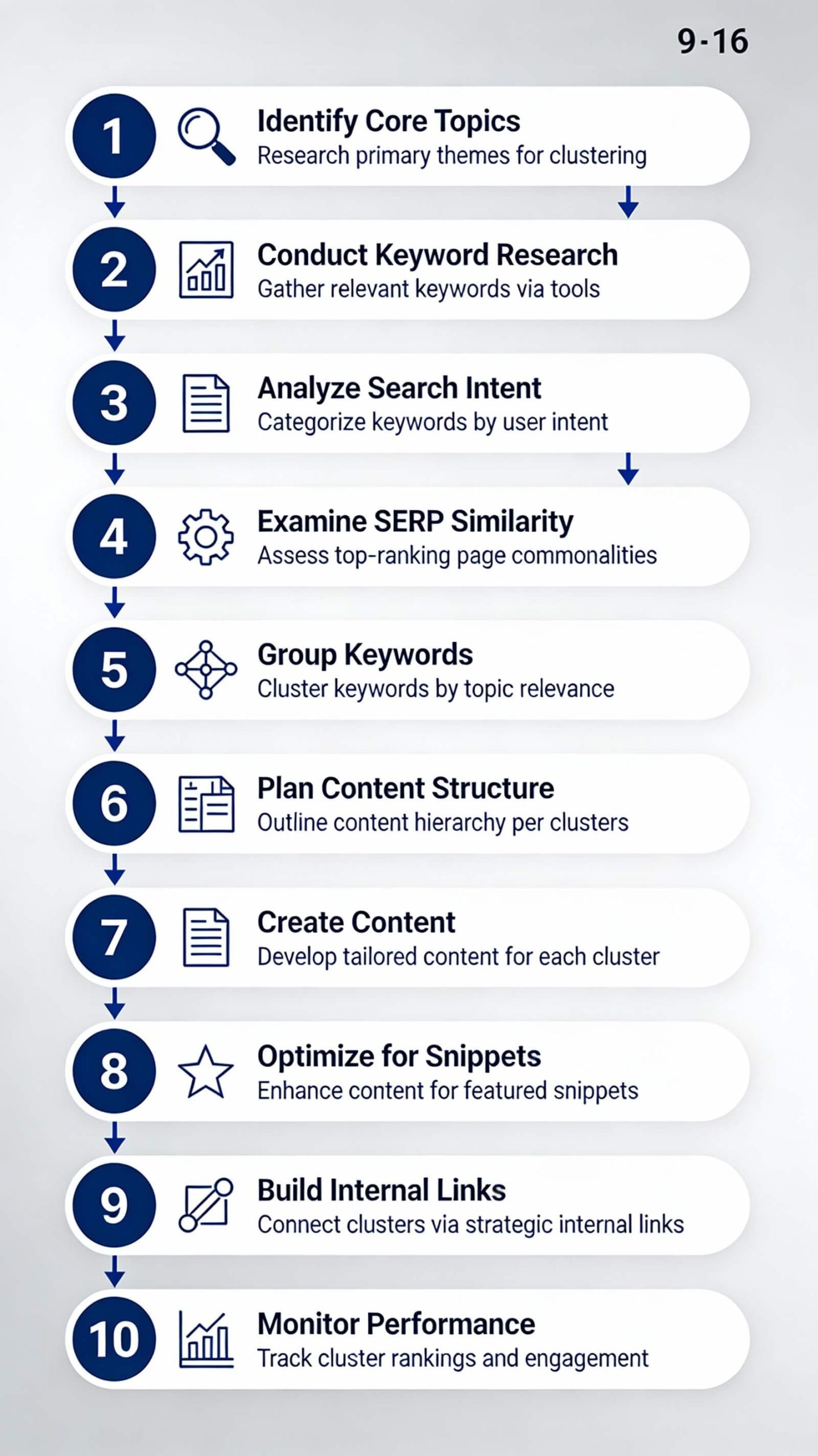
Implementing semantic keyword clustering requires a systematic approach. While the concept is straightforward, execution demands attention to detail and strategic thinking.
Step 1: Identify Core Topics and Seed Keywords
Begin by defining your core topic areas—the broad subjects your business or website addresses. For a fitness website, core topics might include “home workouts,” “nutrition planning,” or “injury recovery.” These become your pillar topics.
Within each core topic, identify 2-3 seed keywords—high-volume, foundational keywords that represent the main topic. For “home workouts,” a seed keyword might be “home exercise routines.”
Seed keywords form the foundation of your clusters. Everything else builds from here.
Step 2: Conduct Comprehensive Keyword Research
Use keyword research tools to generate lists of keywords related to each seed keyword. Capture search volume, difficulty scores, and related terms. Cast a wide net—you want 50-100+ keywords per core topic at this stage.
Include long-tail keywords, question-based keywords, and variations. Don’t worry about organization yet; simply compile a comprehensive list.
Tools like Google Keyword Planner, Semrush, Ahrefs, and Keyword Insights all provide data for this phase. The best tools combine keyword research with SERP analysis, showing you which pages rank for multiple keywords.
Step 3: Analyze Search Intent for Each Keyword
This step separates semantic clustering from basic keyword grouping. For each keyword in your list, determine its primary search intent:
- Is the user seeking information (informational)?
- Are they comparing options (commercial)?
- Are they ready to purchase (transactional)?
- Are they looking for a specific website (navigational)?
This analysis is crucial. Keywords with different intent shouldn’t live in the same cluster, even if they’re topically related.
Many modern keyword tools now include search intent classification. However, human review is still valuable—you understand your audience and business context better than any algorithm.
Step 4: Examine SERP Similarity
Look at the actual search results for each keyword. Are the same pages ranking in the top results across multiple keywords? If yes, those keywords are suitable for clustering together. Google has already indicated it considers them similar.
SERP analysis reveals which keywords Google sees as related. When the same URLs dominate results for different keyword variations, it signals those keywords belong in the same cluster.
This analysis helps you understand whether Google will accept these keywords being on a single page. It’s validation that your clustering makes sense from an algorithm perspective.
Step 5: Group Keywords into Semantic Clusters
Now organize your keywords into clusters based on:
- Shared user intent (all informational, or all commercial)
- SERP similarity (same ranking pages)
- Semantic relationship (the keywords address the same concept or user need)
Cluster size varies. Some clusters might contain 5-10 keywords; others could have 50+. There’s no universal ideal size—it depends on topic depth and intent variation.
Within each cluster, identify a primary keyword (usually highest search volume or most strategic) and organize supporting keywords around it.
Step 6: Plan Your Content Structure
For each cluster, plan the content you’ll create. Most semantic clusters are best served by:
- A pillar page: Comprehensive, high-level content covering the entire cluster topic
- Cluster pages: Detailed deep-dives into specific subtopics or variations
This hub-and-spoke structure allows you to address the full scope of user intent while organizing information logically. The pillar page links to cluster pages, and cluster pages link back to the pillar.
Alternatively, for smaller clusters, a single comprehensive page addressing all keywords might be sufficient.
Step 7: Create Comprehensive, Intent-Aligned Content
Write content that thoroughly addresses the user intent revealed by your keyword cluster. Don’t just sprinkle keywords throughout—build content that genuinely answers the questions your audience is asking.
Structure your content for scannability and comprehension:
- Use clear H2 and H3 subheadings
- Keep paragraphs short (2-4 sentences)
- Include lists and formatted sections
- Add images with descriptive alt text
- Include a FAQ section
Include semantic keywords naturally throughout the content, but prioritize readability and value over keyword frequency.
Step 8: Optimize for Featured Snippets and Schema Markup
Featured snippets appear above standard search results and drive significant traffic. Structure some of your content to answer specific questions concisely (40-60 words), making it eligible for snippet capture.
Implement schema markup (structured data) that helps search engines understand your content’s meaning. For a how-to cluster, use HowTo schema. For FAQs, use FAQSchema. For article content, use Article schema.
Schema markup reinforces semantic relationships and can improve your visibility in search results, including through knowledge panels and rich snippets.
Step 9: Build Strategic Internal Linking
Connect your pillar pages to cluster pages using keyword-rich anchor text. This internal linking serves two purposes: it guides users through your content ecosystem and signals topical relationships to search engines.
Use first-mention anchor text links—link the first mention of a related topic to the relevant cluster page. This natural approach feels organic to readers while clearly indicating relationships to algorithms.
Step 10: Monitor Performance and Iterate
Track how your clusters perform. Monitor:
- Rankings for all keywords within each cluster
- Organic traffic to pillar and cluster pages
- Click-through rates from search results
- User engagement metrics (time on page, bounce rate)
- Conversion rates
This data reveals which clusters are performing well and which need optimization. Adjust your strategy based on actual results, and continually add new content to deepen cluster coverage.
Advanced Strategies: Entity-Based Semantic Clustering
The next evolution in semantic optimization involves entity-based clustering. This approach recognizes that Google increasingly organizes information around entities—people, places, objects, organizations, and concepts.
Understanding Entity-Based Search
Google’s Knowledge Graph contains information about over 8 billion entities and 800 billion facts. When you search for something, Google doesn’t just match keywords—it understands the entities involved and their relationships.
This means modern semantic clustering should consider entities as central organizing principles. Rather than organizing content only around keywords, organize it around the entities your audience is interested in.
For example, instead of a keyword cluster about “coffee brewing methods,” think of a cluster organized around the entity “coffee” with relationships to sub-entities like “espresso machines,” “filter coffee,” and “pour-over brewing.”
Building Entity-Focused Clusters
To leverage entity-based clustering:
- Identify primary entities relevant to your business or content topic
- Research entity attributes and properties that matter to your audience
- Create content addressing entity relationships and characteristics
- Use consistent entity terminology across all content
- Implement entity schema markup (Organization, Person, Product, etc.)
- Link content around entity relationships rather than just keyword similarity
Research shows that websites using proper entity-based optimization see dramatic improvements. Real-world examples include a 1,400% visibility increase after entity optimization and over 100% organic traffic growth following entity-focused restructuring.
Implementing Entity Schema Markup
Use structured data to tell search engines about the entities in your content. Schema types include:
- Organization schema: Information about your company, including name, logo, contact info, and social profiles
- LocalBusiness schema: Details about physical locations, hours, and services
- Person schema: Information about people mentioned in content
- Product schema: Details about products, including price, availability, and reviews
- Article schema: Metadata about news articles, blog posts, and editorial content
Proper schema markup reinforces the semantic meaning of your content and improves visibility in search results.
LSI Keywords and Semantic Keywords: A Comparison
To clarify the contemporary role of different keyword types, here’s how they stack up:
| Aspect | LSI Keywords | Semantic Keywords |
|---|---|---|
| Definition | Terms frequently co-occurring with a main keyword | Keywords reflecting user intent and meaning |
| Focus | Word relationships and context | Meaning, intent, and user goals |
| How They Work | Based on mathematical indexing concepts | Based on NLP and entity understanding |
| Ranking Impact | Limited—Google doesn’t use LSI officially | Significant—directly influences rankings |
| User Intent | May include unrelated contexts | Always aligned with actual search queries |
| Best Use | Adding context and topical depth | Primary clustering strategy |
| Example | For “coffee”: beans, brewing, caffeine | For “how to make coffee”: brew time, temperature, extraction |
The takeaway: While LSI keywords add topical context, semantic keywords should form the foundation of your clustering strategy because they represent actual user search behavior.
Frequently Asked Questions About Semantic Keyword Clustering
Q1: What’s the ideal size for a semantic keyword cluster?
There’s no universal ideal. Cluster size depends on topic depth, audience intent variation, and how comprehensively you want to cover a subject. Some effective clusters contain 5-10 keywords; others include 50+. The key is ensuring all keywords within a cluster share genuine semantic similarity and user intent alignment.
Small clusters (5-15 keywords) work well for highly specific topics or niches. Larger clusters (30-100+ keywords) suit broad topics with diverse variations. Monitor performance and adjust cluster size based on results.
Q2: How does semantic clustering differ from creating a single long-form article?
While semantic clustering can involve comprehensive long-form content, the strategy encompasses more. True semantic clustering typically combines:
- A pillar page (comprehensive overview)
- Multiple cluster pages (deep-dives into subtopics)
- Strategic internal linking (connecting related content)
- Entity relationships (showing how concepts connect)
This structure allows you to address dozens of keywords while maintaining clear organization and excellent user experience. A single 10,000-word article addressing many keywords might feel disorganized and difficult to navigate.
Q3: Can I cluster keywords with different search intents together?
No, keywords with different intents should be in separate clusters. If you mix informational and transactional keywords on one page, you’ll satisfy neither audience well. Someone seeking to “learn about running shoes” (informational) has different needs than someone searching “buy running shoes online” (transactional).
However, you can create related clusters for different intents within the same pillar topic. A pillar on “running shoes” might have one cluster for informational content, another for commercial comparisons, and a third for transactional product pages.
Q4: Which keyword clustering tools work best?
Several excellent tools specialize in semantic keyword clustering:
- Semrush: Comprehensive clustering with intent analysis and SERP similarity data
- Keyword Insights: Focuses on semantic relationships and opportunity volume metrics
- Keyword Cupid: Uses machine learning and SERP data for clustering with confidence ratings
- Ahrefs: Strong keyword research with clustering features and rank tracking
- Zenbrief: Straightforward clustering tool allowing customization of cluster size
The best choice depends on your budget, team size, and specific needs. Many professionals use multiple tools to validate clusters.
Q5: How long does it take to see results from semantic clustering?
Results vary based on domain authority, competition, content quality, and cluster optimization. Generally:
- Quick wins (2-4 weeks): Improved rankings for your lowest-competition keywords
- Moderate gains (2-3 months): Noticeable traffic increases and ranking improvements for mid-difficulty keywords
- Significant results (3-6 months): Substantial traffic growth and authority establishment
New domains typically take longer than established ones. Highly competitive niches take longer than niche markets. Consistent optimization and content additions speed results.
Q6: Should I use AI-generated content for semantic clusters?
Not exclusively. While AI tools help with research, outlining, and idea generation, high-quality semantic clustering content requires human expertise. Google’s helpful content update increasingly penalizes purely AI-generated content lacking genuine value and firsthand experience.
Best practice: Use AI for ideation and initial outlining, then have human experts write and heavily revise content based on their genuine knowledge and experience.
Q7: How do I handle semantic clusters across multiple languages?
Create separate clustering strategies for each language market. Search behavior, intent, and available keywords vary significantly between languages. What clusters effectively in English might not cluster the same way in Spanish or Vietnamese.
Conduct keyword research and clustering within each language independently. This ensures your content genuinely addresses user intent in each market rather than assuming translation alone will work.
Case Study: Semantic Clustering in Action
To illustrate how semantic clustering drives real results, consider this real-world example from a coffee equipment and knowledge brand:
The Situation
The brand had created scattered content addressing coffee-related topics: brewing methods, coffee types, equipment reviews, and recipes. While individual pieces ranked for their specific keywords, the overall site lacked authority and didn’t capture the full opportunity.
The Solution
The team implemented semantic clustering, reorganizing content around these core clusters:
- Cluster 1: “Home Coffee Roasting” (addressing DIY roasting, equipment, techniques)
- Cluster 2: “Espresso Fundamentals” (covering machines, technique, troubleshooting)
- Cluster 3: “Coffee Bean Selection” (origins, roast levels, flavor profiles)
- Cluster 4: “Brewing Methods Compared” (pour-over, French press, AeroPress, etc.)
Each cluster featured a pillar page with links to 5-8 deeper cluster pages. Content addressed different user intent within each cluster (informational for guides, commercial for comparisons, transactional for product recommendations).
The Results
Within six months:
- Rankings improved dramatically for 70+ keywords
- Organic traffic to cluster pages increased 150%
- Time on page rose 40%, indicating better content engagement
- Bounce rate declined, showing users found what they sought
- Conversion rates for equipment recommendations improved 35%
- The brand established clear topical authority, earning backlinks from authoritative coffee websites
This case exemplifies how semantic clustering transforms scattered content into a coordinated authority-building system.
Common Mistakes to Avoid
As you implement semantic keyword clustering, watch out for these pitfalls:
Mistake 1: Forcing Unrelated Keywords Into Clusters
The temptation to create large clusters can lead to including keywords that don’t truly belong together. Mixing different user intents or unrelated topics damages both user experience and SEO performance.
Fix: Rigorously validate semantic relationships. If a keyword doesn’t share genuine intent alignment with the cluster, exclude it or create a separate cluster.
Mistake 2: Ignoring SERP Similarity
Checking current search results reveals what Google currently considers related. Ignoring SERP data can lead to clustering keywords that search engines don’t view as compatible.
Fix: Always analyze top-ranking pages. If completely different URLs rank for two keywords, they likely shouldn’t be in the same cluster.
Mistake 3: Poor Internal Linking Structure
Semantic clustering requires strategic internal linking to work effectively. Generic “related posts” sections or missing links between related content squander clustering benefits.
Fix: Create intentional internal linking architecture. Link from pillar to cluster pages and between related cluster pages using keyword-rich anchor text.
Mistake 4: Neglecting Featured Snippet Opportunities
Many semantic clusters can capture featured snippets, but only if content is structured optimally. Missing this opportunity leaves significant traffic on the table.
Fix: Structure content to answer specific questions in 40-60 words. Use bulleted lists, numbered steps, and definitions to increase snippet eligibility.
Mistake 5: Creating Content Without User Intent Focus
Content that addresses keywords without addressing user intent might rank temporarily but won’t hold rankings or drive conversions.
Fix: Prioritize user intent above keyword inclusion. Write content that genuinely satisfies what searchers want, then naturally incorporate semantic keywords.
SEO Best Practices for Semantic Clustering
Keyword Density and Natural Inclusion
Maintain semantic keyword density between 0.5-1.5% of your total word count. Modern search engines penalize obvious keyword stuffing. Instead, use semantic keywords and their variations naturally throughout your content.
First Paragraph Placement
Include your primary keyword naturally in the first paragraph. This signals to both readers and search engines what your content addresses.
Heading Hierarchy and Keyword Variation
Use H2 and H3 subheadings throughout your content, incorporating semantic keyword variations naturally. This improves both user experience and SEO, helping search engines understand content structure.
Image Optimization and Alt Text
Include 2-3 relevant images throughout cluster content. Write descriptive alt text that incorporates semantic keywords naturally, improving accessibility and SEO.
Mobile-First Considerations
Most searches now occur on mobile devices. Ensure your semantic cluster content displays beautifully on mobile, with readable text, appropriately-sized images, and easy-to-tap links.
Page Load Speed
Fast-loading pages provide better user experience and rank higher. Optimize images, minimize code, and use content delivery networks (CDNs) to ensure cluster pages load quickly.
Building Topical Authority Through Semantic Clusters
Semantic keyword clustering, when implemented strategically, builds topical authority—Google’s recognition that your site represents a trusted expert on particular topics.
The Hub-and-Spoke Model
The most effective structure combines:
- Hub/Pillar page: A comprehensive overview addressing the entire topic
- Spoke/Cluster pages: Detailed explorations of specific subtopics
- Internal linking network: Connecting hub to spokes and between spokes
This structure allows Google to understand your site as a comprehensive resource on the topic, improving rankings across the entire cluster.
Content Silo Architecture
Organize your site structure to reflect semantic clusters:
- Dedicate site sections to major pillar topics
- Organize cluster pages within those sections
- Use clear URL structures (example.com/pillar/cluster-page)
- Implement breadcrumb navigation reflecting the hierarchy
This organization helps both users and search engines understand content relationships.
Earning Authority Through Fresh Content
Continuously adding new cluster content deepens your authority. Monitor search queries bringing users to your site, identify gaps in your coverage, and create new cluster pages addressing unmet needs.
As you expand cluster coverage, your authority strengthens, and rankings for the entire cluster improve.
Tools and Technology for Semantic Clustering
Modern SEO tools simplify semantic clustering implementation:
Keyword Research and Clustering Tools
- Semrush: Comprehensive platform with clustering, intent analysis, and SERP data
- Ahrefs: Excellent for keyword research, clustering, and rank tracking
- Keyword Insights: Specialized in semantic relationships and opportunity identification
- Keyword Cupid: Uses ML and SERP data; shows confidence ratings for cluster relationships
- Zenbrief: Simple clustering interface with customization options
Content Optimization Tools
- Surfer SEO: Analyzes top-ranking pages for content optimization guidance
- MarketMuse: AI-powered content strategy and gap identification
- Google Search Console: Free tool showing search queries driving traffic
- Google Keyword Planner: Free basic keyword research
Analytics and Tracking
- Google Analytics: Essential for tracking cluster performance
- Google Search Console: Monitor rankings and search performance
- Ahrefs: Track rankings across clustered keywords
- Semrush: Comprehensive SEO reporting
Content Creation and Optimization
- Grammarly: Writing quality and clarity
- Hemingway Editor: Readability analysis
- Answer the Public: Visual representation of search questions and queries
Internal Linking Opportunities for Semantic Clusters
Strategic internal linking amplifies clustering benefits:
From Pillar to Cluster Pages
Link from your pillar page to cluster pages early in the content, using keyword-rich anchor text. This guides users through your content ecosystem while signaling topical relationships to search engines.
Between Related Cluster Pages
Connect related cluster pages with natural, contextual links. When discussing a concept that another cluster page addresses deeply, link to it.
From High-Traffic Pages
Identify your highest-traffic pages and add strategic links to relevant cluster pages. This flows authority from your strongest content to cluster pages.
Suggested Related Content
At the end of cluster pages, suggest related content within the cluster using a “related articles” section. This increases internal link flow and keeps users engaged.
External Resource Recommendations
To deepen your semantic clustering expertise, reference these authoritative sources:
- Google Search Central Blog: Official guidance on SEO and search optimization
- Search Engine Journal: Industry news and best practices
- Semrush Blog: Detailed SEO strategies and case studies
- Ahrefs Blog: In-depth SEO research and implementation guides
- Moz Blog: Long-standing SEO authority with extensive resources
- Search Engine Land: Comprehensive SEO news and analysis
Measuring Semantic Clustering Success
Track these key performance indicators to measure cluster effectiveness:
Ranking Performance
- Tracks rankings for all keywords within each cluster
- Monitor monthly ranking changes
- Identify which keywords are improving and which need optimization
Organic Traffic Metrics
- Monitor traffic growth to cluster pages
- Compare traffic before and after implementation
- Track traffic from organic search specifically
Engagement Metrics
- Time on page (target: higher is better)
- Bounce rate (target: lower is better)
- Pages per session (target: higher is better)
- Scroll depth (target: higher is better, indicating engagement)
Conversion Metrics
- Conversion rate by cluster
- Revenue per cluster (if applicable)
- Lead generation by cluster
Authority Metrics
- New referring domains linking to cluster content
- Internal link flow to cluster pages
- Featured snippet capture and rankings
Quarterly Reviews
Establish quarterly reviews of cluster performance. Identify high-performing clusters to expand and underperforming clusters needing optimization. This iterative approach continuously improves your strategy.
Advanced Clustering Strategies for Competitive Industries
In highly competitive niches, standard clustering needs enhancement:
Competitive Cluster Analysis
Analyze competitors’ content organization. Identify which keywords they’re targeting and whether their content addresses the full semantic intent. Find gaps they’re missing.
User Journey Mapping
Map your semantic clusters to stages in your customer journey:
- Awareness: Informational clusters helping users identify problems
- Consideration: Commercial clusters helping users evaluate solutions
- Decision: Transactional clusters facilitating purchases
This alignment ensures your content serves users at their actual stage.
Seasonal and Trending Keywords
Include seasonal variations and trending keywords in your clusters. For fitness, seasonal clusters might include “New Year fitness goals” (January), “summer body workouts” (spring), etc.
Long-Tail Cluster Expansion
Focus resources on long-tail keyword clusters with less competition. While individual keywords have lower volume, collectively they drive significant traffic with less competition pressure.
LSI Keywords: Current Role and Legacy Understanding
While LSI (Latent Semantic Indexing) isn’t used by modern search engines, the concept influenced how SEO professionals think about related keywords. Understanding this evolution clarifies why semantic keywords now matter more.
LSI originated from 1980s research on mathematical indexing approaches. Historically, SEO professionals believed LSI helped search engines understand content by identifying related terms. This led to the practice of including “LSI keywords” to improve ranking potential.
Google has clarified it doesn’t use LSI, favoring instead entity-based understanding and natural language processing. This distinction matters: relying on LSI-style related keywords won’t improve modern rankings, but semantic keyword clustering will.
Conclusion: Transform Your SEO Strategy With Semantic Keyword Clustering

The evolution from traditional keyword targeting to semantic keyword clustering represents the future of SEO. Search engines continue advancing their understanding of meaning, context, and user intent. Content creators who adapt to this shift build sustainable competitive advantages.
Semantic keyword clustering isn’t a quick tactic—it’s a fundamental strategic shift in how you organize and produce content. By grouping keywords based on shared user intent and semantic relationships, you create content ecosystems that satisfy users comprehensively while signaling expertise to search algorithms.
The benefits are substantial: higher rankings for multiple keywords per page, improved user engagement, increased organic traffic, and established topical authority. Real-world results prove the approach works, with case studies showing dramatic improvements in visibility and traffic.
Start implementing semantic keyword clustering today. Identify your core topics, conduct thorough keyword research, analyze user intent, and create comprehensive, semantically-optimized content. Monitor performance, iterate based on results, and continuously expand your cluster coverage.
The companies that master semantic keyword clustering will dominate their niches. They’ll rank for dozens of keywords with each page, build undeniable authority, and deliver the comprehensive, intent-aligned content that modern search engines reward. Your SEO transformation begins with understanding and implementing semantic keyword clustering—the modern strategy that actually works in today’s search landscape.