


Search engine optimization no longer requires expensive software subscriptions. The best free SEO AI tools have revolutionized how websites improve their rankings, create optimized content, and analyze competitors. In 2025, artificial intelligence has become the great equalizer—allowing small businesses and individual creators to compete with enterprise-level budgets. Whether you’re looking for keyword research, content optimization, technical audits, or competitive analysis, powerful free solutions exist that deliver professional-grade results. This comprehensive guide explores fifteen proven free SEO AI tools that leverage cutting-edge artificial intelligence to boost your search visibility. From ChatGPT’s versatile brainstorming capabilities to Google Search Console’s authoritative first-party data, these tools empower you to develop data-driven SEO strategies without financial barriers. Discover how to combine these resources effectively to maximize your organic growth potential.
Why AI-Powered SEO Tools Have Become Essential in 2025

The digital marketing landscape has fundamentally shifted. The adoption of AI in SEO has skyrocketed, with 86% of SEO professionals now integrating artificial intelligence into their strategies. This isn’t merely a trend—it’s a competitive necessity.
Artificial intelligence automates repetitive tasks that once consumed hours of manual work. Professionals report that 67% of AI’s key benefit lies in automating repetitive tasks like keyword research, meta-tag optimization, and initial content analysis. The market recognizes this value: the AI-powered SEO sector reached $67 billion in 2025, growing at a robust 22% compound annual growth rate.
Businesses implementing AI-driven content strategies report transformative results. Marketers deploying AI for SEO consistently see a 45% increase in organic traffic and a 38% increase in conversion rates. These aren’t theoretical projections—these are documented outcomes from companies actively using these tools.
The best part? Many enterprise-grade capabilities are now available for free. You no longer need expensive licenses to access AI that can help your website rank higher.
The Top 15 Free SEO AI Tools Transforming Search Rankings
1. ChatGPT: The Versatile AI Assistant for SEO Strategy
Best for: Keyword brainstorming, content ideation, meta descriptions, SEO strategy development
ChatGPT’s free tier remains one of the most versatile tools for SEO professionals. While not a dedicated SEO platform, its natural language capabilities excel at generating keyword ideas, creating content outlines, developing compelling meta titles and descriptions, and analyzing search intent patterns.
Key Features:
- Generate long-tail keyword variations quickly
- Brainstorm content topics and article outlines
- Write compelling meta descriptions
- Paraphrase existing content for diversity
- Analyze competitor content strategies
- Create FAQ sections for featured snippets
Practical Application: Use ChatGPT with specific prompts to reverse-engineer competitor content. Ask it to identify keywords, LSI terms, and entities from top-ranking pages, then incorporate these insights into your content strategy.
Limitations: Message caps during peak usage times, knowledge cutoff date (training data has limits), no real-time data access.
2. Google Search Console: The Official Source of Truth
Best for: Technical SEO, indexing issues, search performance data, ranking analytics
Google Search Console remains the most authoritative free SEO tool because it provides first-party data directly from Google’s search engine. This free platform shows exactly how Google sees your website, which queries drive impressions, click-through rates, and critical performance metrics.
Key Features:
- Monitor search impressions and clicks
- Track keyword rankings and search performance
- Identify and fix indexing issues
- Analyze core web vitals and page experience
- Detect broken links and redirect chains
- Monitor schema markup validation
- Receive security alerts
Why It’s Essential: Google Search Console provides data you cannot get anywhere else. While other tools estimate metrics, GSC shows precisely what’s happening on Google’s end. This is non-negotiable for any serious SEO strategy.
Limitations: Data updates take 24-48 hours, only shows your own site data (no competitor analysis).
3. Perplexity AI: Real-Time Research with Citations
Best for: Fact-checking, real-time research, competitor analysis, topical authority development
Perplexity AI represents a new generation of AI research tools. Unlike ChatGPT, Perplexity accesses current web data in real-time and provides sources for every claim, making it invaluable for creating factually accurate, well-sourced content.
Key Features:
- Real-time web search with AI analysis
- Citation tracking (every claim has sources)
- Conversational search interface
- PDF analysis and summarization
- Follows up on complex research questions
- Eliminates AI hallucinations through source verification
SEO Application: Research trending topics, competitor strategies, and emerging keywords while maintaining factual accuracy. The source citations make content creation faster and more trustworthy.
Limitations: Free tier has usage caps; premium features require subscription.
4. Google Keyword Planner: Search Volume and Intent Data
Best for: Search volume research, keyword difficulty assessment, CPC estimates
Accessed through Google Ads (no ad spend required), Keyword Planner provides legitimate search volume data directly from Google. This free tool shows how many people search for specific terms monthly and provides competition levels for paid advertising—valuable context for organic SEO strategy.
Key Features:
- Monthly search volume estimates
- Keyword difficulty indicators
- Cost-per-click (CPC) pricing insights
- Long-tail keyword suggestions
- Competition data for paid search
- Keyword trends over time
Strategic Value: High CPC keywords often indicate high commercial intent. Keywords with substantial search volume and moderate difficulty often represent sweet-spot opportunities for organic ranking.
Limitations: Data focuses on paid search intent, limited long-tail keyword generation compared to specialized tools.
5. Ubersuggest: Competitor Analysis and Keyword Research
Best for: Competitor content analysis, keyword opportunity identification, backlink insights
Ubersuggest’s free version offers surprising depth despite daily search limitations. Three daily searches provide substantial data for keyword research, competitor analysis, and site auditing. The free backlink checker functionality is particularly valuable—showing your website’s inbound links and spam scores for free.
Key Features:
- 100-million keyword database
- Site audits for up to 100 pages
- Competitor backlink analysis
- Traffic estimation for competitor domains
- Spam score detection for harmful links
- Disavow file recommendations
- Content gap analysis
Competitive Advantage: The free backlink checker reveals both link opportunities and potentially harmful links affecting your domain authority. Identifying and disavowing toxic backlinks improves your domain’s SEO authority.
Limitations: Three searches per day on free plan requires strategic keyword selection.
6. AnswerThePublic: Question-Based Keyword Discovery
Best for: Long-tail keywords, featured snippet optimization, voice search queries, FAQ content
AnswerThePublic visualizes real questions people search for on Google and Bing, displaying results in an intuitive mind-map format. This tool specializes in finding conversational keywords and questions—increasingly important as voice search and AI-powered search grow.
Key Features:
- Question-based keyword visualization
- Preposition-based keyword clusters (“how to,” “why,” “when,” etc.)
- Alphabetical keyword suggestions
- Real user search intent data
- Visual mind-map interface
- Multiple language support
Content Strategy Application: Extract dozens of question-based topics for FAQ sections, blog posts, and featured snippet optimization. These question-format keywords often have lower competition and higher conversion intent.
Limitations: Free version has limited daily searches; no search volume metrics provided.
7. Hemingway App: Readability Optimization
Best for: Content clarity, readability improvement, accessibility enhancement
Many SEO professionals overlook readability, yet Google’s algorithms reward clear, accessible content. Hemingway App (free online version) analyzes text and identifies complex sentences, excessive adverbs, and passive voice constructions that harm readability.
Key Features:
- Real-time readability analysis
- Grade-level scoring
- Highlights overly complex sentences
- Identifies passive voice usage
- Suggests active voice alternatives
- Color-coded difficulty indicators
- Works with copy-paste or direct input
Why Readability Matters: Search engines increasingly prioritize user experience signals. Content that’s easy to read generates better engagement metrics, lower bounce rates, and stronger ranking performance. Hemingway helps you optimize for both humans and algorithms.
Limitations: Analyzes readability only; doesn’t provide SEO-specific suggestions.
8. Screaming Frog SEO Spider: Technical Audit Foundation
Best for: Technical SEO audits, site crawling, broken link detection, metadata analysis
Screaming Frog’s limited free version crawls up to 500 URLs, allowing comprehensive technical audits for small to medium-sized websites. This desktop application simulates how search engines crawl your site, identifying technical issues that harm rankings.
Key Features:
- Crawls up to 500 URLs for free
- Identifies broken links and redirect chains
- Detects duplicate content issues
- Analyzes meta tags and headers
- Shows crawl errors and warnings
- Generates XML sitemaps
- Reports indexation problems
Technical Impact: Technical issues create ceiling effects on rankings. A site with crawl errors, duplicate content, or indexation problems cannot rank well regardless of content quality. Screaming Frog identifies and prioritizes these critical issues.
Limitations: Desktop application only (Windows/Mac), limited to 500 URLs on free version.
9. Moz Free Tools: Keyword Research and Link Analysis
Best for: Keyword metrics, domain authority assessment, backlink analysis
Moz offers several free tools accessible with a free account. While monthly query limits exist, the data quality from Moz is industry-standard, making these free tools worth the limitations.
Key Free Features:
- Keyword Explorer: 10 monthly queries providing 1,000+ keyword suggestions per search
- Link Explorer: 10 monthly queries for backlink analysis
- MozBar: Browser extension showing DA, PA, and spam scores
- SERP preview tool for on-page analysis
- Local listing audit tools
Why Moz’s Data Matters: Moz’s domain authority metric, while not a direct Google ranking factor, correlates with rankings and helps identify high-authority linking opportunities. The Keyword Difficulty score assists in prioritizing keywords based on competition.
Limitations: Free accounts receive limited monthly queries; full functionality requires paid upgrades.
10. Writesonic: AI-Powered Content Creation and Auditing
Best for: Free site audits, headline generation, AI copywriting exploration
Writesonic’s free tier includes valuable tools for content creators. The free site audit analyzes up to 100 pages, while the Chatsonic AI can brainstorm headlines, generate outlines, and create initial content drafts.
Key Features:
- Free site audit for 100+ pages
- Headline and title generator
- AI content outline creation
- Chatsonic AI assistant with research capabilities
- Keyword tool access
- Paraphrase tool
- Citation assistance
Content Workflow: Generate multiple headline variations, run them through the audit, and identify which structures perform best for your audience. This data-driven approach improves click-through rates from search results.
Limitations: Free tier has usage limitations; advanced features require paid subscription.
11. Claude: Advanced AI for Content Refinement
Best for: Detailed content analysis, complex SEO strategy conversations, fact verification
Claude (Anthropic’s AI) offers a free tier with unique advantages. Claude’s extended context window allows longer conversations, making it ideal for in-depth content strategy development where you iterate and refine ideas systematically.
Key Features:
- Longer conversation context than ChatGPT
- Strong reasoning for complex problems
- Excellent for detailed content briefs
- Less prone to hallucinations
- Better contextual memory across conversations
- Free tier available
SEO Application: Use Claude to develop comprehensive content strategies, analyze content gaps, and refine detailed content briefs. The superior context memory means conversations stay focused and coherent over many exchanges.
Limitations: Free tier has usage caps; some features available only on paid plans.
12. Optimo AI Keyword Research Tool: Fast, Free, Anonymous
Best for: Quick keyword generation, semantic keyword discovery, zero-learning-curve tool
Optimo’s AI keyword research tool requires no login and generates semantically related keywords in seconds. This completely free tool excels at discovering keyword variations quickly without account creation or usage limitations.
Key Features:
- 100% free with no limits
- Generates related keywords instantly
- Semantic keyword clustering
- No sign-up required
- No credit card necessary
- Works with any seed keyword
Speed Advantage: When you need quick keyword inspiration without setup friction, Optimo delivers instantly. Perfect for rapid content ideation sessions where you’re exploring multiple topic angles.
Limitations: No search volume data, no competitive metrics, basic keyword suggestions only.
13. Google Trends: Seasonal Keyword and Trend Discovery
Best for: Seasonal keywords, trending topics, regional search variations
Google Trends visualizes search volume trends over time, revealing seasonal patterns and emerging topics. This free tool helps identify content opportunities before competitions notice trends.
Key Features:
- Visualizes keyword search volume trends
- Shows regional interest variations
- Identifies related queries
- Compares multiple keywords simultaneously
- Displays forecast trends
- No login required
Strategic Application: Identify seasonal spikes in search demand for your industry. Create content ahead of peak seasons, establishing rankings before competition intensifies. Monitor emerging related searches to catch trending angles early.
Limitations: No absolute search volume numbers, only relative popularity data.
14. Bing Webmaster Tools: Underrated Alternative SEO Data
Best for: Alternative search engine insights, technical audits, crawl reports
While Google dominates, Bing’s Webmaster Tools provide complementary insights and often reveal issues Google Search Console misses. This completely free platform offers technical SEO data from an alternative search engine perspective.
Key Features:
- Technical audit reports
- Crawl error identification
- Keyword research insights
- Site performance metrics
- Mobile usability analysis
- Security alerts
- XML sitemap management
Why It Matters: Bing powers multiple search channels (Bing, Edge, AOL, Yahoo). While smaller than Google, Bing traffic converts well and represents meaningful traffic volume. Optimizing for both search engines expands your reach.
Limitations: Smaller search volume than Google means less aggregate data.
15. AlsoAsked: Featured Snippet and FAQ Optimization
Best for: Question mining, featured snippet research, H2 and H3 heading ideas
AlsoAsked extracts related questions from Google’s “People Also Ask” section, visualizing them as an interactive map. This tool helps identify question-based content angles and featured snippet opportunities.
Key Features:
- Extracts “People Also Ask” questions
- Shows question relationships visually
- Identifies common question patterns
- Helps with FAQ page structure
- Reveals long-tail keyword opportunities
- Interactive mind-map exploration
Featured Snippet Strategy: Position your content to answer each “People Also Ask” question clearly. Structure your article with dedicated sections answering these questions, increasing the likelihood of claiming featured snippets.
Limitations: Free version has limited daily searches in some regions.
How to Build a Complete Free SEO Strategy Using These Tools
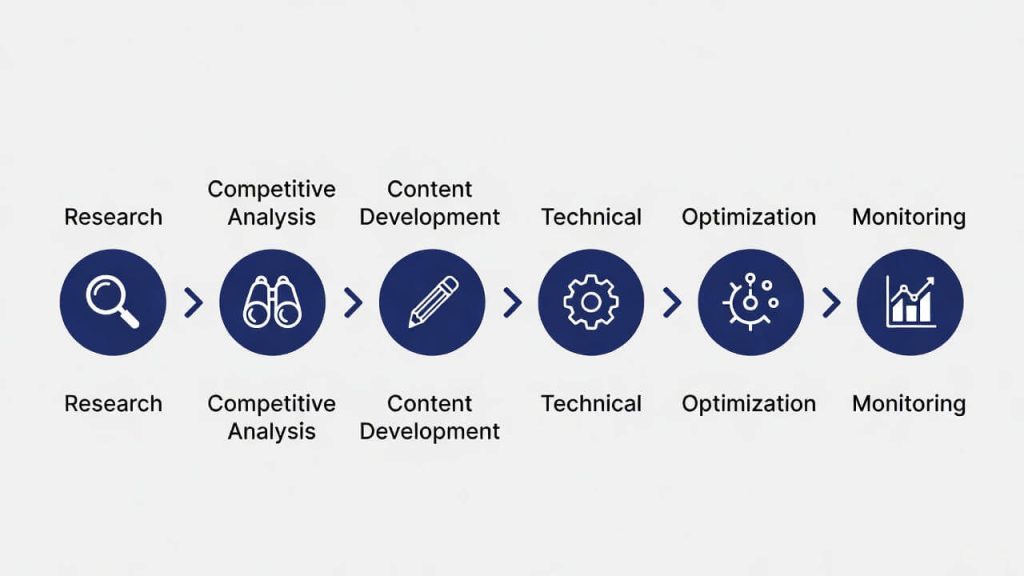
Step 1: Foundational Research
Start with ChatGPT and Google Keyword Planner to identify primary keywords and search intent. Use AnswerThePublic to uncover question-based variations and content angles.
Step 2: Competitive Analysis
Deploy Ubersuggest’s free backlink checker to analyze competitor link strategies. Use Moz’s Link Explorer (free queries) to identify high-authority linking opportunities your competitors have missed.
Step 3: Content Development
Generate content outlines with ChatGPT, then refine them using Perplexity for real-time research validation. Write clear, readable content refined through Hemingway App’s readability checker.
Step 4: Technical Implementation
Run your site through Screaming Frog to identify technical issues. Verify indexation in Google Search Console and Bing Webmaster Tools. Check core web vitals and mobile usability.
Step 5: Optimization
Use Writesonic’s free audit to identify on-page optimization opportunities. Structure FAQ sections based on AlsoAsked data to capture featured snippets.
Step 6: Monitoring
Track performance weekly in Google Search Console. Monitor competitor strategies with monthly Ubersuggest audits. Watch trend data in Google Trends to identify seasonal content opportunities.
Why Free AI Tools Deliver Real Results
Statistics that Prove Effectiveness:
Businesses leveraging AI for SEO-driven content strategies experience a 45% increase in organic traffic and a 38% increase in conversion rates. AI tools improve SEO rankings by an average of 49.2%, with nearly half of businesses reporting enhanced rankings after algorithm updates.
The adoption statistics confirm this works: 88% of US marketers currently use AI in their daily work, while 86% of SEO professionals have integrated AI into their strategies. These aren’t edge-case adopters—this is mainstream adoption proving value.
The Freemium Model Advantage:
Free tools with usage limits actually benefit users. They force strategic thinking about keyword selection and competitive analysis. Professionals using free tools report developing better SEO intuition because they must carefully prioritize research efforts rather than running endless analyses.
Common Mistakes When Using Free SEO AI Tools
Mistake 1: Overlooking Technical Foundations
Some professionals focus exclusively on keyword research while ignoring technical SEO. Tools like Screaming Frog reveal critical issues that prevent rankings regardless of content quality. Always address technical issues first.
Mistake 2: Treating Free Tools as Complete Solutions
Free tools work best in combination. Using only ChatGPT for keyword research misses data from Google Keyword Planner and AnswerThePublic. Combining multiple perspectives reveals opportunities single tools miss.
Mistake 3: Ignoring Search Intent
Finding keywords with high search volume means nothing if the intent doesn’t match your content. Use ChatGPT and Perplexity to analyze search intent behind keywords before optimizing for them.
Mistake 4: Neglecting Readability
AI-generated content sometimes sacrifices readability for keyword inclusion. Hemingway App prevents this by forcing clarity. Never skip the readability optimization step.
Mistake 5: Failing to Monitor Performance
Professionals who set strategies but don’t monitor performance in Google Search Console never understand what actually works. Consistent monitoring reveals opportunities and problems quickly.
Frequently Asked Questions About Free SEO AI Tools
Q1: Can I really rank competitively using only free tools?
Yes. Free tools provide all necessary data for ranking competitively. The limitation isn’t functionality—it’s time investment. Free tools require more manual analysis than paid platforms that automate workflows. However, the results are identical.
Q2: Is ChatGPT’s free version reliable for keyword research?
ChatGPT excels at generating keyword ideas and identifying semantic variations, but lacks real search volume data. Use it for ideation and brainstorming, then validate findings with Google Keyword Planner or Ubersuggest data.
Q3: What’s the biggest limitation of free tools?
Usage caps and monthly query limits. Professional SEO often requires analyzing hundreds of keywords and domains monthly. Free tools force prioritization, which isn’t necessarily bad—it encourages strategic focus.
Q4: How often should I audit my site with free tools?
Run technical audits monthly using Screaming Frog. Check Google Search Console weekly to catch indexation issues quickly. Run competitive analysis quarterly to identify emerging opportunities.
Q5: Can free tools help with AI search engine optimization (GEO)?
Partially. ChatGPT and Perplexity help optimize content for AI systems like ChatGPT and Perplexity, but dedicated GEO tools provide more comprehensive tracking. However, fundamental content optimization for AI systems works similarly to traditional SEO.
Q6: Which free tool should beginners start with?
Start with Google Search Console (if you own a website) and ChatGPT (for content ideation). These two tools cover half of basic SEO needs. Add Google Keyword Planner for search volume data.
Q7: Do free tools limit the results you can achieve?
No. Limitations exist in convenience and workflow automation, not in results. A professional using free tools will achieve similar results to someone using expensive platforms—it simply requires more manual work.
The Future of Free AI SEO Tools
The trajectory is clear: artificial intelligence is democratizing search engine optimization. What required $500+ monthly software subscriptions five years ago is now free or freemium. This trend will continue as AI becomes increasingly commoditized.
Emerging Opportunities:
AI search engines (ChatGPT, Perplexity, Claude) are becoming significant traffic sources. Generative Engine Optimization (GEO)—optimizing content for AI answers—is becoming as important as traditional Google optimization. Free tools will increasingly include GEO tracking and optimization features.
What This Means for Your Strategy:
Don’t wait for perfect tools. Use what’s available now. The professionals who master current free tools will easily transition to future AI tools. The fundamentals of keyword research, content optimization, and technical SEO remain constant regardless of tools used.
Key Takeaways: Your Free SEO AI Tools Action Plan
Immediate Actions:
- Set up Google Search Console if you haven’t already
- Generate your first keyword list using ChatGPT
- Validate keywords with Google Keyword Planner
- Run a technical site audit with Screaming Frog
Weekly Responsibilities:
- Check Google Search Console for new opportunities
- Monitor top-ranking keywords and impressions
- Identify technical issues or crawl errors
Monthly Tasks:
- Generate new content ideas with ChatGPT and AnswerThePublic
- Analyze competitor strategies with Ubersuggest
- Review Hemingway readability on published content
Quarterly Reviews:
- Comprehensive technical audit with Screaming Frog
- Competitive analysis across all tracked domains
- Evaluate which free tools provided the most value
Conclusion: Start Ranking Higher Today

The best free SEO AI tools remove financial barriers to competitive search engine optimization. Whether you’re a beginner building your first website or an agency managing multiple domains, these fifteen tools provide enterprise-grade capabilities completely free.
The statistics are undeniable: 45% organic traffic increases, 38% conversion rate improvements, and 49.2% ranking enhancements are achievable with the right strategy and tools. These aren’t hypothetical benefits—thousands of businesses are realizing these results right now.
Your next step is simple: Choose three tools from this list that address your most pressing SEO challenge. If keyword research is your bottleneck, start with ChatGPT, Google Keyword Planner, and AnswerThePublic. If technical issues concern you, begin with Google Search Console, Screaming Frog, and Bing Webmaster Tools. If content optimization is your focus, prioritize Hemingway App, Writesonic, and Perplexity.
Implement the free SEO strategy outlined above, monitor your Google Search Console data weekly, and adjust based on performance. Consistency and strategic tool combination create compounding results over time.
Stop letting budget constraints limit your SEO potential. These best free SEO AI tools are ready to transform your organic traffic, rankings, and business growth. Your competition is already using them. The question isn’t whether you can afford to use these tools—it’s whether you can afford not to.
Start today. Your search rankings will thank you.