

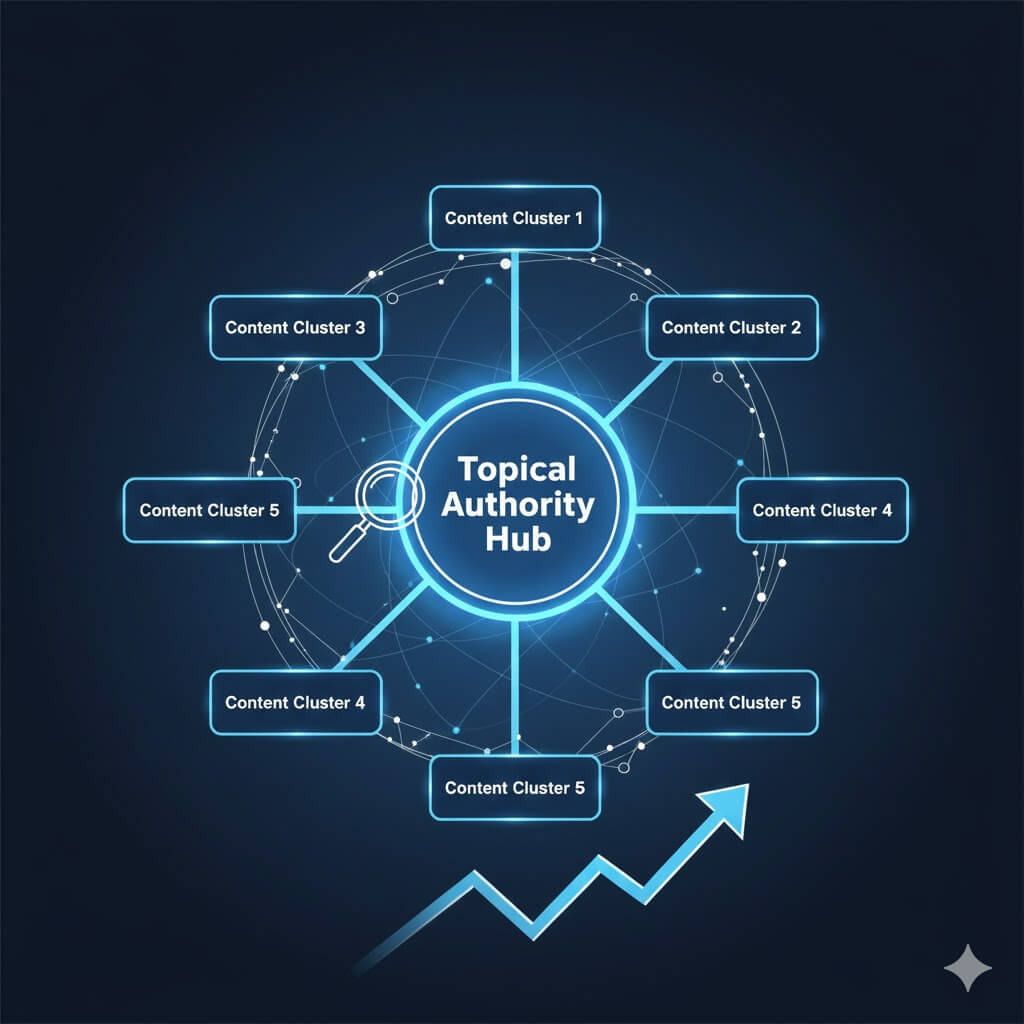
In today’s competitive digital landscape, ranking for individual keywords is no longer enough. Search engines have fundamentally shifted how they evaluate websites, moving away from single-keyword optimization toward a more sophisticated approach: topical authority SEO.
Topical authority SEO represents a paradigm shift in search engine optimization. Rather than chasing individual keywords scattered across your website, topical authority focuses on establishing your site as the definitive expert on a specific subject. Google and other search engines now prioritize websites that demonstrate comprehensive knowledge about a topic through interconnected, strategically linked content.
This comprehensive guide will walk you through everything you need to know about building topical authority, from understanding the foundational concepts to implementing practical strategies that deliver measurable results. Whether you’re managing a startup blog or overseeing enterprise-level content, mastering topical authority SEO is essential for long-term organic visibility and sustainable search rankings.
What Is Topical Authority in SEO?
Topical authority is your website’s demonstrated expertise in a specific niche or subject area. Simply put, it’s the level of trust and credibility search engines assign to your domain based on how thoroughly and expertly you cover a particular topic.
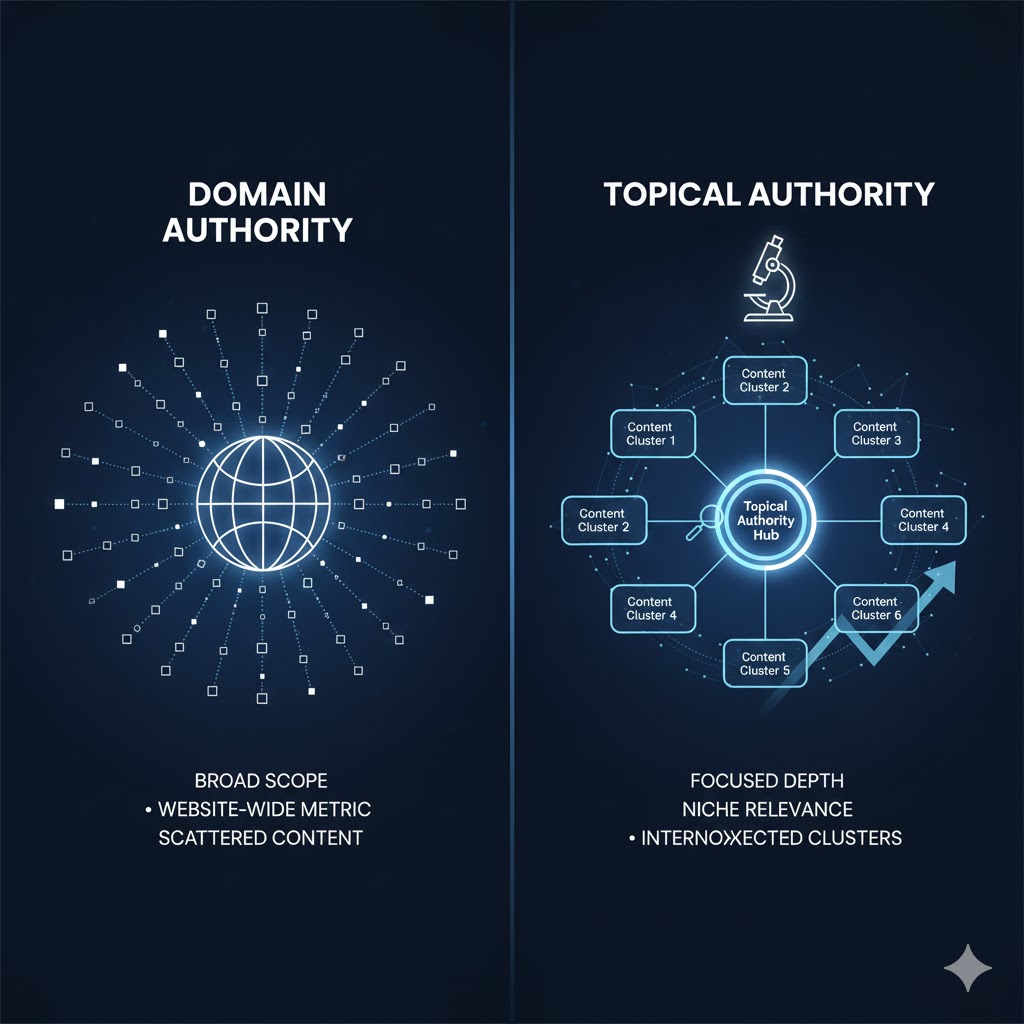
Rather than being a single, measurable metric like domain authority, topical authority is built through strategic content creation, internal linking, and demonstrable expertise. According to SemRush, strong topical authority directly improves search performance by signaling to search engines that your website is a reliable, comprehensive resource on the subject.
How Topical Authority Differs from Domain Authority
These two concepts are frequently confused, but they serve entirely different purposes in SEO:
Domain Authority measures your website’s overall strength across all topics. It’s influenced by factors like your backlink profile, site age, technical performance, and general content quality. A site with high domain authority has earned trust across the entire web, but that doesn’t necessarily mean it has expertise in any specific area.
Topical Authority, on the other hand, measures how deeply you cover a specific subject. You can have lower domain authority than competitors yet still rank higher for niche-specific queries if your topical authority is stronger. In fact, data shows that new websites with zero domain authority can outrank established high-DA domains when they have superior topical authority on a given subject.
This distinction is critical for 2025 SEO strategy. While domain authority still influences overall rankings, topical authority increasingly determines visibility for niche searches, featured snippets, and AI-generated search overviews.
Why Topical Authority SEO Matters Now More Than Ever
The Shift in Google’s Algorithm
Google’s algorithm has evolved dramatically over the past few years. The integration of entity-based indexing, the emphasis on E-E-A-T signals, and the introduction of the Helpful Content System in 2024 all point toward one clear direction: search engines reward topical depth and expertise above generic, scattered content.
In 2022, Google added an additional “E” to its E-E-A-T framework (now Experience, Expertise, Authoritativeness, Trustworthiness), signaling that real-world experience and demonstrated expertise are increasingly important ranking factors. This shift directly correlates with the rising importance of topical authority.
Key Benefits of Building Topical Authority
Increased Organic Traffic
When search engines recognize your website as an authority on a topic, they rank you higher for not just one keyword, but entire clusters of related terms. This expanded visibility drives significantly more qualified organic traffic to your site.
Higher Rankings for Related Keywords
One of the most powerful aspects of topical authority is the “halo effect.” As you build expertise in one area, your rankings improve across all semantically related queries. You’re not limited to ranking for your primary keyword—you naturally rank for dozens of variations and long-tail terms within your topic area.
Enhanced User Trust and Credibility
Users gravitate toward authoritative sources. When your website demonstrates comprehensive knowledge about a topic, visitors perceive you as more trustworthy, spend more time on your pages, and are more likely to convert. This increased engagement sends positive signals back to search engines.
Growth in Quality Backlinks
Authoritative, comprehensive content naturally attracts links from other websites. When your content is positioned as the most valuable resource on a topic, other publishers want to cite and link to it. These earned backlinks further boost both your domain authority and topical authority.
Better Long-Term Sustainability
Topical authority builds a competitive moat around your content. It’s harder for competitors to dislodge you from rankings because they’d need to create equally comprehensive content clusters, which takes significant time and resources. This creates sustainable, long-term ranking advantages.
Higher Conversion Rates
Demonstrating expertise doesn’t just improve rankings—it improves conversions. Users who find comprehensive, authoritative content are more likely to trust your brand and take desired actions, whether that’s making a purchase, signing up for a newsletter, or requesting a demo.
How to Build Topical Authority: Step-by-Step Strategy
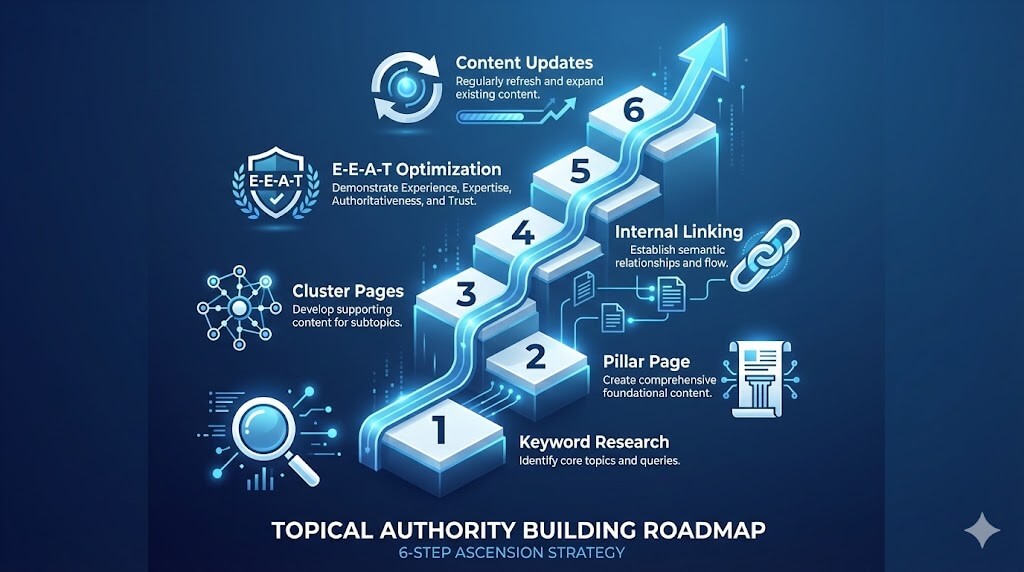
Step 1: Conduct Comprehensive Keyword and Topic Research
Building topical authority starts with understanding what your audience is actually searching for within your niche.
Use Google’s Search Features
Begin with basic Google searches related to your main topic. Pay attention to:
- Autocomplete suggestions – These show the most frequent searches related to your term
- People Also Ask boxes – These reveal follow-up questions users ask
- Related Searches – Found at the bottom of the SERP, these show semantically related queries
Systematically document all variations and related searches. This process helps you identify the full scope of topics you need to cover.
Implement Semantic Keyword Research
Modern topical authority requires understanding not just keywords, but semantic relationships between concepts. Tools like Ahrefs, SEMrush, and Answer Socrates help you identify semantic clusters—groups of related keywords that Google considers conceptually connected.
Semantic keywords differ from LSI (Latent Semantic Indexing) keywords, a commonly misunderstood concept. Rather than “LSI keywords,” focus on words and phrases that naturally co-occur when discussing your topic. For example, an article on “coffee makers” should naturally include terms like “brewing methods,” “grind size,” “filter types,” and “water temperature.”
Identify Your Core Topic and Subtopics
Once you’ve completed your research, organize findings into a hierarchy:
- Core topic – Your main subject area (e.g., “coffee brewing”)
- Subtopics – Specific aspects of the core topic (e.g., “pour-over brewing,” “espresso extraction,” “cold brew methods”)
- Supporting subtopics – Granular aspects of each subtopic (e.g., “pour-over water temperature,” “pour-over brew time”)
Step 2: Create a Pillar Page and Topic Cluster Framework
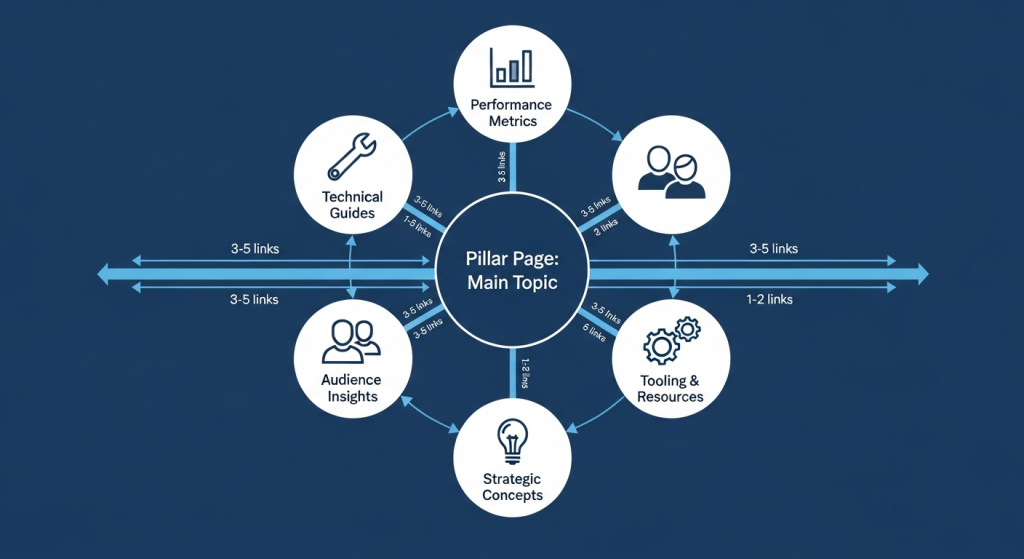
The pillar and cluster model forms the backbone of topical authority building.
Understanding the Hub and Spoke Model
Think of your strategy as a wheel:
- The hub is your pillar page—a comprehensive article that covers your main topic broadly
- The spokes are cluster pages—detailed articles that explore specific subtopics in depth
Develop Your Pillar Page
Your pillar page should be:
- Comprehensive – It covers the main topic broadly, touching on key subtopics
- Well-structured – Clear headings and sections make it easy to navigate
- Approximately 2,500-5,000 words – Long enough to be thorough but not overwhelming
- Introduction to all key subtopics – Each main section briefly introduces a cluster topic with internal links to detailed cluster articles
For example, if your pillar is “Coffee Brewing Methods,” it would introduce four to six major brewing approaches, with each introduction linking to a detailed cluster article on that method.
Create Your Cluster Pages
Each cluster page should:
- Focus on one specific subtopic – Deep dive into a single angle
- Range from 1,500-3,000 words – Detailed but focused
- Link back to the pillar page – Multiple contextual links help search engines understand the relationship
- Link to related cluster pages – Help users and search engines see connections between subtopics
- Use descriptive anchor text – Anchor text should clearly describe what the linked page covers
Step 3: Implement Strategic Internal Linking
Internal linking is perhaps the most underutilized tool for building topical authority, yet it’s absolutely critical.
Create a Clear Hierarchy
Your pillar page should be your hub—the page that receives the most internal links. Every cluster page should link back to the pillar with relevant anchor text. Additionally, cluster pages should link to related cluster pages when contextually appropriate.
Use Contextual Anchor Text
Avoid generic anchor text like “click here.” Instead, use descriptive anchors that tell both users and search engines what the linked page covers. For example: “Learn more about pour-over brewing techniques” is far more effective than “read more.”
Identify and Fix Orphan Pages
An orphan page is content that isn’t properly connected to your topic cluster structure. Use site: search operators combined with intitle: and intext: operators to identify pages that should be part of your cluster but aren’t properly linked. These disconnected pages waste their ranking potential.
Create Hub Pages for Subtopics
As your clusters grow, consider creating secondary hub pages for major subtopic areas. These secondary hubs can contain their own mini-clusters, creating a more sophisticated information architecture.
Step 4: Optimize Content with E-E-A-T Signals
E-E-A-T is no longer optional—it’s essential for topical authority.
Demonstrate Experience
Share real-world experience and first-hand knowledge. If you’ve personally used the products or services you’re discussing, say so. Include case studies, personal experiments, or lessons learned from implementation.
Show Expertise
Back up claims with data and research. Cite authoritative sources, include statistics, and explain the “why” behind recommendations. Don’t just tell readers what to do—explain the reasoning.
Build Authoritativeness
Establish credibility through author bios, credentials, and thought leadership. If your content is written by industry experts, make this clear. Link to author credentials, speaking engagements, or other authoritative work.
Earn Trustworthiness
Be transparent about potential conflicts of interest. If you’re recommending products you sell or affiliate links you profit from, disclose this clearly. Update your content regularly to maintain accuracy and freshness.
Step 5: Develop Fresh, Original Content
Google’s 2025 priorities increasingly emphasize original content. The leaked “OriginalContentScore” signals that Google values genuinely novel perspectives and unique insights.
Add Proprietary Data
Original research, case studies, and proprietary data sets are among the most valuable content you can create. If you’ve conducted surveys, experiments, or analysis unique to your business, share those insights.
Include Contrarian Perspectives
Don’t just rehash what everyone else says. Offer evidence-based counterpoints or unique angles that differentiate your content from competitors’ coverage of the same topic.
Create Multimedia Assets
Video, infographics, interactive tools, and other multimedia content demonstrate depth and provide value in different formats. This also increases engagement signals.
Step 6: Update and Maintain Your Content Clusters
Topical authority isn’t built once and then forgotten.
Implement Quarterly Updates
Set a schedule to review and update your pillar and cluster content quarterly. Add new data, address emerging trends, and expand sections that have become outdated.
Monitor Content Performance
Track which cluster pages are driving the most traffic, generating the highest engagement, and converting best. Invest additional resources into your strongest performers while improving lower-performing pieces.
Add New Cluster Pages
As you identify new keyword opportunities or notice gaps in your content, create new cluster pages. Over time, aim to build 10-20 cluster articles supporting each major pillar page.
Advanced Topical Authority Strategies
Entity-Based SEO
Modern search is moving beyond keywords to entities. Entities are concepts, people, places, and things that search engines understand and connect.
Google’s Knowledge Graph maps these entities and their relationships. To build topical authority in this environment:
Identify Key Entities in Your Niche
What people, companies, products, tools, standards, or concepts are central to your topic? For example, in coffee brewing, key entities might include specific brewing equipment brands, coffee bean origins, or historical figures in coffee culture.
Establish Entity Relationships
Clearly connect entities in your content. Show how different entities relate to each other through hierarchical relationships (“espresso is a coffee brewing method”), associative relationships (“espresso pairs with milk-based drinks”), or equivalence relationships (“espresso machines and super-automatic machines serve similar purposes”).
Optimize for Knowledge Panels
If relevant to your niche, optimize your content to potentially appear in Google’s Knowledge Panels. This requires consistent entity information across your website and structured data implementation.
Content Depth and Comprehensiveness
Topical authority requires going deeper than surface-level content.
Cover the Topic From Multiple Angles
A single article on “coffee brewing” isn’t sufficient. You need articles on brewing methods, bean selection, grind sizes, water temperature, equipment, common mistakes, advanced techniques, and more. Comprehensive coverage signals expertise.
Address Advanced Concepts
Don’t just cover beginner material. Include advanced topics that show you understand nuanced aspects of your subject. This positions you as an authority not just for beginners but for experienced practitioners.
Create Comparison Content
Comparative content that weighs different approaches within your topic builds authority. Articles like “French Press vs. Pour Over” or “Cold Brew vs. Iced Coffee” address real user questions and demonstrate comprehensive knowledge.
Building Citations and Authority Signals
Earn Mentions from Authoritative Sources
The more mentions you receive from authoritative websites in your industry, the stronger your topical authority becomes. This might involve guest contributions, expert interviews, or being cited in industry research.
Develop Thought Leadership Content
Original research, whitepapers, and industry reports position you as a thought leader. Other websites want to cite and link to such content.
Participate in Industry Communities
Active participation in forums, Reddit communities, and industry discussions builds recognition and authority that eventually translates to more citations and links.
Measuring Your Topical Authority
Unlike domain authority, topical authority doesn’t have a single standard metric. However, several approaches help you assess your progress.
Traffic Share by Domain
Using Ahrefs’ Keyword Explorer:
- Identify your main topic cluster keywords
- Export all related keywords in your cluster
- Run them through Ahrefs’ “Traffic Share by Domain” report
- Compare your traffic share against competitors for these keywords
A higher traffic share indicates stronger topical authority.
Topical Authority Ratio
SEOwind‘s topical authority ratio measures:
Topical Authority Ratio = (Number of pages on the topic) / (Total pages on site)
A ratio of 40-60% for your main topic indicates good topical authority focus.
Keyword Rankings and Visibility
Track rankings for your target keyword cluster:
- Count how many keywords you rank for in position #1
- Count how many you rank for in positions 1-3
- Track rankings for 1-10 positions
- Monitor SERP features (featured snippets, knowledge panels, etc.)
Strong topical authority is reflected in many rankings across your keyword cluster.
Engagement Metrics
Google uses behavioral signals to assess content quality and authority:
- Dwell time – How long users spend on your pages
- Scroll depth – How far down the page users scroll
- Return visitors – How many users come back to your site
- Click-through rate – Your ranking click-through rate for target keywords
Strong topical authority content typically shows higher engagement metrics.
Common Mistakes to Avoid
Mistake 1: Creating Scattered Content
Don’t publish dozens of unrelated articles hoping to rank. Instead, build organized clusters around main topics.
Mistake 2: Neglecting Internal Linking
The pillar-cluster structure only works if you strategically link pages together. Don’t create great cluster content and then leave it orphaned.
Mistake 3: Thin Content and Surface-Level Coverage
Topical authority requires depth. Aim for 2,000+ words per pillar page and 1,500+ words per cluster page, but only if that depth provides genuine value.
Mistake 4: Ignoring E-E-A-T Signals
Don’t just optimize for keywords. Demonstrate experience, expertise, authoritativeness, and trustworthiness through content, author bios, and structure.
Mistake 5: Setting and Forgetting
Building topical authority is not a one-time effort. Regular updates, new content additions, and performance monitoring are essential for maintaining and growing your authority.
Topical Authority and AI Search
As Google integrates artificial intelligence and AI Overviews into search results, topical authority becomes even more critical.
Brands with strong topical authority receive 2-3 times more citations in AI Overviews compared to sites with weak topical authority. This means your well-researched, comprehensive content clusters are more likely to be cited as source material for AI-generated answers.
To optimize for AI search while building topical authority:
- Emphasize originality – AI models prefer content with unique data and fresh perspectives
- Update clusters quarterly – AI systems reward fresh, current information
- Incorporate entities naturally – Use semantic depth to help AI systems understand your expertise
- Implement structured data – Schema markup helps AI systems parse and understand your content structure
FAQ: Common Questions About Topical Authority SEO
Q1: How long does it take to build topical authority?
Building meaningful topical authority typically requires 3-6 months of consistent content creation and optimization. However, you’ll see measurable improvements in specific keyword rankings much sooner—often within 4-8 weeks of optimizing your pillar and cluster structure.
Q2: Can a new website compete with established brands in topical authority?
Yes. If your content is more comprehensive, better organized, and more directly addresses user intent than an established competitor’s scattered content, you can outrank them even with zero domain authority. Topical authority focuses on depth and relevance, not domain age or authority.
Q3: How many articles do I need to build topical authority?
There’s no magic number, but aim for at least 10-15 high-quality articles within a topic cluster to begin demonstrating real topical authority. Ideally, build toward 20-30+ articles for major topic areas.
Q4: What’s the difference between topical authority and topic clusters?
Topic clusters are the content structure you create. Topical authority is what you build through that structure. Clusters are the method; topical authority is the result.
Q5: Should I focus on topical authority or link building?
Both matter, but in 2025, topical authority increasingly drives rankings more than ever before. Start with topical authority through content clusters and internal linking. Strong topical authority content naturally attracts quality backlinks over time.
Q6: How do I know if my topical authority is strong?
Strong topical authority is indicated by rankings for many related keywords, high organic traffic from your target topic area, strong engagement metrics on cluster pages, and mentions from authoritative sources in your industry.
Q7: Can I have topical authority in multiple topics?
Theoretically yes, but it’s not recommended. Search engines perform best when a site focuses on one or two main topic areas. Trying to be an authority on too many disparate topics dilutes your topical authority across all of them.
Conclusion

Topical authority SEO represents the future of search engine optimization. As Google’s algorithm becomes increasingly sophisticated in understanding expertise and demonstrating E-E-A-T signals, building comprehensive, interconnected content clusters becomes essential for long-term organic visibility.
The shift from keyword-focused to authority-focused SEO isn’t a passing trend—it’s the direction search is fundamentally moving. Websites that adapt to this reality early will enjoy significant competitive advantages, capturing organic traffic and establishing themselves as trusted resources in their niches.
Building topical authority requires strategic planning, consistent content creation, and ongoing optimization. Start by conducting thorough keyword research, building a pillar page that broadly covers your main topic, and creating cluster pages that explore specific subtopics in depth. Connect these pages through strategic internal linking, demonstrate E-E-A-T signals, and commit to regular updates and expansion.
The websites that will dominate search results in 2025 and beyond won’t be those chasing individual keywords—they’ll be the ones that build genuine topical authority through comprehensive, expert-level content. Start building yours today.
Ready to build topical authority for your niche? Begin by mapping out your main topic areas, conducting comprehensive keyword research, and creating your first pillar page. Track your progress monthly, expand your clusters consistently, and watch as your organic traffic and search visibility grow alongside your topical authority.