


The way people search online is fundamentally changing. With the rise of AI chatbots, voice assistants like Alexa, and Google’s Search Generative Experience (SGE), users are abandoning short, generic search phrases in favor of longer, more conversational queries. This shift is making long tail keyword research AI the most powerful weapon in modern SEO.
If you’ve been struggling to rank on Google or convert website visitors into customers, you’re likely missing out on the true goldmine: long-tail keywords. Unlike their competitive broader counterparts, long-tail keywords attract highly motivated searchers with crystal-clear intent. The best part? They’re easier to rank for and convert 2.5 times better than generic terms.
This comprehensive guide reveals exactly how artificial intelligence is revolutionizing keyword research in 2025. You’ll discover cutting-edge AI tools, proven strategies, and actionable tactics to identify the exact phrases your ideal customers are searching for. Whether you’re a content creator, e-commerce entrepreneur, or marketing professional, this article will transform how you approach SEO.
What Are Long-Tail Keywords? Understanding the Foundation
Long-tail keywords are specific, targeted search phrases that typically contain three or more words and receive lower monthly search volumes compared to broad keywords. The key characteristic that defines them isn’t necessarily length—it’s search volume. Any keyword receiving fewer than 100 monthly searches qualifies as a long-tail keyword, regardless of word count.
Consider this example: “shoes” is a head term, while “best running shoes for flat feet” is a long-tail keyword. The longer phrase tells you exactly what the searcher wants and at what stage of their buying journey they’re in. This specificity creates the magic that makes long-tail keywords so valuable for both SEO and conversions.
The Long-Tail Distribution Curve
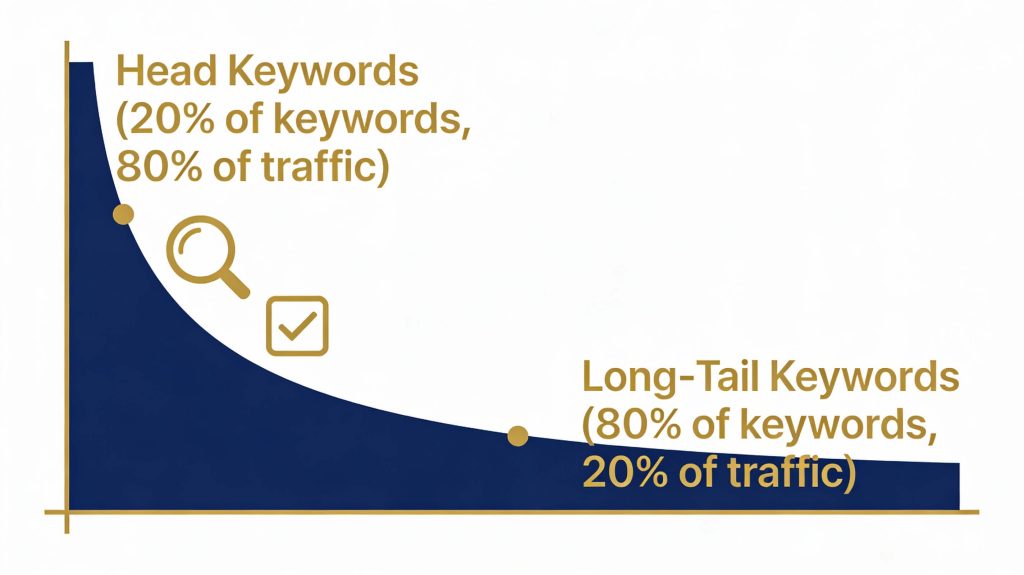
Here’s a fascinating statistic: over 70% of all search queries are long-tail keywords. Even more revealing, 92% of keywords receive 10 or fewer monthly searches. This means that while individual long-tail keywords have lower search volumes, collectively they represent the majority of all searches happening on Google.
What does this mean for your strategy? By targeting numerous long-tail keywords instead of a handful of competitive head terms, you can capture significantly more total organic traffic across your website.
Why Long-Tail Keywords Are Dominating SEO in 2025
The Conversion Rate Advantage
The most compelling reason to focus on long-tail keywords is their exceptional conversion performance. Data consistently shows that long-tail keywords convert 2.5 times higher than generic terms. Some studies report even more impressive results, with conversion rates reaching 36% for optimized long-tail pages compared to just 11.45% for average landing pages.
Why? The answer is straightforward: long-tail keywords capture users with specific intent. Someone searching for “organic cotton baby diapers Malaysia” is further along in their decision journey than someone typing “baby products.” They know what they want, and if your content delivers exactly that, they’ll convert.
Lower Competition Means Faster Rankings
The majority of SEO professionals focus on head keywords because they drive high search volumes. This creates an ironic opportunity: long-tail keywords have dramatically lower competition, making it exponentially easier to rank.
Research shows that pages optimized for long-tail keywords rank 11 positions higher on average compared to pages targeting head keywords. For new websites or small businesses competing against established domains, this advantage is game-changing. You can rank on page one much faster by targeting long-tail variations first.
AI and Voice Search Are Changing Search Behavior
Here’s the fundamental shift happening in 2025: 70% of users prefer natural language when searching, and 50% of searches are now voice-based. Voice assistants like Google Assistant, Siri, and Alexa understand conversational language, which means users naturally phrase voice queries as complete questions.
Instead of typing “best laptop gaming,” voice search users ask “What’s the best laptop for gaming in 2025?” These conversational queries are inherently long-tail keywords. As voice search grows, optimizing for long-tail keywords becomes essential for capturing this traffic.
AI Algorithms Now Prioritize User Intent Over Keywords
Google’s AI-powered algorithms, particularly BERT (Bidirectional Encoder Representations from Transformers), have fundamentally changed how the search engine ranks content. BERT doesn’t just match keywords—it understands the context and intent behind entire sentences.
This update prioritizes content that genuinely answers what users are searching for. Long-tail keywords make it easier for you to demonstrate this relevance because they express clear intent. An article optimized around “how to start a dropshipping business with no money” clearly addresses a specific user need better than one targeting just “dropshipping.”
How AI Is Revolutionizing Long-Tail Keyword Research

The Power of AI in Keyword Analysis
Artificial intelligence has transformed keyword research from a manual, time-consuming process into a scalable, data-driven operation. Here’s what’s changed:
Data Processing Speed: AI tools analyze billions of search queries instantly, identifying patterns that would take humans weeks to discover manually.
Pattern Recognition: Machine learning algorithms identify relationships between keywords, user behavior, and search intent that traditional tools miss entirely.
Predictive Analysis: AI doesn’t just show you what’s ranking now—it predicts which keywords will gain traction in the future, letting you get ahead of trends.
User Intent Decoding: Advanced natural language processing (NLP) understands whether a search is informational, commercial, navigational, or transactional, helping you create perfectly matched content.
According to recent statistics, 86% of SEO professionals are already integrating AI into their keyword research strategies, with adoption expected to climb even higher in 2025.
Natural Language Processing (NLP) and Semantic Understanding
At the core of AI-powered keyword research lies Natural Language Processing. Unlike traditional keyword matching, NLP understands the actual meaning behind search phrases. It recognizes synonyms, variations, colloquialisms, and even misspellings.
For example, NLP-powered tools understand that “how do I fix my slow laptop,” “my computer is running slow,” and “best practices for speeding up a PC” all address the same user intent. This semantic understanding allows AI to cluster related keywords intelligently, ensuring your content strategy covers all variations of what users are actually searching for.
AI-Powered Clustering and Topical Authority
One of the most significant advantages of AI in keyword research is its ability to cluster keywords based on semantic relevance and user intent—not just word similarity. This creates what’s known as “semantic clustering.”
Rather than treating keywords as isolated targets, semantic clustering organizes them into logical groups around core topics. For instance, keywords like “what is SEO,” “how to do SEO,” and “SEO for beginners” belong in the same cluster because they address the same core topic from different angles.
This approach helps you build topical authority—Google’s preferred content structure where you comprehensively cover a topic through interconnected content pieces. AI tools automatically identify these opportunities and suggest which keywords should be grouped together.
Top AI Tools for Long-Tail Keyword Research in 2025

Semrush Keyword Magic Tool
Semrush‘s Keyword Magic Tool analyzes over 27.2 billion keywords and stands as one of the most comprehensive AI-powered keyword research platforms available. The tool excels at identifying long-tail keyword variations with filtering options for search volume, keyword difficulty, and intent classification.
Key Features for Long-Tail Research:
- Filter by word count (4+ words for pure long-tail focus)
- Intent-based keyword classification (informational, commercial, transactional)
- Search volume and difficulty scores for competitive analysis
- Question-based keyword grouping for voice search optimization
- AI-generated content briefs showing optimal article structure
Ahrefs Keywords Explorer
Ahrefs provides a free keyword generator tool that particularly excels at identifying long-tail opportunities through its “Parent Topic” analysis feature. The tool shows broader themes related to your target keyword, helping you branch into multiple long-tail variations.
Standout Features:
- Questions Report: Generates question-based long-tail keywords automatically
- Search volume and keyword difficulty scoring
- Click metrics showing actual traffic potential
- SERP analysis revealing what content currently ranks
ChatGPT for AI-Enhanced Keyword Discovery
While not a traditional keyword tool, ChatGPT has become invaluable for long-tail keyword research when used strategically. The AI can generate comprehensive long-tail keyword lists, organize them by search intent, and create keyword clusters in seconds.
Effective ChatGPT Prompts:
- “Generate 15 long-tail keywords for [your niche] focusing on buyer intent and specific use cases”
- “List long-tail question-based keywords that customers search for regarding [your topic]”
- “Group these keywords by user intent: informational, comparison, problem-solution, and purchase-ready”
KWFinder
KWFinder specializes in finding low-competition, long-tail keywords with a user-friendly interface. It extracts keyword suggestions using Google’s autocomplete algorithm and provides up to 700 suggestions for any seed keyword.
Why It Excels at Long-Tail Research:
- Google autocomplete extraction for natural, real-world searches
- Low-competition keyword filtering
- SERP analysis showing actual top-ranking content
- Bulk keyword import for large-scale analysis
Long Tail Pro
True to its name, Long Tail Pro focuses specifically on identifying long-tail keywords with minimal competition. The tool includes rank tracking, SERP analysis, and backlink data all in one platform.
Long-Tail Specific Features:
- Designed specifically for long-tail keyword discovery
- Straightforward interface ideal for beginners
- Accurate search volume and competition data
- Integration with rank tracking for monitoring progress
Step-by-Step Strategy: Finding and Optimizing Long-Tail Keywords with AI
Step 1 – Define Your Core Topic and Seed Keywords
Begin by identifying your main topic or niche. Seed keywords are broad starting points that will generate long-tail variations. If you run an e-commerce site selling organic coffee, your seed keyword might be simply “organic coffee” or “ethically sourced coffee.”
Use ChatGPT or Google Trends to brainstorm 5-10 seed keywords related to your business. These should represent the main problems your products or services solve.
Step 2 – Generate Long-Tail Keyword Lists with AI Tools
Input your seed keywords into platforms like Semrush, Ahrefs, or KWFinder. Set filters specifically for long-tail characteristics:
- Search volume under 1,000 monthly searches
- Word count of 4+ words
- Keyword difficulty below 60 (easier to rank)
Run separate searches for each seed keyword to capture the full range of long-tail variations. Most professional tools will generate hundreds of opportunities from a single seed keyword.
Step 3 – Analyze Search Intent Using AI
This crucial step separates successful long-tail strategies from average ones. Every keyword has an underlying intent: informational (seeking knowledge), commercial (comparing options), and transactional (ready to buy).
Use ChatGPT to analyze your keyword list:
Prompt: “Analyze the search intent for each of these keywords and classify them as informational, commercial, or transactional: [paste your keywords]”
This ensures you create content that perfectly matches what searchers actually want when they use each keyword.
Step 4 – Organize Keywords Into Semantic Clusters
Rather than creating individual pages for each keyword, organize related keywords into topic clusters. Use AI tools or spreadsheets to group keywords that share semantic relevance and intent.
Example cluster for organic coffee:
- Core pillar page: “Organic Coffee: Complete Buyer’s Guide”
- Supporting content pieces:
- “Best Organic Coffee Brands for Fair Trade Sourcing”
- “How to Brew Organic Coffee to Preserve Flavor”
- “Organic Coffee vs. Conventional: Environmental Impact”
AI tools like Semrush can suggest these clusters automatically based on keyword relationships.
Step 5 – Prioritize Keywords by Opportunity Score
Not all long-tail keywords deserve equal attention. Prioritize based on:
Search Volume vs. Difficulty Ratio: Find keywords with decent search volume (100+ monthly searches) but manageable competition. AI tools calculate this automatically.
Commercial Intent Strength: Transactional keywords (with words like “buy,” “best,” “review”) typically convert better than purely informational queries.
Ranking Potential: Analyze current SERP competitors. If top-ranking pages are low-quality or outdated, you have better ranking potential.
Step 6 – Create Content Optimized for Your Target Keywords
AI writing assistants and content optimization tools streamline the creation process:
- Generate Content Briefs: Tools like Semrush’s AI Content Assistant automatically create outlines optimized for your target keywords
- Write First Draft: Use the outline as a guide and write naturally for your audience first, not for search engines
- Optimize with AI: Use semantic SEO tools to identify missing related terms and opportunities to improve relevance
- Incorporate Keywords Naturally: Add your primary and related long-tail keywords in:
- H1 and H2 headings
- First paragraph (naturally)
- Meta description
- Image alt text
Step 7 – Implement Internal Linking Strategy
Connect your content pieces through strategic internal linking. When you write about “Best Organic Coffee Brands,” link to your pillar page on “Organic Coffee Buyers Guide.” This signals to Google that you’re comprehensively covering the topic and helps distribute page authority.
AI tools can suggest internal linking opportunities automatically by identifying semantic relationships between your content pieces.
The Statistics That Prove Long-Tail Keyword Success
Let’s look at concrete data proving the power of long-tail keyword strategy:
Traffic and Ranking Statistics:
- Long-tail keywords account for over 70% of all Google searches
- Pages optimized for long-tail keywords rank an average of 11 positions higher than head keyword pages
- 20-25% of all Google search queries are completely unique, with many being long-tail variations
- Long-tail advertisers generate approximately 50% of Google’s total revenue
Conversion Performance:
- Long-tail keywords convert 2.5 times higher than generic terms
- The average conversion rate for long-tail keywords is 36%, compared to 11.45% for average pages
- Users searching with long-tail phrases have 3-5% higher click-through rates than those using head terms
- Long-tail keywords have lower cost-per-acquisition in paid advertising due to reduced competition
AI and Voice Search Growth:
- 86% of SEO professionals are integrating AI into their keyword research strategies
- 50% of all searches are now voice-based, which are inherently more long-tail and conversational
- AI search traffic increased 527% year-over-year (January-May 2024 vs. 2025)
- Google AI Overviews triggered by 13.14% of queries in March 2025, up from 6.49% in January
Advanced Techniques: Semantic Clustering and Topical Authority
Understanding Semantic Clustering vs. Traditional Clustering
Traditional keyword clustering groups keywords by surface-level similarity. Semantic clustering, powered by AI, groups keywords by actual user intent and contextual relevance.
Example:
Traditional clustering might group “coffee recipe,” “how to make coffee,” and “iced coffee” together because they contain the word “coffee.”
Semantic clustering would separate them because:
- “Coffee recipe” users want creative preparations
- “How to make coffee” users want basic instructions
- “Iced coffee” users are specifically interested in cold beverages
AI understands these distinctions through natural language processing and creates clusters that genuinely match user intent.
Building Topical Authority with Long-Tail Keywords
Topical authority means Google recognizes your website as a comprehensive, authoritative source on a specific subject. Rather than scattering content across random topics, you create interconnected content pieces that thoroughly cover one area.
How Long-Tail Keywords Support Topical Authority:
- Each long-tail keyword represents a specific subtopic within your main area of expertise
- Creating content for multiple long-tail variations demonstrates comprehensive coverage
- Internal linking between related long-tail content pieces shows semantic relationships to Google
- This structure makes it easier for Google’s algorithms to understand your expertise level
For example, if you want topical authority for “digital marketing,” you’d create comprehensive content around long-tail keywords like:
- “Digital marketing strategies for B2B companies”
- “How to measure digital marketing ROI”
- “Digital marketing tools for small businesses”
- “Content marketing vs. digital advertising”
Together, these pieces demonstrate comprehensive knowledge that a single page targeting just “digital marketing” never could.
Voice Search and Long-Tail Keywords: The Future of SEO
Why Voice Search Demands Long-Tail Keywords
Voice search fundamentally changes how people express search queries. When typing, users often omit words and use shorthand. When speaking, they use complete sentences with natural language.
Compare these search expressions:
- Typed Query: “best running shoes flat feet”
- Voice Query: “What are the best running shoes for people with flat feet?”
The voice query is inherently a long-tail keyword. This shift toward voice search makes long-tail optimization increasingly critical. With 50% of searches now voice-based, optimizing for conversational, question-based long-tail keywords isn’t optional—it’s essential for SEO success.
Optimizing for Featured Snippets with Long-Tail Keywords
Voice assistants frequently pull answers from Google’s Featured Snippets (Position Zero). Long-tail keywords, particularly question-based ones, align perfectly with the question format that triggers Featured Snippets.
To capture Featured Snippets:
- Target long-tail question keywords: “How to…”, “What is…”, “Best way to…”
- Create concise, direct answers (40-60 words)
- Use clear formatting with lists, tables, or definitions
- Implement proper schema markup
AI tools identify question-based long-tail keywords automatically, making this optimization straightforward.
Common Mistakes in Long-Tail Keyword Strategy
Targeting Extremely Low-Volume Keywords
While long-tail keywords have lower search volume than head terms, targeting keywords with virtually no searches (1-5 monthly) wastes your effort. Aim for long-tail keywords with at least 100-200 monthly searches for meaningful traffic potential.
AI tools help avoid this mistake by filtering for keywords with minimum search volume thresholds.
Ignoring Keyword Difficulty and Competition
Some beginners target long-tail keywords that seem easy but face entrenched competition from high-authority sites. Use keyword difficulty scores (KD) from AI tools to find the sweet spot: long-tail keywords with manageable competition where you actually have a chance of ranking.
Creating Duplicate Content Across Similar Keywords
Rather than creating separate articles for “organic coffee beans,” “organic coffee grounds,” and “organic coffee pods,” cluster these related keywords into a single comprehensive piece with internal links for each variation.
This approach maximizes topical authority and improves your site’s overall SEO performance.
Forgetting About Search Intent
Targeting the best long-tail keyword statistically won’t help if your content doesn’t match user intent. Before creating content, analyze what users actually want when they search for each keyword phrase.
Featured Snippet Opportunity: Direct Answer Section
Question: “What is the primary advantage of using long-tail keywords in SEO?”
Optimized Answer (58 words):
Long-tail keywords offer three critical advantages: they attract users with specific intent (converting 2.5 times better than generic terms), face significantly lower competition (easier to rank), and align perfectly with voice search queries. Since over 70% of searches are long-tail keywords and voice search is growing exponentially, focusing on these specific phrases is essential for modern SEO success in 2025.
FAQ: Your Long-Tail Keyword Research AI Questions Answered
How do I find long-tail keywords if I’m just starting out?
Start with Google’s autocomplete and “People Also Ask” features—they’re free and show real searches. For more comprehensive research, ChatGPT can generate keyword lists instantly. Once you have keywords, use free tools like Ahrefs Free Keyword Generator or Semrush’s limited free plan to check search volume and difficulty. As you scale, invest in premium tools like Semrush or Ahrefs for complete data.
What’s the difference between a long-tail keyword and just any specific phrase?
The defining characteristic of a long-tail keyword is search volume, not length. A keyword is “long-tail” when it receives fewer monthly searches than broader variations. While long-tail keywords typically contain 3+ words, a single word could technically be long-tail if it has low search volume. The real distinction is the Pareto principle: 80% of searches come from 20% of keywords (head terms), while the remaining 80% of keywords comprise just 20% of searches (long-tail).
How many long-tail keywords should I target on a single page?
Focus on one primary long-tail keyword per page, with 5-10 semantically related variations naturally incorporated. Trying to rank for too many different keywords on one page waters down your relevance signal to Google. Instead, create a cluster of related pages, each targeting a primary long-tail keyword with supporting variations.
Is keyword research still relevant with AI chatbots and Google’s SGE?
Absolutely. While AI chatbots like ChatGPT provide direct answers, they still use search engines for training data and current information. As Google implements Search Generative Experience, optimizing for keywords remains crucial because Google still crawls and ranks traditional web pages. In fact, long-tail keyword optimization becomes even more important as it helps your content surface in both traditional search and AI-generated answers.
Can I use ChatGPT instead of paid keyword research tools?
ChatGPT is excellent for brainstorming, clustering, and intent analysis, but it has limitations. It can’t provide current search volume data, real-time SERP rankings, or competitive difficulty scores. For comprehensive keyword research, combine ChatGPT’s ideation capabilities with at least one data-driven tool like Semrush or Ahrefs. Many professionals use ChatGPT first for ideas, then validate with paid tools.
How long does it take to see ranking improvements from long-tail keyword optimization?
This depends on your domain authority, competition level, and content quality. Well-optimized long-tail keyword content typically ranks within 3-6 months, compared to 6-12+ months for competitive head keywords. New websites might see initial rankings in 2-3 months, while established sites sometimes rank within weeks. Consistency matters most—maintain regular content creation around long-tail keywords for sustained ranking growth.
What’s the best way to track long-tail keyword performance?
Use your platform’s search analytics (Google Search Console for organic rankings, Google Analytics for traffic), then track rankings with tools like Semrush or Ahrefs. Monitor these metrics: ranking position, search impressions, click-through rate, and conversion rate. AI-powered analytics dashboards now provide automated insights, highlighting which long-tail keywords are performing exceptionally and which need optimization.
Conclusion: Your 2025 Long-Tail Keyword Strategy Awaits

The future of SEO belongs to businesses that master long-tail keyword research AI. The data is crystal clear: long-tail keywords convert 2.5 times better, rank faster, and align perfectly with how people actually search—especially through voice assistants.
Artificial intelligence has made this optimization accessible to everyone. Whether you’re using ChatGPT, Semrush, Ahrefs, or a combination of tools, you now have the capability to identify exactly what your ideal customers are searching for and create content that serves their specific needs.