

The search landscape has fundamentally shifted. For decades, the goal of SEO was simple: rank in the top ten blue links. Today, that target has moved. With the widespread rollout of Google’s AI Overviews (formerly SGE), the most valuable real estate on the search results page is no longer a link—it’s a comprehensive, AI-generated summary that appears above the traditional results.
If you are wondering “how to rank in AI Overviews,” you aren’t alone. This new paradigm, known as Generative Engine Optimization (GEO), requires a completely different approach from traditional SEO. It’s no longer just about keywords and backlinks; it’s about becoming the trusted source that AI models cite when constructing their answers.
In this guide, we will dismantle the mechanics of AI search. We will explore exactly how to structure your content, authoritative signals you need to build, and technical optimizations required to ensure your brand doesn’t just survive but thrives in the age of AI search.
Understanding the Shift: SEO vs. GEO
To rank in AI Overviews, you first need to understand how they differ from traditional search engines. Traditional Google search is an information retrieval engine—it finds documents matching your keywords. AI Overviews are information synthesis engines—they read those documents, understand them, and generate a new answer based on the consensus.
The Rise of “The Great Decoupling”
In 2025, we are witnessing a phenomenon experts call “The Great Decoupling.” This refers to the growing gap between search impressions and website clicks.
- Zero-Click Searches: Data shows that nearly 60% of searches now end without a click to a website. The user gets their answer directly from the AI.
- The Citation Economy: While clicks may be down for simple queries, being cited in an AI Overview is the new gold standard. These citations often have higher intent. A user clicking a citation in an AI summary has already read the synthesis and is looking for deep-dive details.
How AI Models Choose Sources
AI models like Gemini (which powers Google Search) favor content that is:
- Structured: Easy for a machine to parse and extract.
- Authoritative: Backed by real-world expertise (E-E-A-T).
- Consensus-Driven: Aligns with the factual consensus found across other top-ranking sites.
Core Strategy 1: The “Answer-First” Content Structure
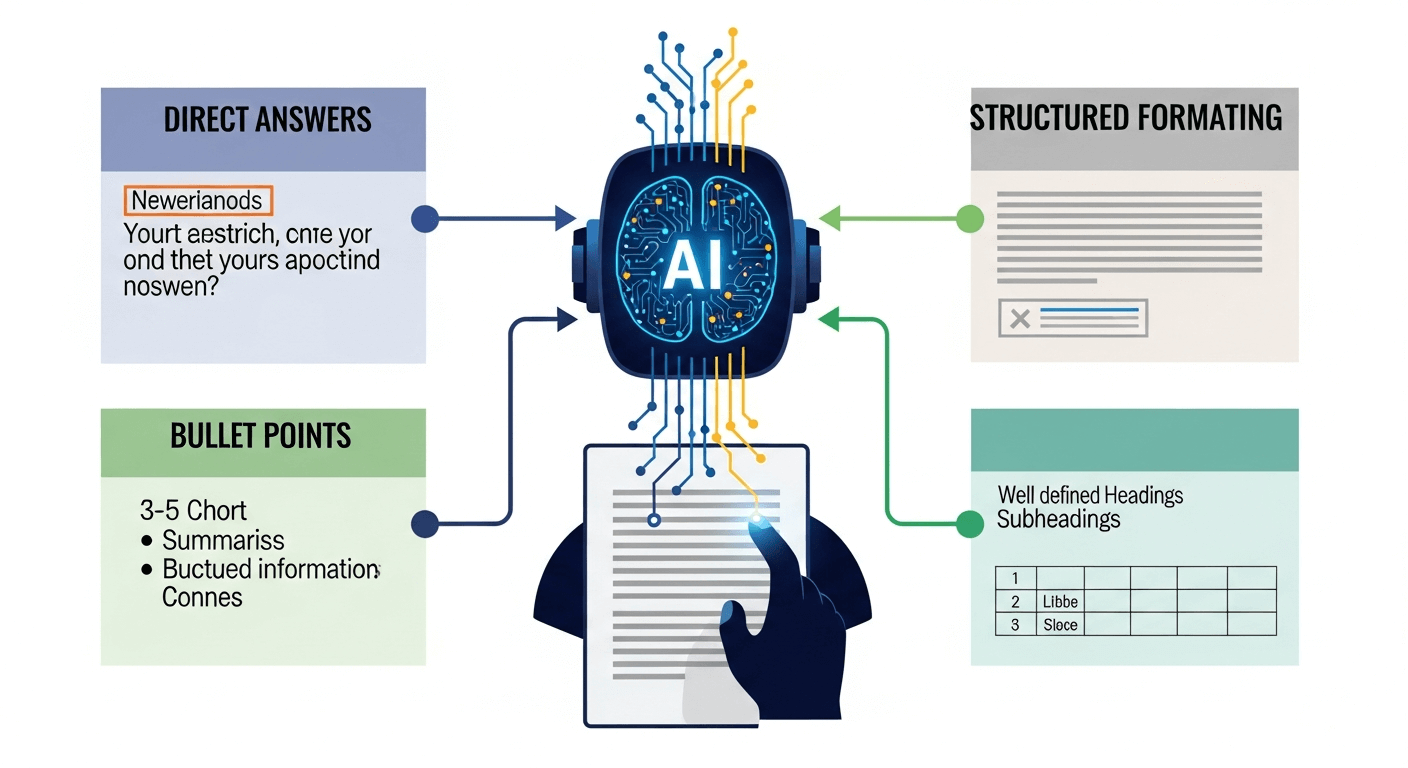
The most effective way to rank in AI Overviews is to structure your content so that AI models can easily “read” and extract your answers. This is often called the Inverted Pyramid style for AI.
The Direct Answer Paragraph

For every main section of your article, especially the introduction, start with a direct, definitional answer.
- The Technique: Identify the core question (e.g., “What is technical SEO?”).
- The Execution: Write a 40-60 word paragraph that directly answers the question without fluff. Avoid “In this section, we will discuss…” openers. Instead, say: “Technical SEO is the process of optimizing website infrastructure…”
This “answer-first” format increases the likelihood that an AI model will grab that specific paragraph to use as a definition in its overview.
Semantic Formatting for Machine Readability
AI models struggle with walls of text. They thrive on structure. To optimize for “how to rank in AI Overviews,” you must rigorously format your content.
- Lists and Bullet Points: AI loves lists. If you are explaining a process, use a numbered list (
<ol>). If you are listing features, use bullet points (<ul>). - Comparison Tables: One of the most common AI Overview formats is a comparison table. If you are writing a “X vs. Y” article, always include a markdown table comparing features, price, and pros/cons. This makes it incredibly easy for the AI to lift your data directly into its own table.
Actionable Tip: Review your top 10 performing blog posts. Do they have clear, 2-3 sentence answers immediately following each H2 header? If not, rewrite them today.
Core Strategy 2: Generative Engine Optimization (GEO)
Generative Engine Optimization (GEO) is the practice of optimizing content specifically for AI recommendation engines.
Optimization for Citations
In the world of GEO, your goal is to be cited. Research indicates that 92% of citations in AI Overviews come from pages that already rank in the top 10 organic results. However, simply ranking isn’t enough. You must be the authority.
- Quote Expert Sources: AI models look for consensus. By quoting other authoritative sources and linking to them, you signal that your content is part of the trusted knowledge graph.
- Unique Data & Statistics: AI models prioritize unique information. If you publish original research, surveys, or case studies, you become the primary source that other AI summaries must reference.
Semantic and LSI Keywords
Keywords still matter, but “keyword stuffing” is dead. You need to focus on Latent Semantic Indexing (LSI) keywords. These are terms conceptually related to your main topic that help the AI understand the full context.
15 LSI Keywords for “How to Rank in AI Overviews”:
- Generative Engine Optimization (GEO)
- Search Generative Experience (SGE)
- Zero-click searches
- Entity authority signals
- Structured data markup
- Knowledge graph optimization
- Large Language Model (LLM) SEO
- User intent optimization
- Conversational search queries
- AI citation building
- E-E-A-T signals
- Semantic search optimization
- Featured snippet optimization
- Voice search optimization
- Answer engine optimization
Integrating these terms naturally proves to the AI that your content covers the topic comprehensively.
Core Strategy 3: Mastering Schema Markup for AI

If content is the body, Schema Markup is the language you use to speak directly to the AI. Schema (structured data) helps search engines understand the entities on your page—who wrote it, what organization they belong to, and exactly what the content covers.
Essential Schema Types for 2025
To rank in AI Overviews, you need to go beyond basic schema.
- Article Schema: Don’t just slap this on; ensure you populate fields like
author,publisher, anddateModified. Freshness is a huge signal for AI. - FAQPage Schema: This is critical. By wrapping your Q&A sections in FAQ schema, you explicitly tell the AI, “Here is a question, and here is the answer.” This is a direct pipeline to being featured in AI Q&A boxes.
- HowTo Schema: For instructional content, this breaks down your steps into a machine-readable format, making it easy for AI to extract step-by-step instructions.
- Organization & Person Schema: This builds your Knowledge Graph. It connects your content to a real-world entity (your brand) and an expert author, satisfying the “Authority” in E-E-A-T.
Nested Entity Relationships
Advanced GEO involves “nesting” schemas. For example, if you have a case study, connect the Organization (client) to the Place (location) and Service (what you did). This helps the AI build a 3D understanding of your business relationships, increasing trust.
Core Strategy 4: E-E-A-T and Brand Authority
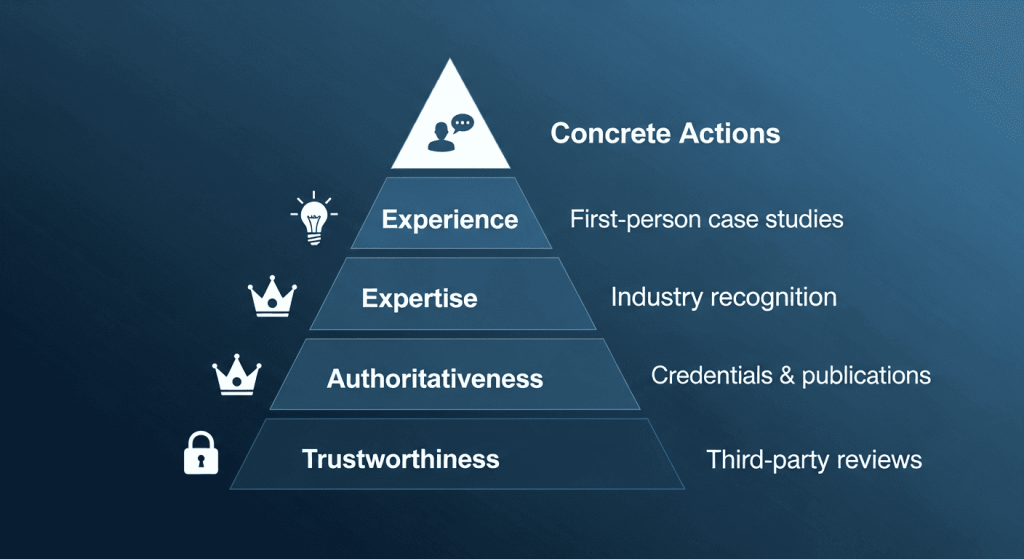
Google’s E-E-A-T (Experience, Expertise, Authoritativeness, Trustworthiness) is the filter AI uses to separate high-quality advice from noise. For AI Overviews, usually only the most trusted sources are cited.
Building “Experience” into Content
AI can write generic content, but it cannot have experiences. To beat the AI, you must be human.
- First-Person Narratives: Use phrases like “In our testing…” or “When we worked with Client X…”
- Evidence of Use: Include photos or videos of you actually using the product or performing the service.
- Author Bios: Ensure every article has a detailed author bio linking to their LinkedIn or Twitter/X profiles to prove they are a real expert.
Brand Mentions and “Digital PR”
AI Overviews rely heavily on brand co-occurrence. This means if your brand name frequently appears alongside keywords like “best CRM software” on other trusted websites (forums like Reddit, G2, Capterra, or industry news sites), the AI begins to associate your brand as a top recommendation.
- Strategy: Focus on Digital PR. Get interviewed on podcasts, write guest posts on authoritative sites, and encourage happy customers to leave detailed reviews on third-party platforms.
Technical Foundations for AI Crawlers
You cannot rank in AI Overviews if the AI cannot crawl your site efficiently.
Page Speed and Mobile Usability
While AI is smart, it is also efficient. It prefers pages that load quickly and are easy to parse.
- Core Web Vitals: Aim for a Lighthouse performance score of >90.
- Mobile-First: Most AI searches happen on mobile devices. Ensure your text is legible and your layout is responsive.
Clean Code Structure
Avoid burying your content in complex JavaScript. AI models are getting better at rendering JS, but plain HTML is still the easiest for them to digest. Use semantic HTML tags (<article>, <section>, <aside>) to help the crawler understand the hierarchy of your page.
FAQ: Common Questions About AI Overviews
Q: Can I opt out of AI Overviews?
A: Currently, there is no direct meta tag to specifically opt out of just AI Overviews without deindexing your page entirely from Google Search. Google views AI summaries as part of the core search experience.
Q: Do AI Overviews steal traffic?
A: They can reduce click-through rates (CTR) for simple definitions (e.g., “What is the capital of France?”). However, for complex buying guides or “how-to” queries, they can drive highly qualified traffic to your site.
Q: How often does Google update AI Overview data?
A: AI Overviews are generated dynamically, but the underlying index is updated constantly. Using dateModified schema and frequently updating your content helps signal that your information is current, which is vital for AI inclusion.
Q: Is “keyword density” still important?
A: Strict keyword density (e.g., “use this word 5 times”) is outdated. Instead, focus on semantic density—covering the topic depth with related terms and answering all logical follow-up questions a user might have.
Q: Does social media impact AI ranking?
A: Indirectly, yes. Discussions on platforms like Reddit and LinkedIn are often ingested by LLMs to determine “real human consensus.” Being part of the conversation on these platforms can influence how your brand is perceived by the AI.
Conclusion: The Future is Generative

Mastering “how to rank in AI Overviews” is not about tricking an algorithm; it is about maturing your content strategy. The days of churning out 500-word generic posts are over. In 2025, you must be the definitive source—the expert entity that the AI has to cite to provide a good answer.
Key Takeaways:
- Adopt an “Answer-First” Format: Start every section with a clear definition.
- Leverage Schema: Use FAQPage and Article schema to speak the AI’s language.
- Build Entity Authority: Focus on Digital PR and getting cited on other reputable sites.
- Think Like an Editor: Review your content—is it better than the AI summary? If not, improve it.
Ready to future-proof your SEO? Start by auditing your top 10 pages today. Add FAQ schema, restructure your headers, and inject real-world experience into your copy. The AI revolution isn’t coming—it’s here. Make sure your brand is part of the conversation.