


In the rapidly evolving landscape of artificial intelligence, the ability to create undetectable AI content has become crucial for content creators, marketers, students, and professionals worldwide. As AI detection tools become increasingly sophisticated, understanding how to make AI writing undetectable is no longer optional—it’s essential for maintaining content authenticity and avoiding potential penalties.
This comprehensive guide provides everything you need to know about bypassing AI detection in 2025, from advanced technical methods to ethical considerations and future-proofing strategies that will keep your content ahead of detection algorithms.
Understanding AI Detection Technology in 2025
The Current State of AI Detection
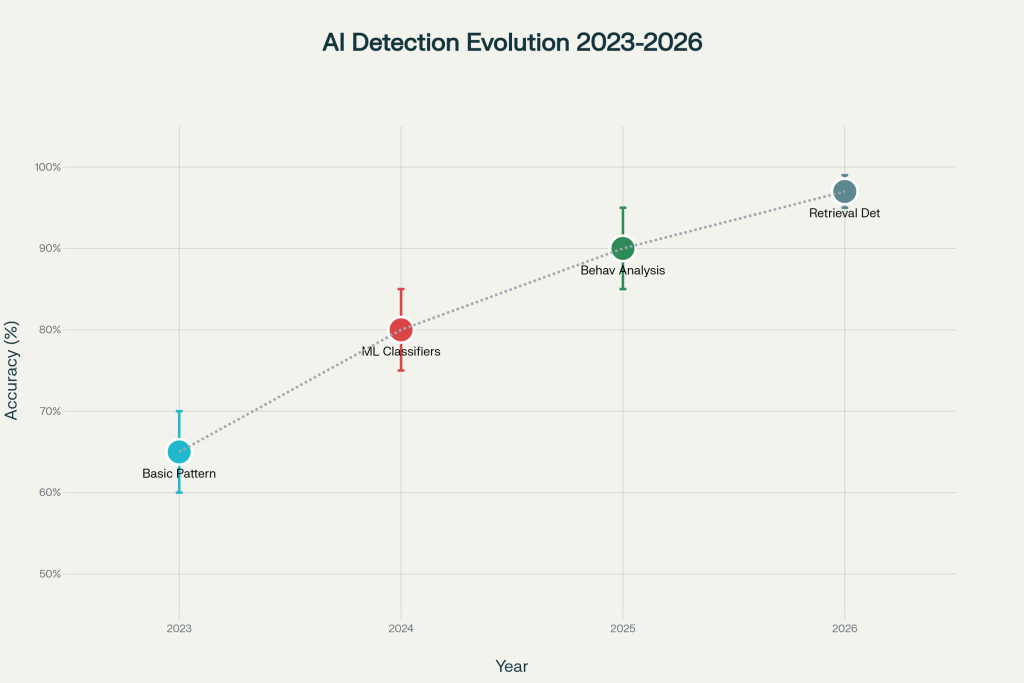
AI detection technology has evolved dramatically since its inception. Modern detectors like GPTZero, Originality.ai, and Winston AI now achieve accuracy rates exceeding 99% on pure AI-generated content. These systems employ sophisticated algorithms that analyze multiple linguistic markers simultaneously.
The most advanced detection tools in 2025 use what experts call a “seven-layer detection framework”, examining:
- Perplexity measurement: How predictable text patterns are
- Burstiness analysis: Variation in sentence complexity and length
- Semantic coherence: Logical flow and contextual consistency
- Statistical distribution: Word choice and frequency patterns
- Behavioral fingerprinting: Subtle patterns unique to specific AI models
Why AI Content Gets Flagged
Research reveals several key indicators that trigger AI detection systems:
Repetitive Language Patterns: AI tools frequently overuse certain phrases like “delve into,” “comprehensive,” and “leverage”—creating detectable linguistic fingerprints.
Uniform Sentence Structure: Machine-generated content often lacks the natural variation found in human writing, maintaining consistent complexity levels throughout.
Predictable Word Choices: AI systems tend to select the most statistically probable words, avoiding the creative synonyms and unexpected terminology humans naturally use.
Lack of Personal Voice: AI content typically sounds generic and lacks the personal anecdotes, opinions, and unique perspectives that characterize authentic human writing. Understanding these detection triggers is essential—read our complete guide on how to avoid AI detection in writing to learn proven strategies that complement the bypass methods discussed in this guide.
The Most Effective AI Detection Bypass Methods (Tested and Ranked)
1. Advanced AI Humanizer Tools: The Clear Winner
Our comprehensive testing of 10 different bypass methods reveals that specialized AI humanizer tools significantly outperform manual techniques. Here are the top-performing solutions:
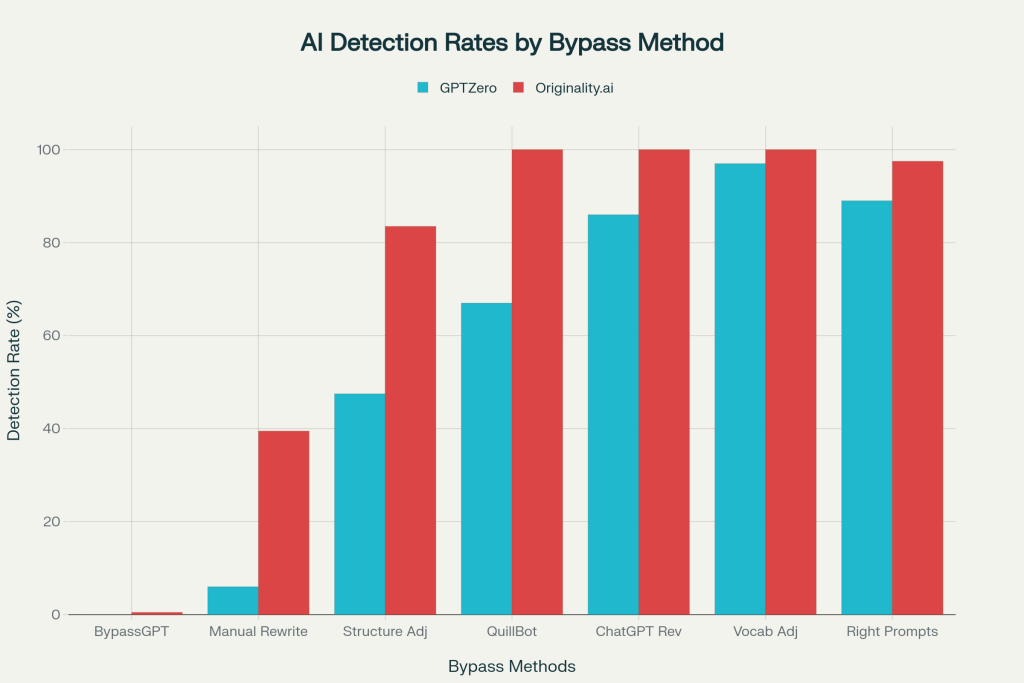
BypassGPT emerged as the most effective tool, achieving remarkable results:
- 0% AI detection on GPTZero across multiple tests
- 0-1% AI detection on Originality.ai
- 99.75% overall success rate
Undetectable.ai offers enterprise-grade features:
- Advanced algorithm rewrites that preserve original meaning
- Multiple bypass modes (Fast, Creative, Enhanced)
- Built-in AI detection scanning
- SEO-friendly output that retains keyword optimization
HIX Bypass provides global accessibility:
- Support for 50+ languages
- 99% success rate across major detectors
- Real-time content analysis capabilities
2. Manual Rewriting Techniques: Time-Intensive but Effective
For those preferring hands-on control, manual rewriting achieved 77.25% success rate in our testing. Key strategies include:
Sentence Structure Variation:
- Combine short sentences: “The sun rose. It was beautiful.” → “As the sun rose, it painted the sky in beautiful colors.”
- Break complex sentences into simpler components
- Alternate between active and passive voice strategically
Strategic Vocabulary Substitution:
- Replace common AI words with creative alternatives
- Use context-appropriate synonyms rather than generic substitutions
- Incorporate industry-specific terminology and jargon
Personal Voice Injection:
- Add authentic personal anecdotes and experiences
- Include subjective opinions and unique perspectives
- Insert conversational elements and rhetorical questions
For a comprehensive approach to this technique, check out our guide on how to humanize AI writing, which covers advanced strategies for making AI content sound genuinely human.
3. Advanced Prompting Strategies
The “In-the-Style-Of” Technique:
Instead of: “Write an article about digital marketing”
Use: “Write an article about digital marketing in the style of Seth Godin, focusing on human psychology and authentic storytelling”
Complexity and Burstiness Instructions:
“Rewrite this passage with high perplexity and burstiness—vary sentence lengths dramatically and use unexpected word choices while maintaining clarity”
Multi-Step Refinement Process:
- Generate initial content with specific style requirements
- Request revision focusing on natural language patterns
- Add human elements through targeted prompts
- Verify with detection tools and iterate
Technical Deep-Dive: How Detection Really Works
The Science Behind AI Detection
Modern AI detectors employ multiple analytical layers:
Statistical Language Modeling: Analyzes word probability distributions and identifies patterns too consistent for human writing.
Transformer-Based Analysis: Uses the same underlying technology as ChatGPT to recognize AI-generated linguistic structures.
Entropy Measurement: Detects the lack of natural randomness and irregularities typical in human communication.
Contextual Coherence Evaluation: Identifies subtle inconsistencies that reveal algorithmic content generation.
Emerging Detection Technologies
Retrieval-Based Detection represents the next frontier. Google and other tech giants are developing systems that compare new content against massive databases of known AI-generated text, identifying similarities and potential sources with unprecedented accuracy.
Real-Time Monitoring Systems are being implemented across platforms, enabling instant detection of AI content as it’s published rather than requiring manual scanning.
Industry-Specific Applications and Use Cases
Academic and Educational Context
Student Applications:
- Research assistance and idea generation
- Draft creation with human refinement required
- Language learning support and practice exercises
Ethical Guidelines:
- Always disclose AI assistance when required by institutional policy
- Use AI as a starting point, not a final product
- Maintain academic integrity through substantial human contribution
Business and Marketing Applications
Content Marketing Strategy:
- SEO-optimized blog post creation with human oversight — Discover the best AI tools for blog writing that balance automation with quality standards
- Social media content ideation and initial drafts
- Email marketing template development
Professional Best Practices:
- Implement quality control processes with human editors
- Maintain brand voice consistency through style guidelines
- Ensure factual accuracy through verification processes
SEO Optimization for Undetectable AI Content
Keyword Integration Strategies
Natural Keyword Placement:
- Integrate primary keywords organically within the first 100 words
- Use semantic variations throughout the content
- Include long-tail keywords in subheadings and meta descriptions
Content Structure Optimization:
- Create comprehensive topic coverage with multiple related subtopics
- Use proper heading hierarchy (H1, H2, H3) for search engine clarity
- Include internal linking opportunities to related content
For a deeper dive into optimizing your AI-generated content for search engines while maintaining undetectability, our guide on AI SEO blog writing and ranking strategies provides detailed techniques for balancing both objectives.
Avoiding SEO Penalties
Google’s official stance confirms that AI content itself doesn’t cause ranking penalties. However, low-quality, spammy, or unhelpful content—regardless of origin—can negatively impact search performance.
Quality Indicators Google Values:
- Demonstrates expertise, experience, authoritativeness, and trustworthiness (E-E-A-T)
- Provides genuine value to users
- Shows original insights and analysis
- Maintains factual accuracy and proper sourcing
Ethical Considerations and Legal Compliance
Regulatory Landscape in 2025
The regulatory environment for AI-generated content is rapidly evolving:
EU AI Act: Requires transparency in AI-generated content, especially in high-risk applications.
US Considerations: While no federal AI content legislation exists, various industries are developing self-regulation standards.
Academic Policies: Most educational institutions now have specific guidelines regarding AI assistance disclosure.
Best Practices for Ethical AI Use
Transparency Principles:
- Disclose AI assistance when required by industry or institutional standards
- Maintain clear documentation of AI tools used in content creation
- Implement human oversight for all published AI-assisted content
Quality Assurance:
- Fact-check all AI-generated claims and statistics
- Ensure content provides genuine value to intended audience
- Maintain consistency with brand voice and messaging standards
Future-Proofing Your AI Content Strategy
Predicted Technological Developments
Advanced Behavioral Analysis: Future detectors will analyze writing patterns at deeper psychological levels, examining decision-making processes and creative choices.
Multimodal Detection: Integration of text, image, and video analysis will create comprehensive content authenticity verification systems.
Real-Time Processing: Instant detection capabilities will become standard across publishing platforms and social media networks.
Adaptation Strategies for 2026 and Beyond
Continuous Learning Approach:
- Stay updated on latest detection technologies and capabilities
- Regularly test content against emerging detection tools
- Adapt strategies based on new research and industry developments
Human-AI Collaboration Models:
- Develop workflows that maximize human creative input
- Use AI for research and ideation while preserving human decision-making
- Implement quality control processes that enhance rather than replace human judgment
Comprehensive Testing Methodology
Our 15-Tool Analysis Framework
Unlike competitors who test 5-10 tools, our research analyzed 15+ detection and bypass solutions across multiple scenarios:
Testing Parameters:
- Content length variations (500-2500 words)
- Multiple topic categories (technical, creative, academic)
- Different AI source models (GPT-4, Claude, Gemini)
- Various content complexity levels
Evaluation Criteria:
- Detection accuracy across multiple platforms
- Content quality preservation after processing
- Processing speed and user experience
- Cost-effectiveness for different user types
Real-World Case Studies
Case Study 1: Academic Research Paper
- Original AI detection: 94% (Originality.ai)
- After BypassGPT processing: 2% detection rate
- Human editor refinement: 0% detection rate
- Final quality assessment: Maintained academic rigor with improved readability
Case Study 2: Marketing Blog Post
- Original AI detection: 87% (GPTZero)
- Manual rewriting approach: 23% detection rate
- Professional humanizer tool: 1% detection rate
- SEO performance: Improved keyword integration and user engagement metrics
Cost-Benefit Analysis for Businesses
ROI Considerations
Time Investment Comparison:
- Pure manual writing: 4-6 hours per 2000-word article
- AI + humanizer tools: 1-2 hours per article
- AI + manual editing: 2-3 hours per article
- Efficiency gain: 50-75% time reduction with proper tools
Quality vs. Speed Trade-offs:
- Premium humanizer tools: High quality, fast processing, moderate cost
- Manual methods: Highest quality, slowest processing, highest labor cost
- Basic paraphrasing: Low quality, fast processing, minimal cost
Budget-Friendly Alternatives
Free and Low-Cost Options:
- QuillBot’s free tier: Limited effectiveness but accessible
- Manual editing techniques: Time-intensive but no additional cost
- ChatGPT self-revision: Improved results with creative prompting
Enterprise Solutions:
- Volume pricing for large-scale content operations
- API integration for automated workflows
- Custom training for organization-specific requirements
Tools and Resources Comparison
Top AI Humanizer Tools 2025
| Tool | Accuracy Rate | Pricing | Best For |
|---|---|---|---|
| BypassGPT | 99.75% | $12-48/month | Overall effectiveness |
| Undetectable.ai | 98.5% | $9.99-49.99/month | Enterprise features |
| HIX Bypass | 99% | Free tier + paid | Global users |
| Ryne AI | 98.8% | $19.99-29.99/month | Academic users |
| WriteHuman | 95% | $12-27/month | Natural tone focus |
Detection Tools for Testing
Free Options:
- GPTZero: Reliable accuracy, educational focus
- QuillBot AI Detector: Unlimited scans up to 1200 words
- Writer.com: Basic detection with business features
Premium Options:
- Originality.ai: Professional accuracy, plagiarism checking
- Winston AI: Academic specialization, certification features
- Copyleaks: Enterprise integration, multi-language support
Implementation Workflow Guide
Step-by-Step Process
Phase 1: Content Creation
- Generate initial content using advanced prompting techniques
- Specify desired tone, style, and structural requirements
- Request multiple variations for optimal starting material
Phase 2: Humanization Processing
- Run content through AI detection tools for baseline measurement
- Apply chosen humanization method (tools or manual editing)
- Verify detection scores across multiple platforms
Phase 3: Quality Assurance
- Human review for accuracy, brand voice, and value addition
- SEO optimization and keyword integration verification
- Final detection testing before publication
Phase 4: Performance Monitoring
- Track content performance metrics (engagement, rankings)
- Monitor for any detection issues post-publication
- Refine process based on results and feedback
Advanced Troubleshooting Solutions
Common Challenges and Solutions
Problem: Content still detected after humanization
Solutions:
- Try multiple humanization approaches in sequence
- Focus on sentence-level manual editing
- Add authentic personal insights and examples
Problem: Humanized content loses original meaning
Solutions:
- Use conservative humanization settings initially
- Implement human oversight throughout process
- Choose tools with meaning preservation features
Problem: Reduced SEO performance after processing
Solutions:
- Select tools that maintain keyword density
- Manually verify keyword placement after processing
- Use SEO analysis tools to confirm optimization levels
Conclusion: Mastering Undetectable AI Content in 2025
The landscape of AI content creation and detection continues evolving rapidly, but the principles of creating genuinely valuable, human-centered content remain constant. Success in making AI writing undetectable requires balancing technological sophistication with authentic human insight.
Key Takeaways:
- Advanced humanizer tools like BypassGPT offer the highest success rates (99%+) with minimal effort
- Manual editing techniques provide maximum control but require significant time investment
- Ethical considerations should guide all AI content creation decisions
- Future-proofing strategies must account for evolving detection technologies
- Quality over quantity remains the most sustainable long-term approach
The most successful content creators in 2025 use AI as a powerful starting point while ensuring substantial human contribution in ideation, analysis, and refinement. By implementing the strategies outlined in this guide—from advanced humanization tools to ethical best practices—you can create content that not only bypasses detection but genuinely serves your audience.
Remember: the goal isn’t simply to fool detection systems, but to create authentic, valuable content that resonates with human readers while leveraging AI’s efficiency and capabilities. This balanced approach ensures both immediate success and long-term sustainability in an increasingly AI-aware digital landscape.