

The search landscape has fundamentally transformed. No longer is optimization limited to traditional Google rankings. Today’s savvy content creators and marketers must understand how artificial intelligence selects and cites sources in generative search engines like ChatGPT, Perplexity, Google AI Overviews, and Gemini. AI search results optimization—the practice of tailoring your content to be selected, quoted, and cited by AI-powered search platforms—has become essential for maintaining visibility in 2025.
Unlike traditional SEO, which focuses on ranking individual pages in search results, AI search results optimization targets inclusion in synthesized answers where AI systems analyze millions of sources and select the most authoritative, relevant, and well-structured content to cite. This shift matters enormously: AI Overviews now appear in 30% of U.S. desktop searches, while Perplexity has experienced 150% growth in the past year. If your content isn’t optimized for these platforms, you’re losing visibility to competitors who are. This comprehensive guide walks you through everything you need to know about AI search results optimization, from understanding how different AI engines select sources to implementing advanced content strategies that get your content cited.
Understanding AI Search Results Optimization
AI search results optimization (also called Answer Engine Optimization or AEO) differs fundamentally from traditional SEO. Where traditional search engines return lists of links, AI search engines synthesize multiple sources into comprehensive, conversational answers—and they cite their sources directly within those answers. This creates both challenges and unprecedented opportunities for content creators.
When a user asks ChatGPT, Perplexity, or Google’s Gemini a question, the AI engine executes a multi-stage process. First, it interprets the user’s intent through natural language processing. Next, it retrieves relevant content from across the web. Then, it evaluates source credibility, relevance, and authority. Finally, it synthesizes information and generates an answer with inline citations pointing back to your content.
The critical insight: if your content gets selected and cited by these platforms, you gain credibility, visibility, and traffic—even if the user never clicks away from the AI interface. This represents a fundamental shift in how content visibility works. Rather than competing for position zero in Google’s organic search results, you’re now competing for inclusion in an entirely new format of search results.
The Growth of AI-Powered Search
The adoption curve has been steep. Google’s AI Overviews, which were experimental in 2023, now appear for 13% of all U.S. desktop searches as of 2025. On mobile devices, AI Overviews have grown by approximately 475% year-over-year. Perplexity’s user base has exploded with 150% growth in the past year, while ChatGPT’s SearchGPT feature now provides real-time web search integration. Microsoft’s Bing Chat continues integrating generative AI capabilities across search.
What this means for content creators: visibility on AI search platforms is no longer optional. It’s a core component of any comprehensive digital strategy. Sites that rank well in traditional search but aren’t optimized for AI citations will see their traffic stagnate while competitors capture the growing AI-search audience.
How AI Engines Select and Cite Sources
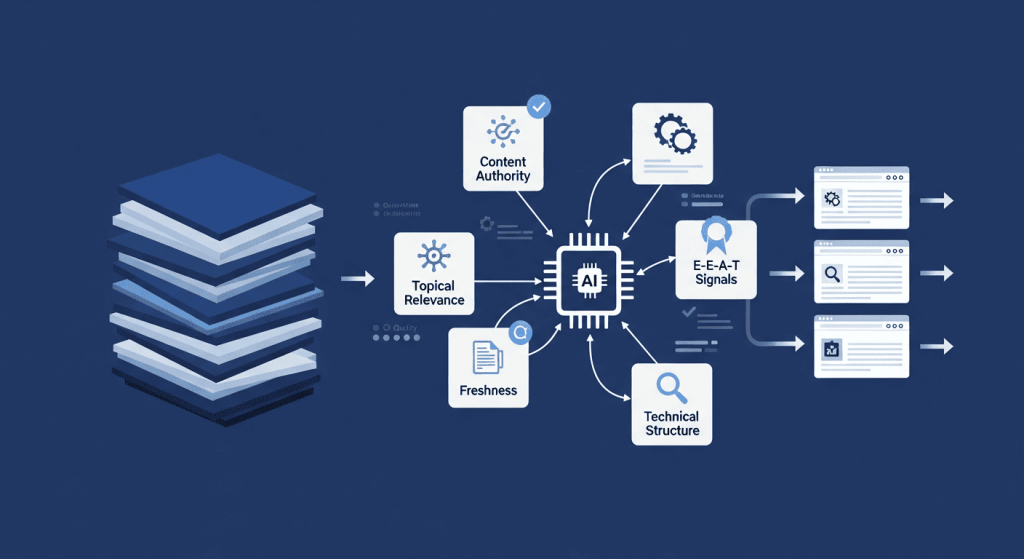
Before optimizing your content, you need to understand the criteria AI systems use when deciding which sources to cite. Different AI engines weight factors differently, but certain patterns consistently emerge across platforms.
Content Authority and Source Credibility
Content authority represents the single most important factor across all AI search platforms. AI engines prioritize sources created by recognized experts in specific fields rather than generalists writing about everything. This extends the traditional SEO concept of domain authority into a more nuanced assessment of expertise depth and topical mastery.
ChatGPT heavily favors established sources like Wikipedia (1.3 million citations), followed by industry-specific authorities like G2, Forbes, and Amazon. Google’s Gemini shows similar preferences for authoritative domains but also recognizes and rewards original research and primary sources. Perplexity, which emphasizes transparency and source diversity, cites Reddit 3.2 million times—showing that user-generated content from credible communities ranks highly when structured properly.
The pattern is clear: if your domain has established authority through consistent publication of high-quality content within a specific niche, AI engines recognize and reward that authority through frequent citations. Building this authority requires sustained effort—publishing original insights, earning backlinks from recognized sources, and consistently demonstrating expertise over months and years.
Topical Relevance and Semantic Alignment
AI engines evaluate whether your content demonstrates comprehensive expertise on specific topics rather than superficial coverage across many subjects. A site that publishes fifteen detailed articles about sustainable agriculture demonstrates more topical authority than a generalist site that mentions sustainable farming once.
Semantic alignment means your content directly addresses what users actually need rather than simply containing relevant keywords. When someone asks “How can I reduce my carbon footprint in daily life?”, AI engines look for content that genuinely explores this question comprehensively, addressing transportation, diet, energy use, and consumption patterns. Content that stuffs keywords without providing real value gets filtered out.
This matters because AI systems understand context and relationships between concepts in ways traditional keyword matching cannot. A page that discusses related concepts—using LSI keywords and semantic keywords naturally—signals to AI engines that you understand the topic deeply. Pages that jump between unrelated keywords appear shallow by comparison.
Content Freshness and Currency
AI search systems consistently prioritize recently updated content, especially for time-sensitive queries. Content that’s two years old gets cited less frequently than current content addressing the same topic, even if the older content is more authoritative.
Freshness signals matter because they indicate ongoing engagement with a topic. When you update an article to include 2025 statistics, new research findings, or recent examples, you’re telling AI engines that you actively maintain your expertise and care about accuracy. This is particularly important in rapidly evolving fields like technology, health, and business where information becomes outdated quickly.
The implication: schedule regular content audits and updates. Even if your core information remains accurate, adding new examples, recent statistics, and updated timestamps improves your chances of AI citation.
Entity Recognition and Knowledge Graph Integration
AI engines map relationships between entities—people, organizations, products, locations, and concepts—using knowledge graphs. Content that clearly identifies and defines key entities, explains their relationships, and connects them to broader concepts ranks higher for AI citation.
For example, if you’re writing about machine learning, clearly introducing entities like “artificial intelligence,” “neural networks,” “supervised learning,” and “deep learning” while explaining how they relate to each other signals domain expertise. When you mention recognized experts, cite established organizations, and reference known tools or methodologies, you’re providing the semantic context AI engines use to understand and evaluate your content.
Technical Structure and Content Organization
AI engines prioritize well-organized content with clear information architecture. Proper heading hierarchies, structured lists, descriptive subheadings, and logical paragraph organization make it easier for AI systems to extract relevant information and maintain accuracy when synthesizing answers.
Content with semantic HTML markup—using proper tags like <header>, <main>, <section>, and <article>—provides clear roadmaps that help AI crawlers understand your content structure. This technical clarity reduces the likelihood of misquotation and increases the probability of accurate citation.
The practical implication: use clear, descriptive H2 and H3 headings, keep paragraphs to 3-4 sentences, use bullet points and numbered lists where appropriate, and avoid wall-of-text formatting. Your content should be equally useful for humans and AI systems parsing it.
SEO Fundamentals for AI Visibility
While AI search optimization differs from traditional SEO, the two are deeply intertwined. Most content cited by AI engines already ranks in Google’s top search results. Building AI visibility starts with solid SEO foundations.
Traditional SEO as the Foundation
Research shows that approximately 50-60% of content cited by AI engines comes from pages already ranking in Google’s top ten results. This means that optimizing for traditional SEO—including site speed, mobile responsiveness, crawlability, and keyword relevance—creates the foundation that AI citation depends on.
This doesn’t mean you should prioritize traditional SEO over AI optimization. Rather, they’re complementary. A page that ranks poorly in Google is unlikely to be cited by AI engines. But a page that ranks well in Google and is optimized for AI citation has maximum visibility across both search paradigms.
Focus on SEO basics first: ensure your site loads quickly (ideally under 3 seconds), works perfectly on mobile devices, has no crawl errors, includes proper robots.txt configuration, and ranks for relevant keywords. Then layer AI optimization on top of this foundation.
Building Topical Authority
Topical authority—establishing your site as a recognized expert resource for specific topics—matters enormously for AI citation. This typically involves creating content clusters: a central pillar page covering a broad topic comprehensively, supported by cluster pages that explore specific subtopics in depth.
Pages optimized with topic depth rank for approximately 4x more keywords on average compared to pages that address topics superficially. This breadth and depth signals to both Google and AI engines that you understand your subject thoroughly. When users search related queries, AI engines recognize your site as the go-to source and cite you accordingly.
The content cluster approach works like this: create a pillar page that comprehensively covers a topic (3,000-5,000 words), then create 8-15 cluster pages (1,500-2,500 words each) that explore specific subtopics while linking back to the pillar and to each other. This internal linking structure helps both search engines and AI systems understand the relationships between concepts and recognize your expertise.
E-E-A-T Signals for AI Credibility
Google’s E-E-A-T framework—Experience, Expertise, Authoritativeness, Trustworthiness—directly influences both traditional rankings and AI citation. AI engines evaluate these signals when deciding whether to cite your content, particularly for sensitive topics like health, finance, and legal matters.
Demonstrating E-E-A-T means:
- Experience: Show real-world experience with the topic. Personal stories, case studies, and practical examples prove you’ve lived the content you’re creating.
- Expertise: Establish credentials, certifications, and deep knowledge. Write detailed content that covers topics thoroughly rather than superficially.
- Authoritativeness: Build recognition within your niche. Earn backlinks from recognized sources, get featured in industry publications, and establish yourself as a go-to expert.
- Trustworthiness: Cite reputable sources, correct errors promptly, maintain consistent information across platforms, and be transparent about your methods and affiliations.
AI engines analyze these signals across multiple factors: backlink authority, publication in recognized outlets, consistency of information across platforms, and content depth. Sites that score well on E-E-A-T get cited more frequently by AI systems.
Semantic Search and Keyword Strategy for AI Optimization
Effective AI optimization requires shifting from keyword-centric thinking to semantic, intent-based thinking. This means understanding the relationships between concepts, covering topics comprehensively, and creating content that addresses multiple related queries naturally.
Understanding Semantic Keywords and LSI Keywords
Semantic keywords and Latent Semantic Indexing (LSI) keywords are terms and phrases that relate to your primary keyword and help search systems understand context. Rather than optimizing purely for “weight loss,” semantic optimization includes related concepts like “calorie deficit,” “exercise routines,” “metabolism,” “nutrition,” and “lifestyle changes.”
AI systems use these semantic relationships to understand whether you’re writing about weight loss from a medical perspective, fitness perspective, nutrition perspective, or lifestyle perspective. When your content includes diverse semantic keywords naturally, you signal that you understand the topic deeply.
Finding semantic keywords involves analyzing top-ranking content for your primary keyword and identifying terms that appear consistently across those pages. Tools like LSIGraph, Semrush, and SEMrush can identify semantic keyword opportunities. The key is including these terms naturally throughout your content without forcing them or reducing readability.
Long-Tail Keywords and Conversational Queries
AI search users tend to ask questions conversationally rather than using short, fragmented queries. Voice search and AI chat interfaces encourage longer, more natural phrasing. This means optimizing for long-tail keywords—longer, more specific keyword phrases—becomes increasingly important.
Instead of targeting just “healthy recipes,” target phrases like “quick healthy weeknight dinner recipes for families” or “high-protein vegetarian recipes for meal prep.” These longer phrases better match how people actually ask questions and provide more specific information about intent.
Voice search optimization overlaps significantly with AI optimization. Both emphasize natural language, conversational tone, and direct answers to specific questions. A page optimized for voice search is typically also well-optimized for AI citation.
Topic Clusters and Keyword Mapping
Rather than creating standalone articles around individual keywords, create interconnected clusters of content around broader topics. This approach improves AI visibility by demonstrating comprehensive expertise.
Start by identifying 5-10 subtopics related to your main topic. Create detailed cluster pages for each subtopic (1,500-2,500 words), then create a pillar page (3,000-5,000 words) that provides comprehensive overview and links to each cluster page. This structure:
- Helps AI systems understand topic relationships
- Signals topical authority
- Allows you to target multiple related keywords
- Creates opportunities for AI systems to cite multiple pages from your site
The internal linking structure is critical. Pillar pages should link to all cluster pages using descriptive anchor text. Cluster pages should link back to the pillar page and to related cluster pages. This creates a web of contextual relationships that AI systems recognize.
Content Optimization for AI Platforms
Different AI platforms have distinct preferences, but certain content optimization strategies work across all major platforms.
Creating Content for ChatGPT
ChatGPT primarily uses its training data plus real-time web search to synthesize answers. It favors well-structured, authoritative sources—the kinds of pages that already rank well in Google.
To optimize for ChatGPT:
- Use clear structure: Organize content with strong heading hierarchies, short paragraphs, and descriptive subheadings that answer specific questions.
- Provide definitive answers: ChatGPT looks for content that provides clear, direct answers rather than hedging or presenting multiple contradictory viewpoints. Start sections with the answer, then provide supporting details.
- Build semantic richness: Include related terms, concepts, and examples naturally throughout your content. This helps ChatGPT understand your content deeply and use it to answer related questions.
- Get listed in trusted sources: ChatGPT recognizes and prefers certain domains. Getting mentioned in industry publications, directories, and well-known listicles improves your chances of citation.
- Implement schema markup: ChatGPT recognizes and values structured data. Proper schema implementation helps ChatGPT understand your content’s categories, relationships, and context.
ChatGPT scans the top 5-10 search results when answering questions, verifies their authority, and looks for common themes. Pages that rank highly and appear consistently across top results get cited more frequently.
Optimizing for Perplexity AI
Perplexity emphasizes transparency and source citation, with 100% of responses including citations. This creates unique opportunities: if your content is selected, Perplexity users see direct links to your site.
Perplexity citation patterns show distinct preferences:
- Freshness matters significantly: Perplexity prioritizes recently updated content more aggressively than other platforms. Regular content updates directly improve citation frequency.
- Clear structure and formatting: Proper headings, bullet points, and organized information make extraction easier and reduce misquotation risk.
- Question-and-answer format: Content structured as Q&A naturally aligns with how Perplexity processes and presents information.
- Original research and data: Perplexity frequently cites original research, surveys, and data analysis. Publishing original insights gives Perplexity unique content to cite.
- Authority across domains: While Wikipedia and edu/gov domains get cited frequently, Perplexity shows more openness to diverse sources than ChatGPT, including Reddit, YouTube, and LinkedIn content when properly structured.
Estimated traffic boost from Perplexity citations ranges from 12-18% for sites successfully optimizing for this platform.
Google AI Overviews Optimization
Google AI Overviews integrate with traditional search results, combining Google’s understanding of your content quality with AI synthesis. Optimizing for Google AI Overviews means optimizing for both traditional SEO and AI-specific signals.
Google AI Overviews show for approximately 30% of U.S. desktop queries and 50%+ of mobile searches. They particularly favor informational queries (84% of AI Overview triggers) over transactional or navigational queries.
Key strategies:
- Featured snippet optimization: Content that wins featured snippets frequently appears in Google AI Overviews. Structure answers in 40-60 word chunks, use clear headings, and implement FAQ schema.
- Topical depth: Google’s AI Overviews cite content from sites demonstrating comprehensive expertise on topics.
- Entity recognition: Clearly define and explain relationships between key entities in your content.
- Multiple formats: While AI Overviews pull primarily from text, incorporating tables, lists, and visual content increases the chance of selection.
- Accurate citations: Ensure your content is factually accurate and well-sourced. Google’s AI Overviews prioritize citation quality and factual reliability.
Interestingly, research shows that AI Overviews now rank below position 1 in 12.4% of cases—up from less than 2% a year earlier. This suggests opportunities for well-optimized content to outrank AI Overviews if users prefer clicking through to the original source.
Optimization for Claude and Google Gemini
Claude and Gemini represent emerging platforms with distinct characteristics. Claude tends to favor longer-established, larger organizations but will cite newer content if it provides superior information. Gemini uses diverse signals including reviews, ratings, and awards, particularly for local and commercial queries.
For both platforms, focus on:
- Building recognized authority: Both platforms favor established, well-known sources but will cite newer content with superior information.
- Rating and review signals: Positive reviews and ratings, particularly on Google Business Profile and third-party review sites, influence Gemini’s recommendations.
- Award and accreditation signals: Industry recognition, awards, and professional accreditations carry weight in recommendation algorithms.
- Comprehensive content: Both platforms prefer detailed, well-researched content that thoroughly covers topics.
Implementing Structured Data and Technical SEO
Structured data and technical optimization create the technical foundation for AI visibility. While some evidence suggests schema markup alone doesn’t directly boost AI citation, proper implementation improves your overall visibility and makes content easier for AI systems to parse accurately.
Schema Markup for AI Optimization
Schema markup helps AI systems understand content categories, relationships, and context. Implementing schema increases the likelihood of rich results in search, better crawlability by AI systems, and more accurate content extraction.
Priority schema types for AI optimization:
- Article schema: Identifies content as an article, providing publication date, author, headline, and description.
- FAQPage schema: For content structured as frequently asked questions, helping AI systems identify question-and-answer format.
- HowTo schema: For instructional content, signaling step-by-step processes.
- NewsArticle or BlogPosting schema: Identifies content type and metadata.
- BreadcrumbList schema: Helps AI systems understand site structure and content relationships.
- Entity schemas: For Person, Organization, Place, and Event entities, helping knowledge graph integration.
Schema markup should accurately represent your content. Incorrect or misleading schema can hurt rather than help your visibility. Tools like Google’s Rich Results Test and Schema.org documentation ensure proper implementation.
Technical SEO Fundamentals
AI systems encounter the same technical barriers as traditional crawlers:
- Site speed: Slow sites get crawled less frequently and are deprioritized in results. Target under 3 seconds for page load time.
- Mobile optimization: Most AI search queries come from mobile devices. Responsive design and mobile performance are essential.
- Crawlability: Ensure robots.txt doesn’t block AI crawlers. Major AI systems including OpenAI’s GPTBot should be allowed to crawl your site.
- XML sitemaps and robots.txt: Proper configuration helps AI crawlers find and understand your content.
- URL structure: Use descriptive, readable URLs that include relevant keywords.
- HTTPS security: All sites should use secure connections.
These technical fundamentals improve both traditional SEO and AI visibility simultaneously.
Optimizing for Featured Snippets and Position Zero
Featured snippets—highlighted answer excerpts that appear at the top of Google search results—correlate strongly with AI citation. Content that wins featured snippets often gets cited by AI engines, making featured snippet optimization an indirect strategy for improving AI visibility.
Featured Snippet Optimization Strategies
Featured snippets come in several formats: paragraph snippets (brief answers), list snippets (ordered or unordered), and table snippets (comparative data).
To optimize for featured snippets:
- Answer questions concisely: Provide clear, direct answers in 40-60 words. AI systems look for this brevity when synthesizing answers.
- Use clear headings: Structure content with question-based H2 and H3 tags that signal the answer coming below.
- Implement proper formatting: Use bullet points, numbered lists, and tables where appropriate. Different query types trigger different snippet formats.
- Match search intent: Analyze current featured snippets for your target keywords. Understand what format and content style Google currently values for each query.
- Provide comprehensive answers: While featured snippets are concise, surrounding text should provide thorough coverage and context.
Research shows featured snippets average 35% click-through rates—significantly higher than non-featured results. This, combined with their strong correlation to AI citation, makes featured snippet optimization a valuable strategy.
Building Topical Authority and Content Depth
Topical authority emerges as one of the most consistent factors differentiating highly-cited content from average content. AI engines consistently select from sites that demonstrate comprehensive expertise rather than casual coverage of topics.
The Pillar-Cluster Model for Authority
The most effective approach to building topical authority involves creating pillar pages and cluster content:
- Identify core topic: Choose a broad subject area where you can develop substantial expertise and regularly publish content.
- Create pillar page: Develop a comprehensive 3,000-5,000 word pillar page that covers the topic at overview level, touching on major subtopics but not exploring any single subtopic in exhaustive depth.
- Develop cluster pages: Create 8-15 cluster pages (1,500-2,500 words each) that explore specific subtopics thoroughly. Each cluster page should answer specific questions and address specific aspects of the broader topic.
- Establish internal linking: Link from the pillar page to all cluster pages using descriptive anchor text. Link cluster pages back to the pillar and to related cluster pages. This internal linking helps both search engines and AI systems understand relationships between content pieces.
- Maintain consistency: All content within a topic cluster should use consistent terminology, maintain coherent messaging, and reference each other appropriately.
This structure signals to AI systems that you’ve invested in comprehensive coverage. Rather than assessing individual pages in isolation, AI systems evaluate your entire content network for topical coherence and depth.
Publishing Original Research and Data
Original research and data represent highly valuable content for AI citation. When you publish original surveys, studies, statistics, or analysis, you create unique content that other sources cannot replicate. AI systems recognize and frequently cite original research because it provides users with information unavailable elsewhere.
Publishing original research doesn’t require academic credentials. Surveys of your audience, analysis of industry trends, compilation of publicly available data into new insights—all qualify as original research valuable to AI systems.
Demonstrating Expertise Through Multiple Content Formats
While long-form articles provide the primary content format for AI citation, demonstrating expertise across formats—videos, infographics, podcasts, interactive tools—builds broader authority. References to your video content, citations of your tools, and mentions across platforms strengthen your overall topical authority, which AI systems recognize.
FAQ Section: AI Search Results Optimization Questions
Q: How quickly can I see results from optimizing for AI search?
A: AI engines respond faster to changes than traditional Google rankings. Some sites see Perplexity citations within weeks of implementing optimization strategies. However, building sustained authority and citation frequency typically requires 2-6 months. Google AI Overviews may take longer since they’re tied to traditional search rankings, which respond more slowly to changes.
Q: Is structured data/schema markup essential for AI optimization?
A: While schema markup helps AI systems understand and extract information, evidence suggests it doesn’t directly impact AI citation rates like it does for traditional featured snippets. However, proper schema markup improves overall content discoverability and makes extraction more accurate, indirectly supporting visibility. Implement schema for comprehensive optimization, but don’t sacrifice other strategies to prioritize it.
Q: Can I optimize for all AI platforms simultaneously, or should I prioritize?
A: You can optimize for multiple platforms simultaneously since core strategies—content quality, authority building, semantic optimization—work across platforms. However, if you must prioritize, start with Google AI Overviews (largest audience) and Perplexity (highest citation rates). ChatGPT follows, with emerging platforms like Gemini as secondary priorities.
Q: Does content length matter for AI citation?
A: AI systems favor sufficient depth—typically 600-1,200 words for content that gets frequently cited. Very short content (under 300 words) and extremely long content (over 5,000 words for single topics) get cited less frequently. Aim for comprehensive coverage that addresses questions thoroughly without unnecessary padding.
Q: How often should I update content for AI visibility?
A: Content freshness significantly impacts AI citation, particularly on platforms like Perplexity. Update content at least quarterly, more frequently for time-sensitive topics. Adding recent examples, updated statistics, and refreshed dates improves citation likelihood.
Q: What’s the relationship between traditional SEO rankings and AI citation?
A: Strong correlation exists: most AI-cited content ranks in Google’s top 10 results for related keywords. Traditional SEO provides the foundation for AI visibility. However, some well-written content that doesn’t rank traditionally still gets cited by AI if it provides superior information on specific aspects. Build strong traditional SEO first, then layer AI optimization.
Q: How do I monitor my AI search visibility and citations?
A: Tools like Rankability, Peec AI, and seoClarity now track AI search visibility across major platforms. Manually checking platforms like Perplexity and Google AI Overviews for citations provides direct insight. Use these tools to identify which topics and keywords trigger citations and where you’re losing visibility to competitors.
Keyword Strategy and Semantic Optimization
Effective AI optimization requires understanding how semantic relationships, user intent, and topic clusters work together. This section provides specific, actionable keyword strategies.
Intent-Based Content Strategy
AI systems deeply analyze query intent. Rather than creating content around keywords, create content addressing specific intents:
- Informational intent: “How does photosynthesis work?” – Provide detailed explanations
- Navigational intent: “Best CRM for small business” – Compare specific options
- Transactional intent: “Buy running shoes online” – Emphasize value, features, reviews
- Local intent: “Best restaurants near me” – Include location-specific information
Each intent requires different content approaches. AI systems evaluate whether your content satisfies the underlying need expressed in a query. Content that addresses intent comprehensively gets cited more frequently than content addressing only surface-level keyword matches.
Semantic Keyword Integration
Integrate semantic keywords naturally throughout your content:
Rather than artificially forcing keywords, semantic optimization involves ensuring that related concepts appear naturally as you develop ideas. A comprehensive article about sustainable living naturally includes concepts like carbon footprint, renewable energy, waste reduction, and local sourcing without forced keyword inclusion.
Tools like Clearscope, MarketMuse, and SEMrush analyze top-ranking content and identify semantic keywords your content should include. Use these insights to ensure you’re covering the semantic landscape comprehensively.
Featured Snippet Opportunity: 40-60 Word Definition
Answer this question: What is AI search results optimization?
AI search results optimization (also called Answer Engine Optimization or AEO) is the practice of tailoring your content structure, authority signals, and semantic richness to be selected and cited by AI-powered search engines like ChatGPT, Perplexity, and Google AI Overviews. Unlike traditional SEO’s focus on ranking individual pages, AI optimization targets inclusion in synthesized answers where AI systems analyze millions of sources and cite the most authoritative, relevant, and well-structured content.
Building Authority Through Citations and Backlinks
Citation networks and backlink profiles significantly influence AI selection. This extends traditional SEO’s emphasis on backlinks into a more nuanced evaluation of citation quality and relevance.
Internal Linking Strategy for Semantic Coherence
Internal links communicate topic relationships to both search engines and AI systems. Rather than distributing links randomly, strategic internal linking helps AI systems understand content architecture:
- Link from pillar pages to all cluster pages
- Link cluster pages back to pillar pages
- Create contextual links between related cluster pages
- Use descriptive anchor text that indicates link context
- Avoid excessive internal linking; 3-5 internal links per 1,000 words is appropriate
This internal linking strategy helps AI systems understand topic relationships and navigate your content structure efficiently.
Building External Link Authority
External links from recognized, authoritative sources still matter for AI citation. AI systems recognize and value citations from trusted sources like news outlets, academic institutions, and government websites.
Building external links involves:
- Creating link-worthy, original content (original research, unique data, novel perspectives)
- Developing relationships with journalists and publications in your niche
- Providing expert commentary for articles
- Getting mentioned in industry publications and award lists
- Building brand awareness that naturally generates links
AI engines recognize and weight external links from recognized sources more heavily than links from unknown websites. Focus on earning links from relevant, authoritative sources rather than chasing link quantity.
Content Creation Best Practices for AI Visibility
Certain content creation practices specifically improve AI citation rates:
Writing for Clarity and Extraction
AI systems need to accurately extract information from your content. Write with clarity and precision:
- Define terms clearly: When using industry jargon, define terms explicitly. This helps AI systems understand context.
- Provide specific examples: Abstract concepts paired with concrete examples are easier for AI to understand and extract accurately.
- Use consistent terminology: Avoid using multiple terms for the same concept within an article. Consistency helps AI systems understand relationships.
- Cite your sources: When making claims, cite where you got the information. This builds credibility and helps AI systems verify accuracy.
- Avoid ambiguity: Be precise with language. Ambiguous statements confuse both humans and AI systems.
Structuring Content for Synthesis
AI systems look for content that’s easy to synthesize into answers:
- Lead with answers: Put your main point upfront, then provide supporting details. This helps AI systems identify the core answer quickly.
- Use subheadings as answer signals: Each subheading should signal the topic of the section that follows.
- Include concise summaries: Brief 2-3 sentence summaries of major points help AI systems identify key information.
- Organize logically: Group related information together. Logical organization helps AI systems understand content flow.
- Use lists and tables: Formatted lists and tables are easier for AI systems to parse and cite accurately than paragraph text.
Optimization for Multiple Query Variations
Create content that addresses multiple ways people might ask the same question:
- Include question variations naturally: If people ask “How do I lose weight?” and “What’s the best way to shed pounds?”, include both phrasings naturally in your content.
- Cover related questions comprehensively: A comprehensive article on weight loss should address diet, exercise, metabolism, and lifestyle—the major components of weight loss.
- Address different expertise levels: Cover both beginner and advanced aspects of topics, serving users at different knowledge levels.
This comprehensive approach means your single article can be cited for multiple related queries.
Measuring AI Search Visibility and Performance
Tracking your performance in AI search requires different metrics than traditional SEO:
Monitoring AI Citation and Visibility
Use specialized tools to track AI search visibility:
- Rankability ($149/month): Comprehensive AI search tracking with detailed analysis
- Peec AI ($99/month): AI visibility tracking across multiple platforms
- seoClarity: AI Overviews monitoring within their SEO platform
- Manual monitoring: Regularly search your target keywords on ChatGPT, Perplexity, Google AI Overviews, and Gemini to see if your content appears
Track not just whether you’re cited, but how frequently, in which contexts, and with what anchor text. This information guides optimization priorities.
Key Performance Indicators for AI Optimization
- Citation frequency: How often your content gets cited by each AI platform
- Traffic from AI sources: Monitor referral traffic from Perplexity, OpenAI, and other AI platforms
- Featured snippet presence: Percentage of target keywords where you own the featured snippet
- Topical authority coverage: How comprehensively you’re covering your target topic areas
- Domain ranking trend: Track improvements in domain authority and topical authority scores
These metrics help you understand whether your AI optimization efforts are working and where to focus additional effort.
Actionable Implementation Timeline

Month 1: Foundation Building
- Conduct keyword research and identify 3-5 core topics for topical authority building
- Audit existing content for gaps and opportunity areas
- Implement basic schema markup across all content
- Ensure site speed and mobile optimization meet current standards
- Set up AI search visibility tracking tools
Month 2-3: Content Optimization
- Create pillar pages for core topics (3,000-5,000 words each)
- Develop initial cluster content (8 cluster pages per pillar, 1,500-2,500 words each)
- Optimize existing content for featured snippets
- Implement semantic keyword optimization across content
- Build internal linking structure following pillar-cluster model
Month 4-6: Authority Building and Expansion
- Continue publishing cluster content to deepen topical authority
- Secure external links through outreach and relationship building
- Create original research or data to generate unique, citable content
- Conduct regular content audits and updates
- Monitor AI citation performance and adjust strategy based on results
Ongoing: Maintenance and Refinement
- Update high-performing content regularly (quarterly minimum)
- Monitor AI search visibility monthly
- Track keyword rankings and featured snippet ownership
- Publish new content to maintain topical authority
- Refine strategy based on citation data and AI platform algorithm changes
Conclusion: The Future of Search Visibility
AI search results optimization represents a fundamental shift in how digital visibility works. Rather than competing solely for ranking positions in traditional search results, successful content strategies now target inclusion in AI-synthesized answers across multiple platforms. ChatGPT, Perplexity, Google AI Overviews, Gemini, and emerging platforms are reshaping how users find information.
The good news: effective AI optimization strategies overlap significantly with high-quality traditional SEO. Building topical authority, creating comprehensive content, demonstrating expertise, earning quality backlinks, and optimizing for user intent—all foundational SEO principles—simultaneously improve AI visibility. There’s no need to choose between traditional and AI optimization; rather, the two work together.
Start implementing AI search results optimization today. Audit your current content for gaps, identify 3-5 core topics where you can build authority, create comprehensive pillar and cluster content, and monitor your performance across AI search platforms. The sites that optimize for AI search now will capture disproportionate visibility as these platforms grow.
The search landscape has transformed. Your content strategy should transform with it.