


The way marketers discover and analyze keywords has fundamentally changed. Gone are the days of manually sifting through spreadsheets and guessing which search terms matter most. Today, AI keyword research tools are transforming how businesses identify high-value search queries, understand user intent, and build winning content strategies.
According to recent data, 86% of SEO professionals are now integrating AI into their keyword research and optimization strategies. The AI market itself is projected to reach $190 billion by 2025, with a significant portion of this growth attributed to adoption in digital marketing. These aren’t just incremental improvements—they represent a fundamental shift in how search engine optimization works.
AI-powered keyword research tools combine machine learning, natural language processing, and predictive analytics to accomplish what humans cannot: instantly analyzing millions of search queries, identifying hidden patterns, and forecasting which keywords will drive tomorrow’s traffic. Whether you’re managing a small blog or an enterprise marketing operation, understanding these tools is essential for staying competitive in 2025’s search landscape.
This comprehensive guide explores what AI keyword research tools are, why they matter, how they work, and which solutions deliver the best results for different business needs.
What Are AI Keyword Research Tools?
AI keyword research tools are software platforms that leverage artificial intelligence, machine learning, and natural language processing to discover, analyze, and optimize keywords at scale. Unlike traditional keyword tools that rely primarily on historical search data and basic keyword matching, AI-powered solutions add layers of intelligent analysis that reveal opportunities humans would typically miss.
These tools process massive datasets—often billions of search queries—to identify patterns in user behavior, forecast emerging trends, and classify keywords by search intent with remarkable accuracy. They transform raw search data into actionable strategic insights that directly impact your content performance and search visibility.
How AI Keyword Tools Differ From Traditional Methods
The traditional approach to keyword research involved manual research, competitor analysis, and educated guesses about which keywords would drive traffic. Modern AI keyword research tools eliminate this guesswork through:
- Instant analysis of millions of queries instead of hundreds
- Automatic intent classification that determines whether users want to learn, buy, or navigate
- Semantic understanding that groups conceptually related keywords together
- Predictive forecasting that identifies trending keywords before they reach peak search volume
- Real-time SERP data integration showing exactly what content currently ranks
The result? Marketers save 40% of the time spent on keyword research while discovering substantially higher-quality keyword opportunities.
Why AI Keyword Research Tools Matter in 2025
The search landscape is evolving rapidly, and AI keyword research tools are essential for keeping pace with these changes.
The Rise of AI-Driven Search
Recent research reveals that 13.14% of all Google queries triggered AI Overviews by March 2025, up from just 6.49% in January—representing 72% growth in just two months. This explosive growth signals that search behavior itself is fundamentally changing. Users are asking longer, more conversational questions. Voice search now accounts for 20.5% of global internet user queries each quarter, with 153.5 million Americans using voice assistants in 2025.
These shifts create new challenges for keyword research. Traditional keyword tools optimized for short, exact-match queries struggle to address voice search’s longer, more natural language patterns. AI keyword research tools, by contrast, excel at understanding these conversational queries and identifying the semantic intent behind them.
The Competitive Advantage
Businesses using AI-driven keyword research see measurable performance improvements:
- 25% increase in search engine rankings when using AI-powered keyword optimization
- 40% reduction in keyword research time compared to manual methods
- 30% increase in sales revenue through superior user intent analysis
- 50% increase in content engagement when targeting AI-identified keywords
- 71% of businesses report positive ROI from AI-powered keyword tools
These statistics demonstrate that AI keyword research isn’t a nice-to-have feature—it’s becoming essential for competitive survival.
How AI Keyword Research Tools Work
Understanding the technology behind these tools helps you choose the right solution and use it effectively.
Core Technologies Behind AI Keyword Tools
Natural Language Processing (NLP)
Natural Language Processing enables AI tools to understand the meaning behind words and phrases, not just their surface-level appearance. Rather than treating “best marketing automation software” and “top automation tools for marketing teams” as completely different keywords, NLP recognizes they’re semantically similar and should be grouped together.
This capability is crucial because it mirrors how modern search engines work. Google’s BERT algorithm and other advanced ranking factors prioritize semantic relevance over exact keyword matches. AI tools built on NLP help you target keywords the way Google actually interprets them.
Machine Learning and Pattern Recognition
Machine learning algorithms identify patterns in massive datasets that humans cannot detect manually. These models learn from historical data about which keywords drive traffic, which convert visitors into customers, and which are rising or falling in popularity.
Modern AI tools train these models on:
- Billions of historical search queries
- Click-through rate data
- Conversion patterns
- Seasonal trends and cyclical changes
- Competitor strategy shifts
- External events affecting search behavior
The result is a predictive model that accurately forecasts keyword performance.
Semantic Clustering
Rather than displaying thousands of individual keywords in a random list, AI tools automatically group related keywords into meaningful clusters based on semantic similarity. This transforms overwhelming data into strategic content plans.
For example, a query for “project management tools” might cluster into:
- Tools for specific team sizes
- Tools for particular industries
- Tools with specific integrations
- Free or low-cost solutions
- Tools with particular features
Each cluster represents a distinct content opportunity targeting a slightly different user need.
Real-Time SERP Analysis
Modern AI keyword research tools analyze live search engine results pages to understand:
- Which content types rank for specific keywords
- What SERP features appear (featured snippets, People Also Ask, images, etc.)
- Which domains dominate the rankings
- Whether the keyword opportunity is accessible or saturated
This real-time analysis ensures your keyword research reflects current competition, not historical averages.
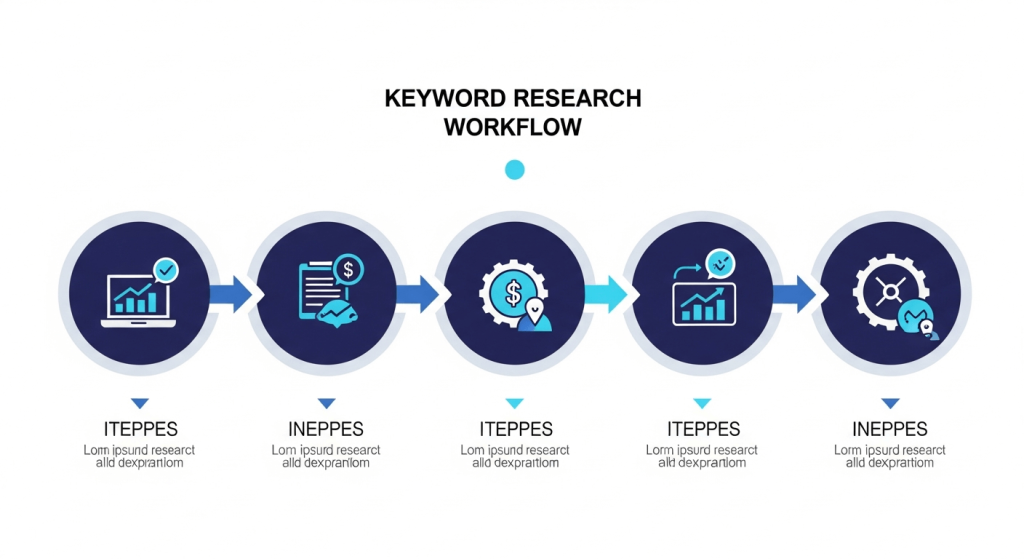
The Keyword Research Process With AI Tools

Here’s how AI streamlines the keyword research workflow:
Step 1: Seed Keyword Input
You begin by entering a single keyword or topic relevant to your business.
Step 2: Intelligent Expansion
The AI instantly generates hundreds or thousands of related keywords using pattern recognition from search data. Rather than simple word combinations, the tool identifies keywords that actually appear in real search queries.
Step 3: Intent Classification
Each keyword receives automatic classification: Informational (users seeking knowledge), Transactional (users ready to buy), Commercial (users comparing options), or Navigational (users seeking specific sites). This classification ensures you target keywords matching your content goals.
Step 4: Semantic Clustering
Related keywords automatically group into clusters revealing natural content gaps and pillar-cluster relationships for your content strategy.
Step 5: Difficulty and Opportunity Analysis
AI algorithms assess keyword difficulty by analyzing:
- Backlink profiles of ranking pages
- Domain authority of competing sites
- Content freshness and update frequency
- SERP feature competition
- Your own domain’s relative strength
Step 6: Predictive Performance Scoring
The tool assigns predicted performance metrics showing search volume, trend direction, and ranking difficulty—helping you prioritize the keywords most likely to drive results.
Key Features of Modern AI Keyword Research Tools
Search Intent Analysis
Understanding why users search is often more valuable than knowing what they search for. Modern AI keyword research tools classify intent with remarkable accuracy by analyzing:
- Query structure and modifiers
- Live SERP results for each keyword
- User behavior signals like CTR and time on page
- Content types currently ranking
This enables precise content matching—ensuring your informational article targets informational queries, product pages target commercial queries, and so on.
Long-Tail Keyword Discovery
AI excels at uncovering long-tail keywords—specific, multi-word phrases with lower search volume but higher conversion intent. These keywords are often underutilized by competitors despite driving substantial traffic.
Modern AI tools identify long-tail opportunities by analyzing:
- Google Autocomplete suggestions
- Related searches
- “People Also Ask” sections
- Voice search query patterns
- Reddit and forum discussions showing real user language
A single seed keyword like “project management” expands into hundreds of long-tail opportunities:
- “Best project management tools for remote teams”
- “Free project management software for small startups”
- “Project management tools that integrate with Slack”
- “How to choose the right project management platform”
Keyword Clustering and Content Planning
Rather than forcing you to manually organize keyword lists, AI automatically clusters related keywords based on semantic similarity. This automatically reveals your content strategy.
Where traditional tools force you to decide manually which keywords deserve their own content, AI clustering shows:
- Which keyword groups justify dedicated pillar pages
- Which subtopic clusters require supporting content pieces
- How to structure internal linking between related content
- Semantic relationships for anchor text optimization
Competitor Keyword Analysis
AI keyword research tools analyze competitor websites to reveal:
- Which keywords they rank for
- Estimated traffic driven by each keyword
- Content gaps where they don’t rank
- Opportunities where you might outrank them
This competitive intelligence answers critical strategic questions:
- Are we targeting the right keywords?
- What keywords are we missing that competitors rank for?
- Where are our opportunities to gain market share?
- Which competitor strategies are working?
Predictive Trend Analysis
One of AI’s most powerful capabilities is forecasting which keywords will trend before they reach peak popularity. Rather than chasing trends after they’ve already peaked, AI tools identify emerging opportunities by:
- Analyzing historical trend patterns
- Identifying cyclical seasonal patterns
- Correlating external events with search interest
- Evaluating competitor strategy shifts
This predictive capability lets you create content before trends peak, capturing first-mover advantage.
Content Optimization Recommendations
Advanced AI tools integrate keyword research with content optimization, providing real-time recommendations like:
- Optimal content length for the target keyword
- Recommended keyword frequency and placement
- Heading structure and organization
- Related keywords and semantic variations to include
- SERP features you should target (featured snippets, People Also Ask, etc.)
Top AI Keyword Research Tools in 2025

Semrush: Best All-in-One Solution
Pricing: Starting at $139.95/month | Best For: Enterprise teams and SEO professionals
Semrush leads the market with access to over 25 billion keywords across 142 countries. Its Keyword Magic Tool transforms a single seed keyword into thousands of organized options grouped by topic and search intent.
Why Semrush Excels:
- Personalized metrics showing how your domain will rank for specific keywords
- AI-powered content recommendations based on SERP analysis
- Competitor analysis revealing their keyword strategies and performance
- Real-time SERP analysis showing current ranking requirements
- Integration with content editor enabling optimization while writing
The platform’s AI capabilities help identify semantic keywords, analyze user intent, and predict ranking potential. While the learning curve is steeper than simpler tools, the depth of data and insights justifies the complexity for serious marketers.
Ahrefs: Best for Multi-Search-Engine Analysis
Pricing: Starting at $99/month | Best For: Content strategists and SEO agencies
Ahrefs maintains one of the largest keyword databases and excels at providing insights across multiple search engines. The Keywords Explorer tool generates keyword suggestions while showing search intent classification.
Key Strengths:
- AI-powered intent insights classifying keywords accurately
- Multi-search-engine data including Google, YouTube, and others
- Content gap analysis identifying keywords competitors rank for that you don’t
- Keyword difficulty scoring assessing ranking potential
- Content performance metrics showing which content types work for each keyword
Ahrefs particularly excels for agencies managing multiple client accounts and larger businesses wanting comprehensive competitive intelligence.
Moz Pro: Best for Domain & Keyword Insights
Pricing: Starting at $49/month | Best For: Beginners and small businesses
Moz democratizes professional-grade keyword research with an approachable interface and fair pricing. The company recently introduced Moz AI tools, adding AI-powered intent insights and domain analysis.
Moz Advantages:
- Beginner-friendly interface with clean, intuitive design
- Accurate difficulty scoring based on domain metrics
- AI intent insights in the Keyword Explorer
- Affordable entry price making professional tools accessible
- Educational resources helping users master keyword research
Moz balances affordability with professional-grade capabilities, making it ideal for businesses stepping up from free tools.
Surfer SEO: Best for Integrated Content Optimization
Pricing: Starting at $79/month | Best For: Content creators and writers
Surfer SEO uniquely integrates keyword research with real-time content optimization. Rather than researching keywords separately then manually optimizing content, Surfer combines both in a seamless workflow.
Surfer’s Unique Value:
- Keyword research in the content editor eliminating constant tool-switching
- Real-time content scoring showing optimization progress as you write
- AI-powered recommendations for keyword placement and semantic variations
- SERP-based optimization briefs showing exactly how to structure content
- Automatic keyword integration suggestions while maintaining natural language
For writers and content creators who want keyword research integrated into the writing process, Surfer eliminates friction and improves efficiency dramatically.
Keyword Insights: Best for Advanced Clustering
Pricing: Starting at $49/month | Best For: Content strategists and large-scale keyword mapping
Keyword Insights specializes in using natural language processing and machine learning to organize thousands of keywords into meaningful clusters automatically.
Key Features:
- NLP-powered clustering organizing keywords by semantic similarity and intent
- Content score indicating ranking potential for existing content
- Golden Filter allowing custom filtering by difficulty, volume, and trends
- Competitor analysis identifying content gaps by comparing keyword coverage
- Workflow integration supporting team collaboration and project management
This tool excels when managing massive keyword lists requiring sophisticated organization and insight.
Google Keyword Planner: Best for Paid Search & Beginners
Pricing: Free (requires Google Ads account) | Best For: PPC campaigns and beginners
Google Keyword Planner, though primarily designed for paid search, remains valuable for organic research. It provides Google’s own data about search volume and competition.
When to Use It:
- Direct access to Google’s search volume data
- Competitor keyword discovery for paid search campaigns
- Budget estimation for PPC campaigns
- Quick research without complex features
While it lacks the AI sophistication of premium tools, Google Keyword Planner serves as a reliable foundation for basic research.
ChatGPT & AI Language Models: Best for Creative Ideation
Pricing: Free (GPT-4o mini) or $20/month (Pro) | Best For: Initial brainstorming and semantic keyword expansion
Large language models like ChatGPT represent an emerging frontier in keyword research. They excel at natural language keyword brainstorming, understanding context, and identifying semantic relationships.
Using LLMs for Keyword Research:
Simply describe your topic or business goal, and ChatGPT generates dozens of semantically related keywords instantly. Ask follow-up questions to refine search intent or explore specific angles. Combine LLM suggestions with dedicated keyword research tools for comprehensive coverage.
While LLMs lack search volume data and ranking difficulty metrics, they provide creative keyword ideation and semantic analysis unmatched by traditional tools.
Benefits of Using AI Keyword Research Tools
Dramatic Time Savings
Manual keyword research is painstakingly slow. Analyzing each keyword’s search volume, difficulty, and intent individually takes hours. AI tools compress this process from days to minutes—40% reduction in research time according to data from WordStream.
This time savings multiplies across an organization. A marketer spending 8 hours per week on keyword research gains back a full workday by implementing AI tools, allowing investment of that time in higher-value strategy work.
Superior Accuracy and Reduced Risk
Human researchers inevitably miss keyword opportunities and occasionally misclassify search intent. AI tools process vastly more data and apply consistent logic, reducing errors and identifying blind spots.
Rather than missing a high-potential keyword because it wasn’t on your competitor’s radar, AI analyzes millions of search queries to surface opportunities humans would never discover manually.
Predictive Insights & Trend Forecasting
The most transformative AI capability is predictive intelligence—identifying keywords trending upward before reaching mainstream adoption. This forward-looking analysis allows creating content for tomorrow’s searches rather than yesterday’s.
Businesses using predictive keyword intelligence gain first-mover advantage, capturing search traffic before competitors even realize the opportunity exists.
Better Search Intent Alignment
One critical advantage of AI intent analysis: ensuring content precisely matches what searchers actually want. Studies show a 30% increase in sales revenue when content precisely matches search intent.
Rather than guessing whether “project management software” users want tutorials, product comparisons, or vendor lists, AI analyzes current rankings to show exactly what content type Google favors.
Scalability for Large Operations
For enterprise marketers managing hundreds of keywords and multiple business units, manual organization becomes impossible. AI clustering automatically organizes thousands of keywords into coherent strategies, making large-scale keyword research manageable.
Using AI Keyword Research Tools Effectively
Combining AI Tools With Human Expertise
While AI excels at processing data and identifying patterns, human judgment remains essential. The most successful strategies combine:
- AI for data analysis and pattern recognition
- Human judgment for strategy and context
- AI for scalability and speed
- Human creativity for unique content angles
Rather than viewing AI and human expertise as competing approaches, think of them as complementary. AI identifies opportunities; humans evaluate strategic fit.
Building Your Content Strategy Around Keyword Clusters
Let AI’s clustering capabilities guide your content architecture. Rather than creating individual articles for every keyword, organize content around clusters addressing entire topic areas:
Step 1: Identify a pillar topic aligned with your business goals
Step 2: Use AI clustering to identify subtopics and related keywords
Step 3: Create a pillar page comprehensively covering the main topic
Step 4: Develop cluster content pieces addressing each subtopic
Step 5: Link cluster content back to the pillar page using semantic anchor text
This cluster-based approach establishes topical authority while efficiently addressing multiple keyword opportunities.
Balancing Quick Wins With Long-Term Opportunities
AI tools simultaneously identify:
- Quick-win keywords with low difficulty and decent volume (rank quickly)
- Strategic keywords with higher difficulty but greater long-term value
Balancing both approaches ensures immediate SEO wins while building authority for competitive keywords. A sustainable strategy typically targets 40% quick wins and 60% strategic opportunities.
Monitoring Keyword Performance & Trend Changes
Keyword research isn’t a one-time activity. Regularly re-analyze keywords using AI tools to:
- Identify emerging opportunities
- Monitor difficulty changes indicating rising competition
- Discover seasonal patterns affecting search volume
- Spot declining keywords no longer worth targeting
Quarterly keyword audits using AI tools ensure your strategy stays aligned with changing search behavior.
AI Keyword Research Tools for Specific Business Types
E-Commerce & Product-Based Businesses
For online retailers, AI keyword research tools excel at identifying commercial intent keywords—search queries where users are actively ready to buy. These tools also:
- Identify product-specific long-tail keywords
- Analyze competitor product page keyword targeting
- Discover seasonal keyword trends affecting sales
- Reveal price-related search intent
Focus on keywords mixing product names with intent modifiers: “best,” “cheap,” “vs.,” reviews,” etc.
Service-Based Businesses & Local SEO
Service providers need AI tools that understand local intent. Modern AI tools recognize geographic modifiers and help identify:
- Location-specific search patterns
- Service type variations by region
- Local competitor keyword strategies
- Seasonal demand fluctuations affecting service searches
Voice search optimization becomes critical for local businesses, as 58% of voice searches target local information.
Content & Information Websites
Publishers and educational sites benefit from AI tools that excel at identifying informational intent keywords. Focus AI research on:
- Question-based keywords users actively search for
- Topic clusters enabling pillar-cluster content architecture
- Emerging topics gaining search interest
- Seasonal editorial planning opportunities
SaaS & B2B Companies
SaaS and B2B marketers leverage AI tools to target commercial-intent keywords indicating purchasing consideration:
- Feature-specific keywords showing buying intent
- Comparison keywords targeting research-phase users
- Integration keywords indicating feature preferences
- Industry-specific terminology and variations
AI intent classification helps distinguish between general interest searches and high-intent queries most likely to convert.
Common Challenges and Solutions
Challenge: Overwhelming Keyword Options
Solution: Use AI clustering to automatically organize keywords into meaningful groups. Rather than facing thousands of unorganized keywords, let AI group them by intent and semantic similarity. Start with broad clusters and progressively narrow focus.
Challenge: Difficulty Assessing Ranking Potential
Solution: Use AI difficulty scoring as one input among many. Rather than relying solely on difficulty scores, analyze what content currently ranks—content type, length, update frequency, and backlink profile. AI tools excel at synthesizing this analysis into actionable insights.
Challenge: Keeping Up With Search Algorithm Changes
Solution: Treat keyword research as an ongoing process, not a one-time activity. Quarterly reviews using AI tools reveal algorithm changes affecting keyword difficulty, ranking requirements, and search intent interpretation.
Challenge: Balancing Keyword Optimization With Natural Writing
Solution: Let AI provide optimization recommendations while maintaining natural language. Modern AI understands semantic variations, allowing natural integration of keywords without forced repetition. Write for humans first; use AI suggestions to ensure search engine visibility secondarily.
AI Keyword Research Tools: The Future Outlook
Emerging Trends in 2025 and Beyond
Voice Search Optimization: As voice queries now represent 20.5% of global searches and are projected to grow, AI tools increasingly specialize in voice-optimized keyword targeting. Voice queries average 3-5 words longer than typed searches and use more natural, question-based language.
Visual & Multimodal Search: AI keyword research is expanding beyond text to include visual search optimization. With more users performing image-based searches, tools are beginning to identify visual keyword opportunities.
Real-Time Personalization: AI tools increasingly incorporate real-time personalization data, helping marketers understand how keywords vary by user demographics, location, and search history.
Semantic Web Integration: As the semantic web matures and knowledge graphs become more sophisticated, AI keyword research integrates deeper semantic understanding. Rather than discrete keywords, future tools will help optimize for entire knowledge entities and their relationships.
The Competitive Advantage of Early Adoption
Businesses implementing AI keyword research tools in 2025 gain significant competitive advantages. As the technology becomes table stakes across industries, those who delay adoption will find themselves increasingly outcompeted by rivals using superior research and optimization strategies.
Featured Snippet Opportunity
Question: What’s the biggest advantage of AI keyword research tools over manual methods?
Answer: AI keyword research tools analyze millions of search queries instantly to identify patterns, intent, and opportunities humans would miss manually. They provide 40% faster research time, predictive trend forecasting, accurate intent classification, and automatic semantic clustering—enabling strategies impossible to develop manually while simultaneously reducing the time investment required. The combination of speed, accuracy, and scalability makes AI tools essential for competitive keyword research in 2025.
Frequently Asked Questions
Q1: Do I need to use AI keyword research tools if I’m just starting with SEO?
A: Not immediately, but they accelerate learning. Free tools like Google Keyword Planner and AnswerThePublic are excellent starting points. Once you understand fundamental concepts, AI tools like Moz Pro or Ubersuggest provide dramatically better insights at reasonable prices. Think of them as investments that accelerate results.
Q2: How do AI keyword tools handle seasonal keyword trends?
A: Modern AI tools analyze historical search volume patterns to identify seasonal fluctuations. They show volume trends throughout the year, helping you plan seasonal content and advertising. Some tools even predict seasonal volume changes based on historical patterns, enabling proactive content planning.
Q3: Can AI keyword tools identify opportunities my competitors aren’t targeting?
A: Yes, this is one of AI’s greatest strengths. AI tools analyze millions of search queries beyond what your competitors probably track. They identify long-tail opportunities competitors miss, emerging trends before mainstream adoption, and specific intent variations competitors haven’t addressed—revealing market gaps and white-space opportunities.
Q4: How accurate is AI difficulty scoring when predicting ranking potential?
A: AI difficulty scoring is fairly accurate for general guidance but should be one input among several. Factors like content quality, backlink profile, domain authority, and search intent interpretation also affect ranking potential. Use AI difficulty as a starting point, then analyze top-ranking content directly to assess real ranking requirements.
Q5: Should I optimize for keywords identified by AI tools or stick with competitor keywords I manually research?
A: Ideally, both. Use AI tools to identify competitor keywords they’re targeting, then expand with AI-discovered opportunities competitors might be missing. The best strategies combine validated competitor keywords (proven to drive traffic) with innovative AI-discovered opportunities (capturing emerging demand).
Q6: How often should I re-run keyword research using AI tools?
A: For competitive industries, quarterly keyword audits using AI tools keep strategies aligned with changing search behavior. For less competitive niches, annual reviews may suffice. Monitor keyword performance monthly, but allow 3-4 months between major strategic keyword research cycles to avoid constant strategy thrashing.
Q7: Can small businesses afford professional AI keyword research tools?
A: Absolutely. Options like Moz Pro ($49/month), Ubersuggest (free with upgrade option), and Google Keyword Planner (free) make professional keyword research accessible to any business size. While enterprise tools like Semrush cost more, they serve organizations with substantial research needs.
Conclusion: Embracing AI for Keyword Research Success

AI keyword research tools represent a fundamental transformation in how businesses approach SEO. Rather than guessing which keywords matter, marketers now have data-driven intelligence revealing exactly where search opportunities exist and why users search for them.
The statistics are compelling: 86% of SEO professionals already use AI in their strategies, businesses see 30% sales increases through better intent analysis, and marketers save 40% of their research time. These aren’t marginal improvements—they’re transformational capabilities that fundamentally improve competitive positioning.
The shift toward AI doesn’t diminish human expertise. Instead, it amplifies it. AI handles massive-scale data analysis, pattern recognition, and optimization suggestions. Humans apply strategic judgment, creative thinking, and business context. Together, they create keyword research strategies that purely manual approaches cannot achieve.
Whether you’re managing enterprise SEO, running a growing e-commerce business, or building a content site, investing in AI keyword research tools should rank among your highest SEO priorities. The competitive advantage gained through superior keyword identification, accurate intent analysis, and predictive trend spotting justifies the investment across virtually any business model.
Start exploring AI keyword research tools today. Most major platforms offer free trials allowing you to experience the capabilities firsthand. Choose based on your business size, budget, and specific needs. Then build your content strategy around AI-identified keyword opportunities. The businesses that embrace this technology in 2025 will establish search dominance that persists for years to come.