


Writing performance reviews ranks among the most time-consuming and challenging tasks for managers. According to recent data, 31% of managers and 26% of employees cite excessive time consumption as their primary complaint about the review process. Companies with 10,000 employees spend between $2.4 to $35 million annually conducting traditional performance reviews, often with minimal positive impact on employee performance. This is where AI for writing performance reviews transforms the landscape, offering managers intelligent solutions that streamline feedback while maintaining fairness and accuracy.
Modern artificial intelligence technology has revolutionized how organizations approach performance management. Rather than spending weeks gathering notes and crafting reviews from scratch, managers can now leverage the best AI for writing performance reviews to generate professional, objective feedback in minutes. This comprehensive guide explores the most effective AI tools available, their unique features, pricing structures, and how they address critical challenges like unconscious bias and recency bias that plague traditional reviews. Whether you manage a small team or oversee an enterprise organization, understanding these AI-powered solutions will help you create fairer, more impactful performance evaluations that genuinely improve employee engagement and development.
The Performance Review Crisis: Why AI Matters
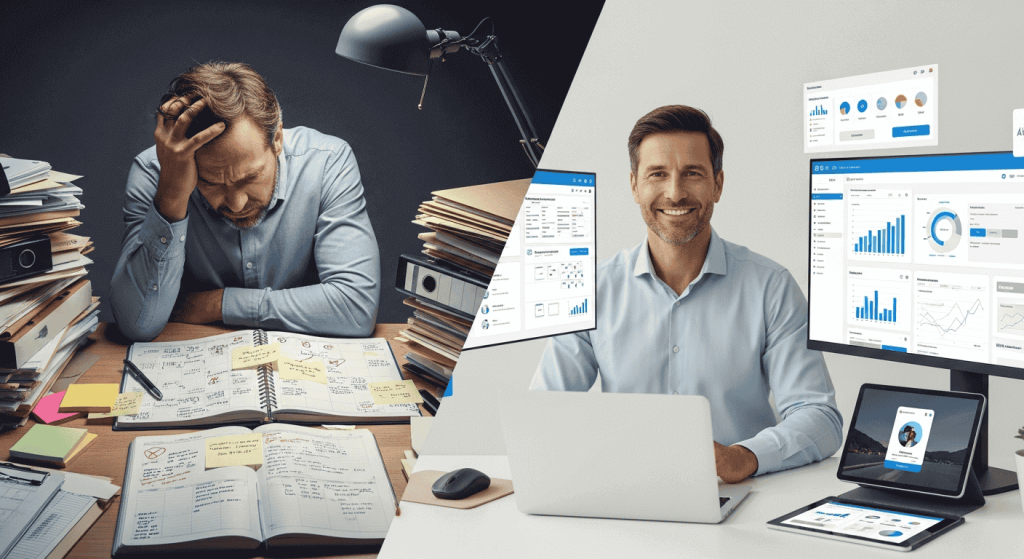
Understanding the Traditional Review Problem
The conventional annual performance review model has become increasingly untenable in modern workplaces. Only 14% of employees strongly agree their performance reviews inspire them to improve, according to Gallup research. Furthermore, 95% of managers express dissatisfaction with their company’s performance appraisal system, revealing a widespread disconnect between intention and execution.
The administrative burden alone creates substantial challenges. Managers must navigate multiple data sources—emails, project management systems, chat conversations, and fragmented notes—to reconstruct an entire year of employee performance. This fragmented approach introduces significant gaps and inaccuracies. Additionally, traditional reviews suffer from recency bias, where managers disproportionately weight recent events while overlooking consistent performance throughout the evaluation period.
Statistical Evidence for AI Solutions
Current research demonstrates compelling reasons to embrace AI-powered performance review tools. According to SuperAGI analysis, AI-powered systems improve productivity by 15% and reduce errors by 20% compared to traditional methods. Organizations implementing these solutions report measurable improvements:
- 85% of organizations using AI-powered performance management tools report increased employee engagement
- 75% of organizations report improved goal achievement
- 60% of organizations see reductions in bias and errors
- 63% of companies using AI for performance reviews report improvements in employee engagement and productivity
- AI-powered bias detection tools can reduce bias in performance evaluations by up to 30%
These statistics underscore a fundamental truth: AI for writing performance reviews isn’t just a convenience—it’s a strategic necessity for organizations committed to fair, efficient talent management.
How AI Performance Review Tools Work
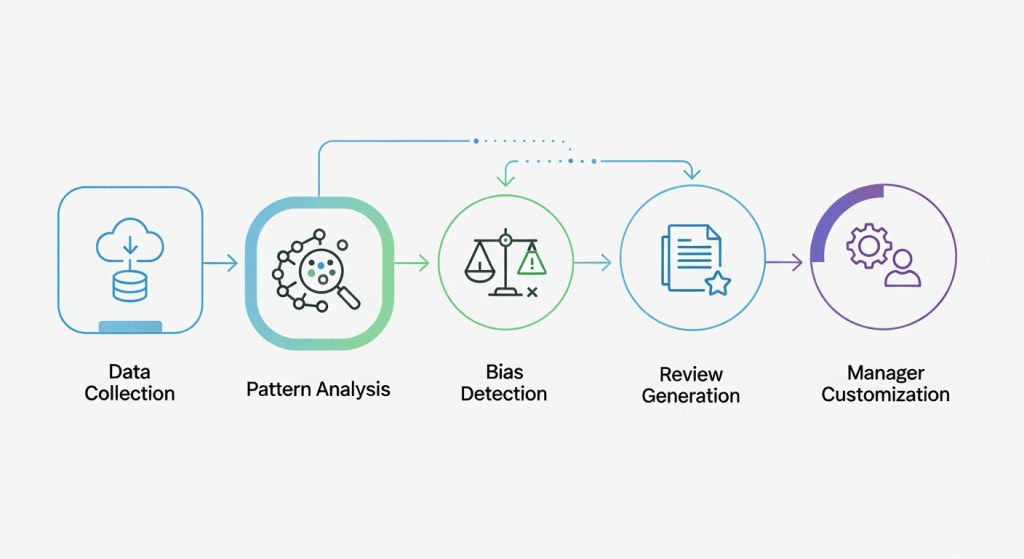
Core Technology Behind AI Review Generators
Modern AI systems designed for performance reviews leverage sophisticated natural language processing (NLP) and machine learning algorithms to analyze performance data from multiple sources. These systems work by:
Aggregating Performance Data: AI tools automatically collect information from employee feedback, peer reviews, manager observations, and quantifiable metrics like sales figures or project completion rates. This comprehensive data gathering eliminates the gaps inherent in manual review processes.
Analyzing Patterns and Trends: Advanced algorithms identify patterns in employee behavior and performance over extended periods, helping managers recognize consistent strengths and areas for development rather than recent fluctuations.
Generating Draft Content: Large language models (LLMs) synthesize performance data into coherent, professional review language that captures nuance while maintaining objectivity. Users can then customize these drafts to reflect their unique organizational culture and specific employee circumstances.
Detecting Bias in Real-Time: Natural language processing analyzes language patterns to identify potentially biased terminology, discriminatory phrasing, or unequal treatment across different employee groups. This feature addresses one of the most persistent challenges in performance management.
The Role of Continuous Feedback Systems
Unlike traditional once-yearly reviews, sophisticated AI platforms now enable continuous feedback models. These systems use real-time performance tracking to monitor progress against goals throughout the evaluation period, reducing reliance on memory and subjective recollection. When combined with automated check-ins scheduled at regular intervals, continuous feedback prevents the recency bias that undermines traditional annual reviews.
Top AI Tools for Writing Performance Reviews in 2025
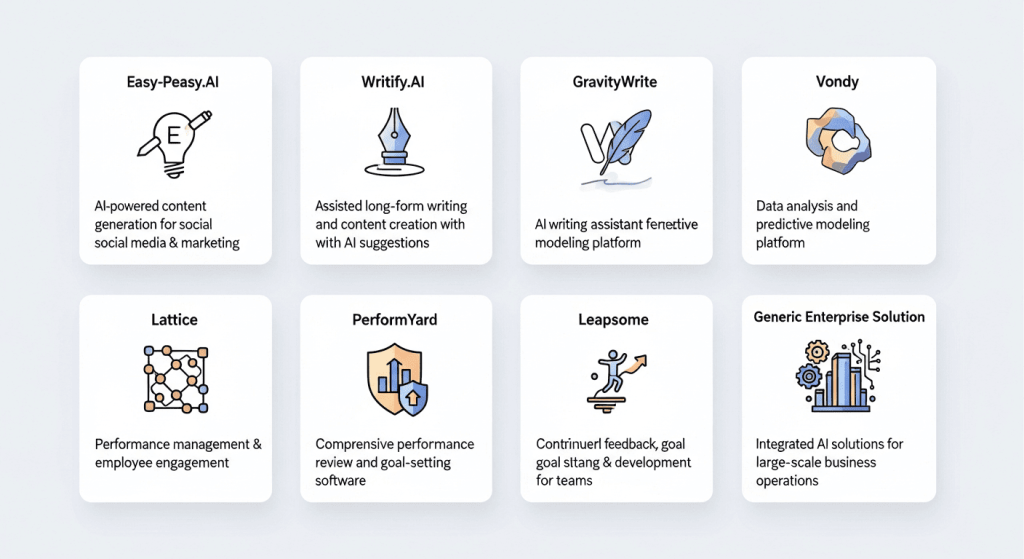
1. Easy-Peasy.AI: Best for Language Versatility
Overall Score: 3.63/5
Easy-Peasy.AI distinguishes itself through exceptional multilingual capabilities, supporting over 40 languages for performance review generation. This makes it particularly valuable for organizations managing globally distributed teams.
Key Features:
- Multilingual review generation with natural phrasing
- Point-of-view modification tool that adjusts writing perspective
- Dictation support for managers who prefer voice input
- Customizable data fields for different review types
Standout Advantages:
The dictation feature proves invaluable for managers juggling multiple priorities. Rather than typing notes, managers can dictate accomplishments and improvement areas using natural language, which the AI then transforms into polished review language.
Limitations:
Daily generation limits restrict free users to two reports per day. Advanced AI features remain exclusive to paid plans, and some data fields have character restrictions that may frustrate users managing complex situations.
Best For: International teams requiring multilingual review support and managers preferring voice-based input methods.
2. Writify.AI: Best for Tone Customization
Overall Score: 3.49/5
Writify.AI excels at what many AI tools struggle with: maintaining consistent, adaptable tone throughout performance reviews. Managers often face the challenge of balancing professionalism with encouragement—Writify.AI automates this balance.
Key Features:
- Tone adjustment with instant regeneration
- In-app editing with formatting options (bold, italic, lists)
- PDF export functionality for easy sharing
- Professional polish requiring minimal manual editing
Standout Advantages:
When managers need to shift review tone—making a developmental conversation warmer or a critical assessment more direct—Writify.AI regenerates the entire review instantly with the requested tone. This eliminates time spent rephrasing and ensures consistency across multiple reviews using the same tone parameters.
Limitations:
Input flexibility lags behind competitors, and some users report needing to adjust generated content more frequently than with alternative tools.
Best For: Managers seeking to maintain consistent, professional tone across multiple reviews while preserving the human elements of encouragement and constructive feedback.
3. Vondy: Best for Structured Feedback
Overall Score: 3.31/5
Vondy stands out for its pre-built performance review structures, eliminating the blank-page problem many managers face when starting reviews from scratch.
Key Features:
- Four pre-built review types: quarterly, annual, self-evaluation, and peer review
- Image upload capability for visual context
- Structured report formatting that adjusts based on review category
- Flexible customization within predefined frameworks
Standout Advantages:
The pre-built review categories provide organizational scaffolding that guides managers through the process. When selecting the quarterly review template, Vondy automatically structures the output appropriately, removing decision fatigue from the review-writing process.
Limitations:
Generic content appears when using pre-built options without fully populating input fields. The tool performs best when managers provide detailed feedback notes rather than relying solely on template structures.
Best For: Organizations with standardized review cycles (quarterly, annual) and managers who appreciate structural guidance throughout the writing process.
4. GravityWrite: Best for In-App Formatting
Overall Score: 3.11/5
GravityWrite delivers sophisticated formatting capabilities directly within the platform, eliminating the common workflow of copying generated content into separate documents for final editing.
Key Features:
- Rich text editing with formatting options (headers, lists, bold, italic)
- Image integration capabilities
- Direct formatting without external tools
- Export options in multiple formats
Standout Advantages:
Managers can finalize reviews entirely within GravityWrite‘s interface, adjusting headers sizes, restructuring bullet points, and formatting emphasis without switching between applications. This seamless workflow significantly reduces the time between generation and distribution.
Limitations:
Output quality sometimes requires more manual adjustment than competing platforms. The formatting capabilities, while powerful, occasionally result in generic content that needs substantial customization.
Best For: Teams prioritizing workflow efficiency and managers who want to complete reviews without toggling between multiple software applications.
5. Lattice: Comprehensive Enterprise Solution
Pricing: $8–$11 per user/month
Lattice represents the enterprise-grade approach to AI performance management, integrating review writing with comprehensive talent management functionality.
Key Features:
- AI-powered feedback summaries condensing entire review cycles
- AI writing assistant suggesting phrasing for manager comments
- Advanced analytics identifying engagement drivers
- Customizable templates and workflows
- Seamless integration with existing HRIS systems
- Nine-box grids and succession planning tools
Standout Advantages:
Lattice’s analytics capabilities extend beyond individual reviews, identifying patterns across teams and departments. Organizations using Lattice gain insights into whether specific departments show gender pay gaps, whether certain manager groups exhibit consistent biasing patterns, or whether particular employee segments experience different performance rating distributions.
Best For: Mid-size to enterprise organizations needing configurable, end-to-end talent management with robust analytics and integration capabilities.
6. PerformYard: Best Value for Growing Companies
Pricing: $5–$10 per user/month
PerformYard balances affordability with substantial functionality, making it ideal for scaling organizations that want enterprise-grade features without premium pricing.
Key Features:
- AI Review Assist for real-time writing suggestions
- Custom review cycles and flexible templates
- 360-degree feedback collection
- Goal and OKR tracking
- Performance calibration tools
- Anonymous feedback options
- Detailed reporting and analytics
Standout Advantages:
PerformYard’s pricing transparency and modular approach allow organizations to add features as needed. The platform includes all core performance management features in base pricing, with optional add-ons for 1:1 meeting management and engagement surveys—no hidden fees or forced bundling.
Best For: Small to mid-size organizations seeking professional-grade performance management at accessible pricing with flexible implementation.
7. Leapsome: All-in-One People Enablement
Pricing: Competitive mid-market pricing
Leapsome bundles performance reviews with engagement surveys, learning management, and feedback tools—creating a comprehensive people-enablement platform.
Key Features:
- AI Review Assistant autocompleting detailed review statements
- Competency framework analysis mapping feedback to skill gaps
- Learning recommendations tied to development plans
- Peer and manager feedback integration
- Performance and engagement data consolidation
Standout Advantages:
Leapsome uniquely connects review outcomes directly to learning recommendations. When a review identifies skill gaps, Leapsome automatically suggests relevant training modules, creating a seamless pathway from performance assessment to professional development.
Best For: High-growth scale-ups wanting consolidated performance, engagement, and learning management in a single user-friendly platform.
8. PerformYard AI Review Assist
Integrated AI Capability
PerformYard‘s AI Review Assist demonstrates the capabilities emerging in mid-market performance management software, helping managers overcome writer’s block and maintain consistent feedback quality.
Key Features:
- Real-time writing suggestions as managers compose reviews
- Bias detection flagging potentially discriminatory language
- Tone adjustment recommendations
- Consistency checking across multiple reviews
- Natural language processing for professional phrasing
Advanced Features: Bias Detection and Mitigation
How AI Detects Bias in Performance Reviews
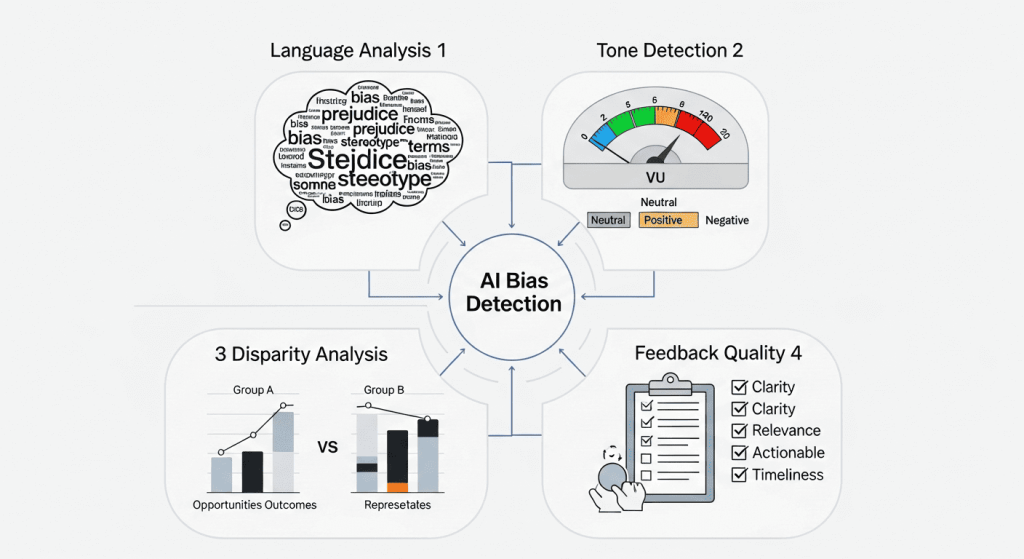
One of the most significant contributions AI brings to performance management is systematic bias detection. Traditional reviews rely on individual manager awareness—an inherently unreliable approach. AI systems detect bias through multiple mechanisms:
Language Analysis: AI examines vocabulary choices, identifying stereotypical or discriminatory language. Terms like “aggressive” applied to male employees but “pushy” for female employees, or “enthusiastic” versus “emotional” reveal subtle gender biases. Similarly, age-related assumptions, cultural stereotypes, or ability-based language become visible through computational analysis.
Tone Detection: Natural language processing analyzes emotional undertones—anger, frustration, sarcasm, or dismissiveness—that might indicate bias. An employee’s identical achievement might receive praise when written by one manager and skepticism when written by another, revealing inconsistent standards.
Disparity Analysis: AI algorithms compare evaluation patterns across employee demographics, identifying whether certain groups systematically receive lower ratings, fewer development opportunities, or harsher language. Gender, racial, age, and ability-based disparities become statistically apparent.
Constructive Content Analysis: AI evaluates whether feedback provides specific examples, actionable advice, and positive reinforcement—or whether reviews lack these elements. Research shows biased reviews often contain vague criticisms without concrete examples or development suggestions.
Real-World Impact of Bias Mitigation
Companies implementing AI-powered bias detection have experienced remarkable outcomes. Microsoft’s AI-powered performance analytics system identifies biased language and provides real-time feedback to managers, reducing discriminatory evaluation patterns. Google developed specialized AI tools for bias detection, resulting in measurably more fair and equitable evaluations. According to Harvard Business Review research, companies using AI-powered bias detection tools are 25% more likely to have diverse and inclusive workforces.
Addressing Recency Bias Through AI
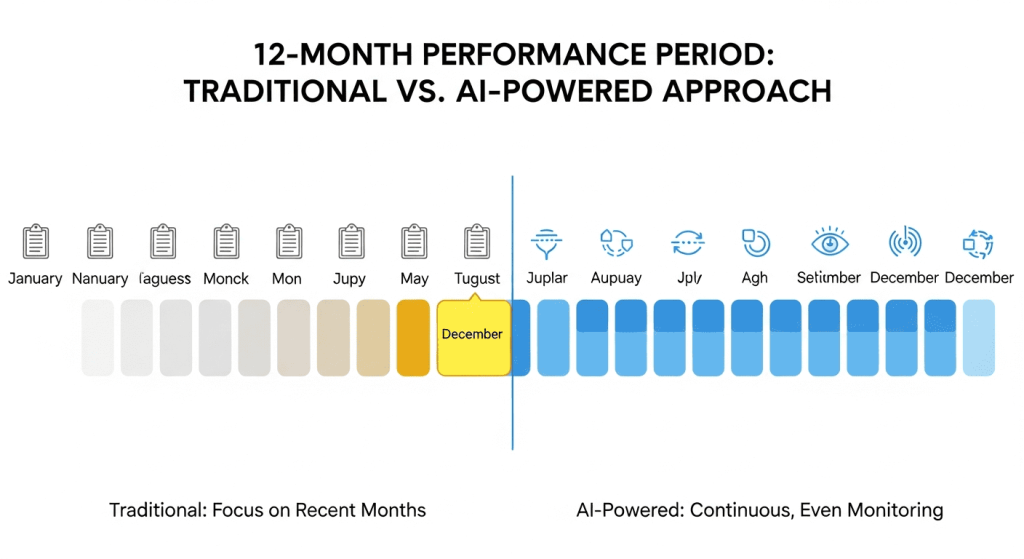
The Recency Bias Problem
Recency bias—the tendency to weight recent events disproportionately—represents one of performance management’s most persistent challenges. An employee with an exceptional nine-month track record who encounters a setback in October may face a negative annual review, despite overall strong performance. Conversely, an underperformer who excels in the final quarter may receive an inflated evaluation.
AI Solutions for Recency Bias
Sophisticated AI platforms address recency bias through continuous data collection and weighted analysis:
Extended Historical Analysis: Rather than relying on manager memory, AI systems maintain comprehensive performance records throughout the evaluation period. Windmill, a performance management platform, automatically generates weekly reports of accomplishments, creating a contemporaneous record that prevents later distortion.
Weighted Averaging: AI calculates performance metrics across the entire evaluation period rather than emphasizing recent months. This mathematical approach removes subjective judgment about what deserves emphasis.
Contextual Analysis: Advanced systems correlate performance with contextual factors. If an employee’s recent performance declined coinciding with a major project deadline or personal hardship, AI notes these contexts rather than interpreting them as performance indicators.
Behavioral Nudges: Some platforms send automated reminders to managers to document accomplishments and challenges throughout the year, preventing the scramble to reconstruct a year’s worth of data in review week.
Research confirms effectiveness: Organizations implementing continuous feedback models report 40% higher employee engagement and 26% better overall performance compared to traditional annual review approaches.
Enterprise Market Trends and Growth
Performance Management Market Expansion
The performance management software market reflects growing organizational recognition of review importance. The global performance management software market is projected to grow from $5.82 billion in 2024 to $12.17 billion by 2032, representing a compound annual growth rate of 9.7%. This expansion reflects several converging trends:
Cloud Adoption: Cloud-based solutions now represent 65% of market share, driven by remote work adoption and the need for real-time performance visibility regardless of location. Enterprise Performance Management Software specifically is projected to reach $5.53 billion in 2025 with a 4.37% annual growth rate through 2030.
AI Integration: Organizations increasingly prioritize AI-powered features. According to research, 71% of HR professionals believe AI will play a significant role in performance management by 2025, with implementation accelerating across organizations of all sizes.
Continuous Feedback Shift: The movement away from annual reviews accelerates. Back in 2016, 82% of companies relied on annual reviews. By 2019, this had dropped to 54%. Today, continuous feedback models dominate leading organizations’ strategies.
Practical Implementation Guide
Step 1: Assess Your Current Challenges
Before selecting an AI tool, identify your organization’s specific pain points:
- Are managers overwhelmed by the time commitment?
- Do reviews reflect recency bias or other cognitive distortions?
- Do your reviews include potentially biased language?
- Are reviews inconsistent in quality and format across managers?
- Do employees report that reviews feel disconnected from reality?
Different tools address different challenges optimally. If bias reduction is primary, emphasize tools with advanced language analysis. If time savings matter most, prioritize platforms with strong automation.
Step 2: Evaluate Tool Fit
Consider these dimensions:
Integration Requirements: Does the tool connect with your existing HRIS, payroll, and collaboration software? Seamless integration prevents duplicate data entry and maintains information accuracy.
Ease of Use: Complex tools create adoption resistance. Evaluate user interface intuitiveness and the training required for adoption.
Customization Level: Some organizations need highly customizable processes; others prefer standardized approaches. Match tool flexibility to organizational preferences.
Reporting Capabilities: Determine what analytics matter most—aggregate performance distributions, departmental comparisons, diversity metrics, or succession planning insights.
Step 3: Pilot Implementation
Begin with a department or manager group rather than organization-wide rollout. This approach allows for refinement before full implementation, identifies unforeseen challenges, and builds internal champions who can advocate for broader adoption.
Step 4: Train Managers on Effective Use
AI tools amplify the effectiveness of good management practices while sometimes amplifying poor ones. Train managers on:
- How to input meaningful performance data
- Interpreting AI-generated suggestions
- Using bias detection feedback to improve their own practices
- Combining AI output with human judgment
- Maintaining review authenticity and specificity
Performance Reviews and Legal Compliance
Legal Risks of Inadequate Review Processes
Performance reviews carry significant legal implications. Poorly executed reviews increase litigation risk by providing evidence in employment discrimination, retaliation, and wrongful termination claims. Under Title VII of the Civil Rights Act, the Age Discrimination in Employment Act (ADEA), and the Americans with Disabilities Act (ADA), employers face liability when reviews exhibit inconsistency or bias.
Key legal principles include:
Consistency: Reviews applying different standards to similarly situated employees create discrimination liability. AI tools help by standardizing evaluation frameworks and flagging inconsistent application.
Documentation: Well-documented evaluations provide evidence of fair employee treatment and communication about performance issues. Vague, subjective reviews offer little legal protection.
Objectivity: Evaluations based on subjective criteria create litigation risk. Using objective, measurable criteria applied consistently reduces legal exposure. AI bias detection helps identify subjective, potentially biased language before reviews enter official records.
How AI Supports Legal Compliance
AI tools strengthen legal compliance by:
- Creating standardized evaluation frameworks applied consistently
- Documenting specific performance examples rather than vague assessments
- Flagging biased language before reviews reach permanent records
- Maintaining comprehensive performance histories showing fair treatment
- Removing inconsistencies across management teams
Common Challenges and Solutions
Challenge 1: Maintaining Authenticity
Problem: Concerns that AI-generated reviews sound generic or robotic.
Solution: Use AI as a starting point for refinement, not the final product. Managers should customize generated content with specific examples, unique contexts, and personal perspectives. The best results come from combining AI efficiency with managerial judgment and knowledge.
Challenge 2: Over-Reliance on AI
Problem: Concerns that managers will accept AI output without critical evaluation.
Solution: Organizations implementing AI tools successfully emphasize that technology augments human decision-making rather than replacing it. Training should stress that managers remain responsible for review accuracy, fairness, and appropriateness. AI provides tools, not final answers.
Challenge 3: Data Privacy and Security
Problem: Concerns about employee performance data stored in cloud systems.
Solution: Evaluate vendor security practices, including encryption, access controls, compliance certifications (SOC 2, ISO 27001), and data residency options. Leading platforms provide enterprise-grade security comparable to financial systems.
Challenge 4: Addressing Bias in System Design
Problem: AI systems themselves can perpetuate historical biases if trained on biased data.
Solution: Prioritize platforms where vendors have actively worked to identify and eliminate bias in AI models. Ask vendors directly about bias detection in their training data and ongoing bias audits. Research published findings about their bias mitigation work.
Frequently Asked Questions
Q1: Can AI write a complete performance review, or does it require manager input?
The best AI tools operate as collaborative partners rather than autonomous writers. They excel at synthesizing data, identifying patterns, and suggesting language—but managers must provide meaningful input about employee accomplishments, development areas, and goals. High-quality reviews result from managers providing specific examples and context that AI then refines into professional language. Managers who input generic or vague information receive generic output; detailed input generates detailed, customized reviews.
Q2: Does AI bias detection eliminate bias in performance reviews?
AI significantly reduces bias but doesn’t eliminate it entirely. AI detects language patterns suggesting bias and flags inconsistencies, but human bias can extend beyond language into the data itself. A manager might use neutral language while still making biased judgments about what accomplishments to recognize or credit. The most effective approach combines AI detection with managerial training about unconscious bias and organizational commitment to fair evaluation.
Q3: How much time does AI actually save in the review process?
Organizations typically report 30-50% time reductions in the writing phase. Some tools enable reviews to be completed in 15-20 minutes compared to 45-60 minutes using traditional approaches. The time savings come from AI handling data aggregation, structure creation, and initial drafting. Even these substantial savings represent partial time reduction—managers still need to personalize content and exercise judgment.
Q4: Can smaller organizations afford AI performance review tools?
Yes. Pricing has become accessible across organization sizes. Free or very low-cost options like Easy-Peasy.AI serve small teams and startups. Paid platforms range from $2.50-$11 per user per month depending on features and scale. Most platforms offer volume discounts for larger organizations. ROI calculations typically show that time savings alone justify the cost for organizations with even modest manager headcounts.
Q5: How do AI tools integrate with existing HR systems?
Leading platforms provide API integrations and pre-built connectors for popular HRIS systems like SAP SuccessFactors, Workday, BambooHR, and others. Integration enables seamless data flow—employee records, organizational hierarchies, goals, and historical performance data automatically populate AI tools. Before selecting a platform, verify integration with your existing systems to prevent duplicate data entry.
Q6: What training do managers need to use AI review tools effectively?
Essential training includes: how to input meaningful performance data rather than vague impressions, interpreting AI-generated content appropriately, recognizing and addressing bias suggestions, combining AI output with managerial judgment, and maintaining review authenticity. Most platforms provide user training, but organizations benefit from supplemental training addressing organizational norms around feedback quality and managerial expectations.
Q7: Do employees see reviews written with AI?
Employees typically see the final review, not the process used to generate it. From the employee perspective, AI involvement remains invisible—they receive professional, well-structured feedback. Some organizations choose to be transparent about using AI tools as part of commitment to fair, objective evaluation. This transparency can actually increase employee confidence in the process when paired with bias detection discussions.
Best Practices for AI-Enhanced Performance Management
1. Maintain Continuous Documentation
Don’t rely on AI to reconstruct performance from incomplete data. Managers should maintain ongoing documentation throughout the review period—notes on accomplishments, challenges, feedback from colleagues, and project outcomes. Better input data produces better AI-generated output and reduces recency bias.
2. Use AI for Standardization, Not Sameness
AI should create consistent frameworks and quality standards across reviews, not eliminate individual voice or context. Managers should customize generated content to reflect each employee’s unique situation, specific accomplishments, and particular development needs.
3. Combine AI with Human Judgment
The most effective reviews result from managers thoughtfully considering AI suggestions, accepting some, modifying others, and adding context AI cannot capture. This collaborative approach preserves the human element crucial to meaningful feedback while gaining AI’s efficiency and objectivity benefits.
4. Train Managers on Avoiding Common Pitfalls
Help managers understand how to avoid common mistakes with AI tools: providing vague input expecting detailed output, over-relying on generated language without customization, failing to provide specific examples, or accepting biased suggestions without questioning them.
5. Establish Quality Standards
Define what constitutes a high-quality review in your organization. Share examples of strong reviews generated with AI tools. Establish expectations around specificity, development focus, and constructive tone. Regular calibration sessions help managers align their AI use with organizational standards.
Conclusion: Transform Your Performance Management with AI

The evolution of performance management hinges on embracing tools that combine human judgment with technological precision. AI for writing performance reviews represents not a replacement for managerial expertise, but an amplification of it—freeing managers from administrative burden so they can focus on meaningful feedback and employee development.
Organizations implementing AI-powered performance review tools report measurable improvements: 85% increase in employee engagement, 30% reduction in bias, and 50% time savings in the review process. These aren’t marginal gains—they represent fundamental improvements in how companies recognize talent, develop capability, and build cultures of continuous feedback. The performance management software market’s projected growth from $5.82 billion in 2024 to $12.17 billion by 2032 reflects this widespread organizational recognition that technology-enhanced reviews are no longer optional—they’re becoming industry standard.
The path forward isn’t about choosing between traditional reviews and AI automation. Instead, it’s about leveraging AI as a strategic partner in creating fairer, more efficient, more meaningful performance management. The tools exist today. The frameworks are established. The only remaining question is whether your organization will lead this transformation or lag behind competitors who have already realized the productivity and engagement gains these solutions deliver.