


Sales teams spend an average of 3-8 hours writing a single proposal from scratch, yet many still miss deadlines and lose deals to faster competitors. The pressure to deliver high-quality proposals quickly has never been greater, especially in competitive markets where response time directly impacts win rates. This is where AI-powered proposal writing tools revolutionize the game.
An AI proposal writer isn’t just a time-saver—it’s a strategic advantage. These tools leverage artificial intelligence and machine learning to automate content creation, research, and formatting while maintaining your company’s unique voice and brand standards. According to a 2024 HubSpot survey of 1,000 B2B professionals, AI proposal writers reduce creation time by an average of 80%, allowing teams to respond to more opportunities and improve overall business outcomes.
Whether you’re a freelancer bidding on Upwork, a B2B service provider managing complex RFPs, or an enterprise handling high-volume government contracts, the right AI proposal tool can transform your entire sales process. This comprehensive guide explores the best AI tools available in 2025, their unique strengths, and how to choose the perfect fit for your team’s specific needs.
What is an AI Proposal Writer?
An AI proposal writer is software that uses artificial intelligence, natural language processing (NLP), and machine learning to automate and enhance the proposal creation process. Instead of starting with a blank page, these tools analyze your requirements, existing content libraries, and client information to generate customized, professional-quality proposals in minutes.
Modern AI proposal generators go far beyond simple content creation. They function as intelligent proposal management systems that combine research, writing, formatting, collaboration, and analytics into a single platform. The AI learns from your organization’s past proposals, identifying which approaches, language patterns, and solutions have historically led to winning deals.
Key capabilities include:
- Automatic content generation based on RFP requirements
- Intelligent research and citation management
- Real-time collaboration across teams
- Document tracking and client engagement analytics
- Compliance and formatting automation
- Integration with CRM and content management systems
Why AI Proposal Writing Tools Matter Now
The business landscape has shifted dramatically. Buyers expect faster responses, more personalized solutions, and professionally formatted documents. Manually writing proposals puts your team at a disadvantage, especially when competitors are leveraging AI to respond 60% faster.
Here’s what makes AI proposal tools essential in 2025:
Speed Without Quality Compromise: Traditional proposal writing is a bottleneck. With AI, teams generate comprehensive first drafts in minutes, not hours. This speed advantage allows you to pursue more opportunities and respond to time-sensitive RFPs that competitors might miss entirely.
Data-Driven Improvements: According to McKinsey research, businesses using AI-powered proposal systems experience a 33% higher win rate and 42% faster conversion times. These improvements stem from AI analyzing successful proposals to identify winning patterns, messaging approaches, and content strategies.
Consistency Across Documents: When multiple team members write proposals, brand voice and messaging often become inconsistent. AI ensures every proposal maintains your company’s tone, terminology, and formatting standards, reinforcing professionalism and credibility.
Reduced Human Error: AI grammar checkers and automated compliance checks catch mistakes that humans might miss—from outdated client names to formatting inconsistencies that could cost you deals.
Scalability: A 70-person proposal team spending 4 hours per proposal might generate 15 proposals monthly. With AI automation increasing output by 240%, that same team could handle 50+ proposals while maintaining quality. This scalability directly translates to more closed deals.
Top AI Tools for Proposal Writing in 2025
1. ChatGPT — Best for Research and Rapid Drafting
ChatGPT remains the most versatile AI tool for proposal research and content generation. It reached one million users within five days of launching in 2022 and continues to dominate as a flexible proposal writing assistant.
Key Strengths:
- Exceptional at gathering and synthesizing information from multiple sources
- Generates detailed, well-researched content that sounds natural
- Creates clear problem statements and research objectives
- Can draft entire proposal sections from bullet points or outlines
- Free tier available for basic usage
Best For:
- Freelancers and consultants working on multiple proposal types
- Teams needing research assistance and content brainstorming
- Budget-conscious businesses wanting to minimize software costs
Limitations:
- Requires precise, specific prompts to deliver optimal results
- Cannot produce industry-specific content without detailed human input
- No built-in proposal templates or formatting features
- Lacks integration with CRM or project management tools
Cost: Free tier; ChatGPT Plus ($20/month)
2. PandaDoc — Best for End-to-End Document Lifecycle Management
PandaDoc transforms proposal writing from a standalone task into part of a comprehensive document automation platform. It handles creation, collaboration, e-signatures, and payment processing—everything needed to close deals.
Key Strengths:
- Complete document lifecycle management (creation through payment)
- Integrates with ChatGPT and other LLMs for AI-powered writing
- Built-in e-signature capabilities eliminating print-and-scan cycles
- Payment processing enables immediate collection from proposals
- Real-time collaboration and version control
- Extensive template library for rapid customization
- CRM integrations (Salesforce, HubSpot, etc.)
Best For:
- Sales teams wanting one platform for proposals through closing
- B2B service providers with complex sales cycles
- Companies seeking to reduce administrative friction
Limitations:
- Higher pricing than specialized proposal tools
- Learning curve for users unfamiliar with document automation
Cost: Custom pricing (typically $50-300/month depending on features)
3. Loopio — Best for High-Volume RFP Responses
Loopio specializes exclusively in RFP management and complex proposal scenarios. It powers “Response Intelligence”—AI trained on over a decade of RFP data specifically for proposal writing.
Key Strengths:
- Specialized AI trained specifically for RFP responses
- Centralized content library eliminates redundant research
- Intelligent content suggestion saves hours of searching archived documents
- Collaboration features route questions to subject matter experts automatically
- Strong analytics showing win/loss rates and content performance
- Seamless CRM integrations (especially strong with Salesforce)
- Compliance tracking and audit trails
Best For:
- Government contractors handling frequent, complex RFPs
- Enterprise organizations with high proposal volume
- Teams prioritizing compliance and accuracy
Limitations:
- Enterprise pricing makes it less accessible for small businesses
- Steeper learning curve than simpler tools
Cost: Custom enterprise pricing (contact for quotes)
4. Better Proposals — Best for Visual, Fast Proposals
Better Proposals balances speed with sophistication. Its intuitive interface and professional templates enable teams to create branded documents in minutes while capturing detailed client engagement analytics.
Key Strengths:
- Professionally designed templates reduce creation time by 75%
- Real-time tracking shows exactly when clients view proposals and which sections they read
- Pre-written content library with example sections
- Mobile-responsive designs
- Custom branding ensures consistent visual identity
- Easy integration with popular business tools
- Affordable for small to mid-sized teams
Best For:
- Service-based businesses (consulting, agencies, freelancers)
- Teams prioritizing visual design and client engagement
- Companies wanting rapid proposals without complexity
Limitations:
- Less advanced AI features compared to enterprise tools
- Limited RFP-specific functionality
Cost: Plans from $25-$99/month
5. HeyIris.ai — Best for Strategic RFP Management
HeyIris.ai positions teams to be proactive rather than reactive. It functions as a comprehensive “AI deal desk” handling RFPs, RFIs, SOWs, and due diligence questionnaires. Its unique strength is proactively identifying and flagging outdated information across connected systems.
Key Strengths:
- Generates well-structured first drafts instantly from RFP requirements
- Proactively identifies outdated information before submission
- Handles multiple document types (RFPs, RFIs, SOWs, DDQs)
- Comprehensive AI deal desk functionality
- Streamlines entire sales cycle, not just proposals
- Reduces first-draft creation time significantly
Best For:
- Teams managing multiple document types across the sales cycle
- Organizations wanting a proactive compliance approach
- Enterprises seeking centralized deal management
Cost: Contact for custom pricing
6. Qwilr — Best for Interactive, Web-Based Proposals
Overview:
Qwilr transforms traditional static PDFs into interactive web experiences. Proposals become engaging microsites with embedded videos, calculators, and dynamic pricing—dramatically increasing engagement and conversion rates.
Key Strengths:
- Interactive proposals increase engagement beyond PDF documents
- Embedded calculators and pricing tools enable self-service exploration
- Video integration enhances storytelling and demonstration
- Mobile-first design captures prospects on any device
- Analytics track engagement metrics in real-time
- CRM integrations automate data capture
- Dynamic pricing adjusts automatically based on selections
Best For:
- Creative agencies and marketing teams
- Technology companies showcasing complex solutions
- Sales teams selling customizable products or services
Limitations:
- Better suited for engaging prospects than compliance-heavy RFPs
- May feel overly designed for simple proposals
Cost: Plans from $35-$125/month
7. Jasper — Best for Marketing-Focused Content
Jasper specializes in marketing content creation and works well for proposals with marketing components. It combines OpenAI’s GPT models with proprietary Jasper technology to deliver versatile content creation.
Key Strengths:
- High-quality, natural-sounding content generation
- Multiple content templates beyond proposals
- Strong at creating persuasive copy
- Customizable brand voice and audience profiles
- Supports Grammarly integration for enhanced writing quality
- Good for creating complementary marketing materials
Best For:
- Marketing teams creating sales proposals
- Agencies combining proposal writing with content production
- Teams leveraging marketing automation
Limitations:
- Struggles with technical or highly specialized content
- May generate content requiring fact-checking and validation
- Less focused on RFP-specific functionality
Cost: Plans from $39-$299/month
8. Proposify — Best for Design-First Sales Teams
Proposify prioritizes beautiful design and real-time tracking, making it ideal for companies where proposal appearance directly impacts perception and conversion.
Key Strengths:
- Stunning, professionally designed templates
- Strong emphasis on visual branding consistency
- Excellent tracking and analytics
- Shows exactly how prospects interact with proposals
- Template customization for brand alignment
- Clean, intuitive interface
Best For:
- Creative agencies and design-focused businesses
- Sales teams where visual presentation matters
- Companies prioritizing brand experience
Limitations:
- Less advanced AI features than enterprise competitors
- Better suited for sales proposals than complex RFPs
Cost: Plans from $39-$299/month
9. Sembly AI — Best for Meeting-to-Proposal Automation
Sembly uniquely combines meeting intelligence with proposal automation. Its Semblian 2.0 technology analyzes meeting conversations to automatically generate tailored proposals, eliminating transcription-to-proposal friction.
Key Strengths:
- Generates proposals directly from meeting recordings or transcripts
- Synthesizes customer requirements from actual conversations
- Automatically extracts relevant information from discussions
- Creates comprehensive proposals without manual data entry
- Meeting notes feature for reference
- Saves hours by eliminating manual information gathering
Best For:
- Sales teams conducting discovery meetings
- Consultants needing meeting-to-proposal workflows
- Organizations wanting to reduce proposal creation steps
Cost: Plans from $19-$49/month
10. Loopio Alternative: RFPIO — Enterprise RFP Automation
Overview:
RFPIO specializes in RFP management with enterprise-grade features. Its AI-powered content library enables teams to build comprehensive response databases that grow smarter with each proposal.
Key Strengths:
- Specialized RFP management with AI integration
- Intelligent content library learning from past responses
- Salesforce CRM integration
- Collaboration features for subject matter expert routing
- Compliance tracking and version control
- Team workflow automation
Best For:
- Large enterprises with frequent RFP volume
- Government contractors and federal compliance needs
- Organizations needing specialized RFP tools
Cost: Custom enterprise pricing
Comparison: Key Features Across Leading Tools
| Feature | ChatGPT | PandaDoc | Loopio | Better Proposals | Qwilr |
|---|---|---|---|---|---|
| AI-Powered Writing | ⭐⭐⭐⭐⭐ | ⭐⭐⭐⭐ | ⭐⭐⭐⭐⭐ | ⭐⭐⭐ | ⭐⭐⭐⭐ |
| Content Templates | None | ⭐⭐⭐⭐⭐ | ⭐⭐⭐⭐⭐ | ⭐⭐⭐⭐⭐ | ⭐⭐⭐⭐ |
| CRM Integration | None | ⭐⭐⭐⭐ | ⭐⭐⭐⭐⭐ | ⭐⭐⭐⭐ | ⭐⭐⭐⭐ |
| E-Signatures | None | ⭐⭐⭐⭐⭐ | ⭐⭐⭐⭐ | ⭐⭐⭐⭐ | ⭐⭐⭐ |
| Client Tracking | None | ⭐⭐⭐⭐ | ⭐⭐⭐⭐ | ⭐⭐⭐⭐⭐ | ⭐⭐⭐⭐⭐ |
| RFP Specialization | None | ⭐⭐ | ⭐⭐⭐⭐⭐ | ⭐⭐ | ⭐⭐⭐ |
| Price Accessibility | ⭐⭐⭐⭐⭐ | ⭐⭐⭐ | ⭐ | ⭐⭐⭐⭐ | ⭐⭐⭐ |
| User-Friendly Interface | ⭐⭐⭐⭐⭐ | ⭐⭐⭐⭐ | ⭐⭐⭐ | ⭐⭐⭐⭐⭐ | ⭐⭐⭐⭐⭐ |
How AI Proposal Tools Improve Win Rates

The real value of AI proposal writers extends beyond speed. Organizations implementing these tools experience measurable improvements in deal closure rates and revenue.
Case Study Results:
A healthcare technology company using AI proposal automation increased drafting speed by 70%, growing from 4 proposals per quarter to 12 within three months. An international government services provider reduced knowledge management effort by 85%, freeing teams to focus on strategic positioning. A global construction firm nearly doubled proposal output within nine months while maintaining quality, resulting in $25M in additional revenue attributed to AI-enhanced proposals.
The Win Rate Formula:
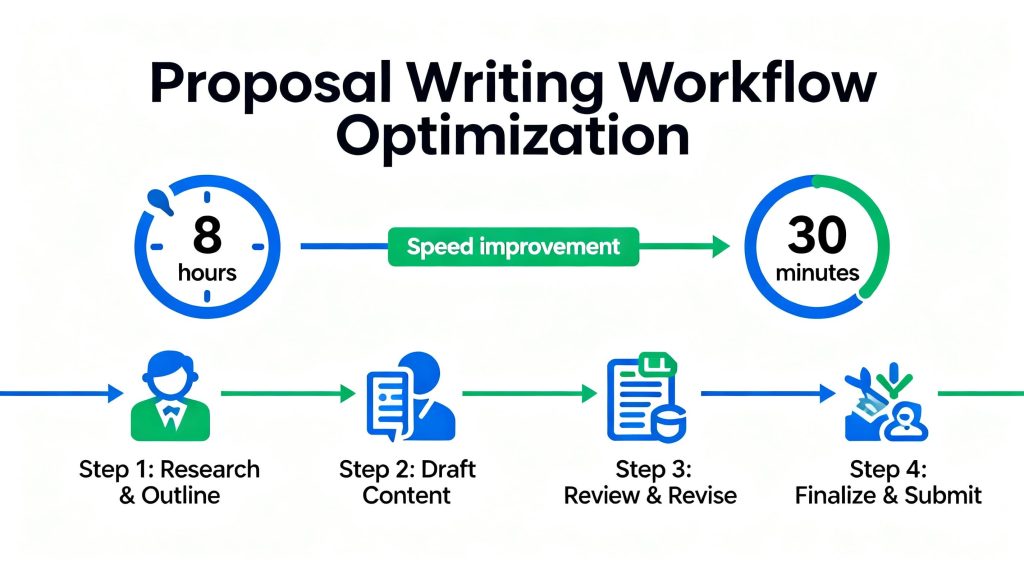
McKinsey research shows businesses using AI-powered proposal systems achieve a 33% higher win rate. This improvement stems from three factors:
- Response Speed: Faster proposals mean more opportunities pursued. If competitors take 10 days and you respond in 2 days, you gain psychological advantage and often exclusivity.
- Better Personalization: AI analyzes client language, priorities, and competitive landscapes to create hyper-personalized responses. Rather than generic templates, each proposal addresses specific evaluation criteria.
- Improved Content Quality: AI systems learn from winning proposals, identifying messaging approaches, structure patterns, and solution combinations that resonate with buyers. Teams can access this institutional knowledge instantly.
Key Features Every AI Proposal Tool Should Have
When evaluating tools, prioritize these essential features:
1. AI-Powered Content Generation
Look for tools that generate contextual, accurate content rather than simple templates. The AI should understand your business, industry, and past successful approaches.
2. Content Library and Knowledge Management
Centralized storage of past proposals, case studies, and approved language prevents starting from scratch and ensures consistency. AI should intelligently suggest relevant content based on current requirements.
3. Real-Time Collaboration
Multiple team members often contribute to proposals. Tools should enable simultaneous editing, commenting, and version control without email chaos.
4. CRM Integration
Seamless sync with your CRM ensures client data automatically populates proposals and closes the feedback loop on proposal performance.
5. Client Engagement Tracking
Analytics showing when clients open proposals, which sections they read, and how long they spend on each page provide invaluable insights for follow-up strategy.
6. E-Signature and Payment Processing
Reducing friction between proposal and signature accelerates closing. Built-in e-signature and payment capabilities streamline the entire process.
7. Compliance and Formatting Automation
For government contracts and regulated industries, automated compliance checking and formatting enforcement prevent costly mistakes.
8. Mobile Responsiveness
Proposals viewed on mobile devices need flawless presentation. Ensure your tool automatically optimizes for all screen sizes.
How to Choose the Right AI Proposal Tool for Your Business
Step 1: Assess Your Primary Use Case
Are you managing one-off sales proposals, high-volume RFP responses, complex government contracts, or something else? Different tools excel in different scenarios.
- High-volume RFPs: Loopio or RFPIO
- Sales proposals with design emphasis: Better Proposals or Proposify
- End-to-end document management: PandaDoc
- Meeting-based proposals: Sembly
- Budget-conscious teams: ChatGPT combined with free templates
Step 2: Evaluate Integration Requirements
Which systems does your team already use? Your proposal tool should integrate seamlessly with your CRM, content management systems, and collaboration platforms. Poor integration creates data silos and reduces efficiency gains.
Step 3: Consider Team Size and Workflow
Enterprise tools built for 50+ person proposal teams include features unnecessary for freelancers. Similarly, simple tools lack features needed by large teams managing complex compliance requirements.
Step 4: Test AI Output Quality
Request trial access and have your team test the AI’s output on real proposals. Quality varies significantly between tools, and you want AI that understands your industry and voice.
Step 5: Calculate True ROI
Compare tool cost against time savings. If a tool saves 5 hours per proposal at a loaded cost of $150/hour, that’s $750 savings per proposal. Enterprise tools paying for themselves after 3-4 proposals makes financial sense. For freelancers, lower-cost tools or free tiers are more appropriate.
Step 6: Prioritize Training and Support
Even excellent tools deliver poor results without proper implementation. Evaluate vendor training, documentation, and support quality.
Common AI Proposal Writing Mistakes to Avoid
Mistake 1: Treating AI as a Complete Solution
AI generates excellent first drafts but requires human review. Submitting unedited AI content often shows, damaging credibility. Plan for a 20-30% review and refinement phase.
Mistake 2: Neglecting Personalization
AI works best when you provide specific context. Generic inputs generate generic proposals. Invest time in briefing the AI with client background, competitive information, and specific requirements.
Mistake 3: Ignoring Fact-Checking Requirements
AI can hallucinate or use outdated information. Especially with statistics, case studies, and compliance details, always verify AI-generated content against authoritative sources.
Mistake 4: Using AI for Confidential Information
Some AI tools store data for model improvement. Never input confidential client information, pricing strategies, or proprietary methodologies into free or basic-tier tools. Use enterprise-grade platforms with data privacy guarantees.
Mistake 5: Not Analyzing Performance Data
AI tools provide engagement analytics most proposals never had. Use this data to understand what works, refine messaging, and continuously improve win rates.
FAQ Section
Q1: How much time do AI proposal writers actually save?
Research shows an average of 80% time reduction, translating to 30 minutes instead of 3-8 hours per proposal. However, this assumes proper AI training and a review phase. The actual savings depend on proposal complexity and your specific workflow.
Q2: Do AI-generated proposals maintain brand voice consistency?
Yes, when properly configured. Most tools allow you to upload brand guidelines, past proposals, and style guides. The AI learns your voice and applies it consistently across all documents, often improving consistency compared to multiple human writers.
Q3: Can AI handle technical or industry-specific proposals?
This varies significantly by tool. ChatGPT requires detailed prompts but can handle technical content with proper guidance. Specialized tools like Loopio (for RFPs) excel in specific scenarios, while general-purpose tools sometimes struggle. Test tools with your most challenging proposal types.
Q4: What about data security and confidentiality?
Never use free AI tools or basic tiers for confidential information. Enterprise tools like PandaDoc, Loopio, and RFPIO include SOC 2 compliance, encryption, and contractual guarantees not to use data for model training. Verify security certifications before using any tool for sensitive proposals.
Q5: How quickly can teams get value from AI proposal tools?
Most teams see time savings within their first 2-3 proposals as they become comfortable with the platform. However, true strategic benefits (improved personalization, data-driven messaging) develop over 2-3 months as teams refine AI prompts and analyze proposal performance.
Q6: Can small teams or freelancers justify AI proposal tool costs?
Absolutely. Even freelancers using ChatGPT Plus ($20/month) see ROI if handling more than 3 proposals monthly. Affordable specialized tools like Better Proposals and Sembly fit small team budgets. Calculate your specific time savings multiplied by hourly rate to confirm ROI.
Q7: Do clients notice proposals are AI-generated?
Well-executed AI proposals are indistinguishable from human-written ones. However, low-quality AI output that’s obviously templated or generic does show. This is why human review and personalization remain critical.
Featured Snippet Opportunity
Q: What is an AI proposal writer and how does it save time?
An AI proposal writer is software using artificial intelligence and machine learning to automate proposal creation, research, and formatting. These tools reduce creation time by an average of 80%, allowing teams to write in 30 minutes instead of 3-8 hours while maintaining quality and brand consistency. They analyze requirements, generate customized content, and often include collaboration, tracking, and compliance features, enabling teams to pursue more opportunities and improve win rates.
Practical Implementation Tips
Week 1-2: Platform Selection and Setup
Choose your primary tool based on the evaluation criteria above. Most offer 14-30 day free trials. Test thoroughly with real proposals. Set up integrations with your CRM and content management systems during this phase.
Week 3-4: Team Training and Process Development
Conduct team training on effective prompting, best practices for AI usage, and review workflows. Develop documentation on your company’s preferred AI settings, approved language, and fact-checking procedures.
Month 2: First Real Proposals
Begin using the tool for actual proposals while maintaining expanded review time. Track metrics on creation speed, team satisfaction, and preliminary client feedback. Refine AI prompts based on early results.
Month 3+: Optimization and Analytics Review
Analyze proposal tracking data showing client engagement. Identify which messaging approaches, structures, and content types perform best. Use these insights to further optimize AI prompts and templates.
Future of AI Proposal Writing
Emerging Trends in 2025:
Predictive Analysis: Next-generation tools will predict proposal win probability before submission, helping teams strategically allocate resources to highest-potential opportunities.
Real-Time Collaboration Integration: AI will seamlessly integrate with video conferencing, enabling teams to build proposals during client calls in real-time.
Advanced Personalization: AI will incorporate deeper buyer behavior analysis, automatically customizing every proposal element (language, examples, pricing structure) to individual decision-makers’ preferences.
Multi-Language Support: As global business expands, AI proposal tools will automatically generate proposals in multiple languages while maintaining cultural nuance and compliance requirements.
Voice-First Interfaces: Teams will create proposals using natural voice commands, enabling hands-free proposal generation while multitasking.
Conclusion

The best AI tool for proposal writing depends on your specific business model, team size, and proposal complexity. For freelancers and small teams, ChatGPT plus affordable platforms like Better Proposals deliver exceptional value. Service-based businesses benefit from Proposify’s design focus or Better Proposals’ client tracking. High-volume RFP shops should explore Loopio or RFPIO’s specialized intelligence. Large enterprises need PandaDoc’s comprehensive document lifecycle management or Loopio’s enterprise capabilities.
The common thread across all successful implementations: AI proposal tools transform proposal writing from a time-consuming bottleneck into a strategic advantage. Organizations using these platforms report faster response times, higher win rates, and teams freed to focus on strategy rather than administrative tasks.
The question isn’t whether to adopt AI proposal tools—it’s which tool best fits your organization’s needs. Start with a free trial, test with real proposals, and measure the time savings against your specific workflow. The 80% time reduction isn’t theoretical; it’s documented across hundreds of organizations implementing these tools today.