

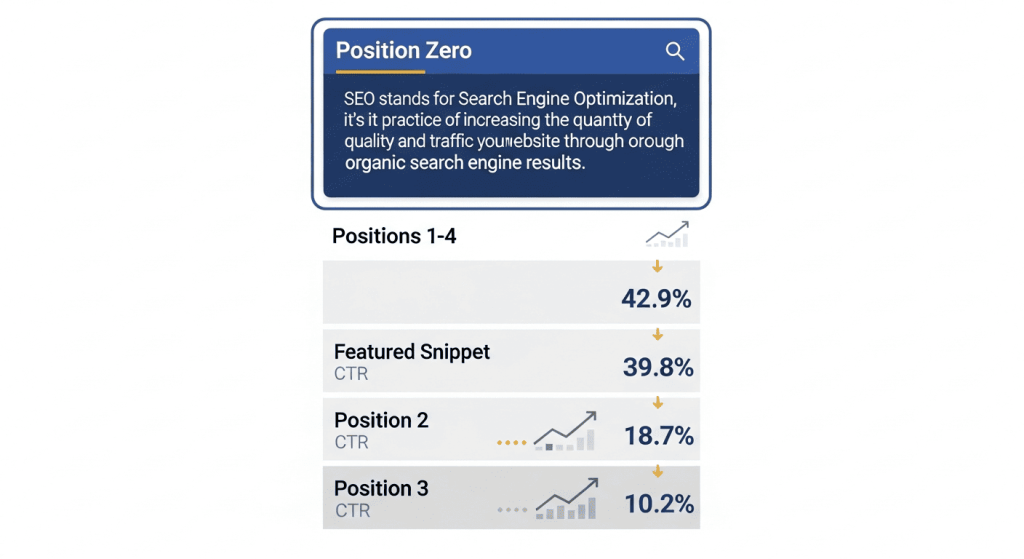
In the constantly evolving landscape of search engine optimization, a new battleground has emerged. It’s called “position zero,” and it’s worth fighting for. Featured snippets—those concise information boxes appearing above traditional organic search results—have become the holy grail of SEO professionals worldwide. These prime real estate positions currently capture 42.9% of all search clicks, significantly outperforming the first organic result’s 39.8% click-through rate. What makes this even more remarkable is that this doesn’t require breaking into the #1 ranking position. You can steal a featured snippet from a competitor ranking at position #2, #5, or even lower.
This comprehensive guide explores the featured snippets SEO strategy framework that separates successful optimization from missed opportunities. Whether you’re a content marketer, SEO specialist, or business owner looking to increase organic traffic without increasing ad spend, understanding how to optimize for featured snippets is no longer optional—it’s essential. By 2025, featured snippets are projected to capture approximately 35% of all clicks across Google search results, making this your opportunity to capture a disproportionate share of organic traffic in your niche.
What Are Featured Snippets and Why They Matter
Understanding Position Zero
Featured snippets are concise, informative summaries that appear at the very top of Google’s search results, above the traditional organic ranking listings. Google extracts these snippets directly from relevant content on the web, presenting them as direct answers to user queries. They’re called “position zero” because they appear before the first organic search result, creating a unique visibility advantage.
The significance of featured snippets extends beyond mere visibility. They serve a critical function in the user journey: they provide immediate answers to search queries, often satisfying user intent directly on the search results page itself. This is why they capture such disproportionately high click-through rates. Users see the answer they’re looking for, but many click through to learn more, access additional resources, or verify information—creating a gateway effect that drives qualified traffic.
The Business Impact of Featured Snippets
The tangible benefits of winning featured snippets are substantial and measurable. Case studies consistently demonstrate significant traffic increases. One education institution captured 17 different featured snippets through strategic optimization, resulting in a 60% average increase in pageviews for featured snippet content, with one blog post achieving a remarkable 127% traffic increase. Another case study reported a 516% increase in organic sessions and improved click-through rates from 2% to 8% after optimizing for featured snippets.
These aren’t isolated success stories. The underlying mechanics are clear: featured snippets provide exponential visibility improvements over traditional ranking positions. When you occupy position zero, you’re essentially claiming the attention of users before they even view traditional search results. This advantage applies across all industries and content types, from B2B technical content to consumer-focused guides.
Featured Snippets vs. AI Overviews: The 2025 Landscape
As of 2025, a new player has entered the field: Google’s AI Overviews. These generative AI summaries appear on approximately 31% of search result pages, presenting Google’s AI-generated synthesis of information. Interestingly, research shows that when AI Overviews appear, organic CTR decreases by approximately 67.8%, and paid CTR declines by 58.0%. This might seem concerning, but featured snippets remain distinct from AI Overviews and continue to drive significant traffic. Featured snippets still appear frequently alongside AI Overviews, and content optimized for snippets often provides the source material Google uses for its AI summaries.
The strategic implication is clear: optimizing for featured snippets in 2025 means positioning your content as the authoritative source that Google relies on for both traditional snippets and AI Overview generation.
The Four Main Types of Featured Snippets
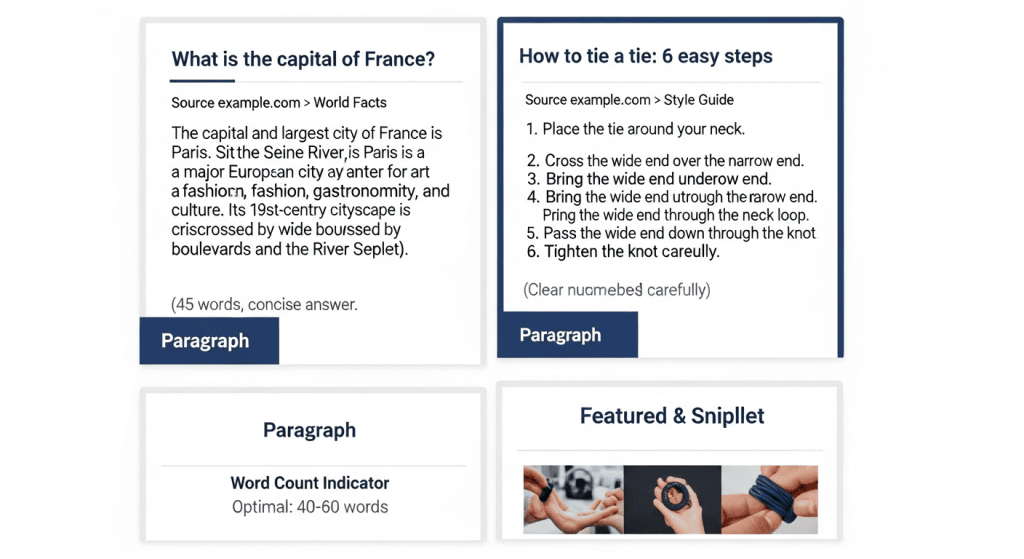
Understanding the different snippet formats is fundamental to optimization strategy. Google adapts the format based on the user’s search intent and the information being presented. Here’s a breakdown of each type and how to optimize for them.
1. Paragraph Featured Snippets (70% of All Snippets)
Paragraph snippets are the most common type, accounting for approximately 70% of all featured snippets. They typically consist of one to three sentences providing a direct answer to question-based queries. The optimal length for paragraph snippets is 40-60 words, with research showing that snippets of exactly 45 words appear on SERPs 21.09% more frequently than any other length.
Characteristics:
- Average length: 40-60 words (approximately 250-320 characters)
- Most common for: “What,” “Why,” “When,” and “How” question queries
- Format: Direct, conversational prose
Optimization tip: Structure your answer with a question-based H2 heading immediately followed by your direct response. Use the “[Keyword] is…” sentence structure to provide clear definitions and explanations. For example: “What is featured snippet optimization? Featured snippet optimization is the process of structuring and formatting web content to increase the likelihood of appearing in Google’s position zero search results.”
2. List Featured Snippets (Numbered and Bulleted)
List snippets present information in either numbered (ordered) or bulleted (unordered) formats. Numbered lists typically showcase step-by-step instructions or rankings, while bulleted lists display collections of related items, benefits, or features.
Characteristics:
- Typical display: 5-8 items (though lists can contain more)
- Ideal item length: 15-20 words per item
- Most common for: “How to,” “Ways to,” “Steps to,” and feature-focused queries
- Format: Clearly structured, scannable list items
Optimization tip: Create lists with parallel structure (all items start with the same grammatical form). Ensure your list answers the specific question completely. For a “how to change a flat tire” query, you might structure 6-7 clear steps. Google favors concise, actionable list items that provide immediate value. Use descriptive, keyword-inclusive list items while maintaining readability.
3. Table Featured Snippets (Data Comparisons)
Table snippets display structured data in rows and columns, making them ideal for comparisons, specifications, pricing, or statistical information. While less common than paragraph and list snippets, they’re highly valuable for queries requiring data comparison.
Characteristics:
- Display size: Typically 3 columns and 7-8 rows
- Cell content: 5-10 words per cell (optimal brevity)
- Most common for: “Best,” “Comparison,” “Difference,” and “List of” queries
- Format: Clean, well-organized HTML table
Optimization tip: Ensure your table has clear header rows and descriptive column names. The first column typically contains the main entities being compared, with subsequent columns showing attributes or values. Keep data concise and accurate. Avoid excessive decimals in numbers—round to whole numbers when appropriate (e.g., “approximately 80%” rather than “79.3%”). Tables with visual clarity and relevant data are much more likely to be selected.
4. Video Featured Snippets
Video snippets pull video content from platforms like YouTube to answer user queries. These are increasingly common for how-to, tutorial, and demonstration queries.
Characteristics:
- Source: Typically YouTube videos
- Context: Often paired with text snippets
- Most common for: “How to” and demonstration queries
- Format: Video thumbnail with description
Optimization tip: Optimize your video titles, descriptions, and transcripts for featured snippet-worthy content. Include your target question in the video title or opening seconds. Provide comprehensive how-to content in clear, sequential steps. Ensure your video is accessible with accurate captions or transcripts, as Google uses these for understanding video content.
The Featured Snippets SEO Strategy: A 9-Step Optimization Framework

Winning featured snippets requires a systematic approach that combines research, content optimization, technical implementation, and ongoing monitoring. This framework outlines the proven process used by leading SEO professionals.
Step 1: Identify Your Target Snippet Opportunities
Start with keyword research focused on snippet potential. Use specialized tools like Semrush, Ahrefs, or Google’s Question Hub to identify keywords that currently show featured snippets. You’re not looking for just any keywords—you’re looking for opportunities where:
- The keyword currently has a featured snippet (easier to compete than starting from scratch)
- Your domain already ranks in the top 10 for that keyword (a practical prerequisite)
- The keyword has meaningful search volume (typically 300-1,000+ monthly searches for long-tail keywords)
- The keyword difficulty is moderate to low (giving you realistic winning chances)
Best practice: Prioritize keywords where you’re already ranking #2-#5. These represent “low-hanging fruit”—you’re already getting traffic, and winning the snippet will multiply that traffic without requiring a complete ranking overhaul.
Step 2: Analyze Current Featured Snippet Content
Once you’ve identified your target keywords, study the currently featured content. Answer these critical questions:
- What format is the current snippet using (paragraph, list, table)?
- How long is the snippet (word count, character count)?
- What is the structure of the featured content?
- What heading tags does it use?
- Does it include supporting images or data?
- Is schema markup implemented?
Pro tip: Use the Wayback Machine to track how the snippet has evolved. If a snippet has remained unchanged for months, it’s harder to displace. If it changes frequently, there’s more fluidity in the position.
Step 3: Analyze Competitor Content and Schema Implementation
Study not just the featured snippet itself, but the entire page it’s pulled from. Examine:
- Overall page structure and content depth
- How they’ve organized headers and subheaders
- Whether they’ve implemented schema markup (check using Google’s Schema Markup Validator)
- Internal and external linking patterns
- Content freshness (when was it last updated?)
- Backlink profile and domain authority
Research finding: Competitors winning featured snippets often have strong domain authority and quality backlinks, but on-page optimization is the primary determining factor for snippet selection. Your content can displace a competitor’s featured snippet if it’s demonstrably better structured, more up-to-date, and more directly answers the query.
Step 4: Create or Optimize Your Content with Snippet-Worthy Structure
This is where your optimization efforts become concrete. Restructure your content to prioritize snippet-worthy formatting:
For paragraph snippets:
- Create a question-based H2 heading that matches the search query exactly
- Follow immediately with a 40-60 word answer paragraph using the “[Keyword] is…” structure
- Provide supporting context and examples in subsequent paragraphs
- Include relevant images with descriptive alt text
For list snippets:
- Use clear H2 heading with the question or topic
- Create a bulleted or numbered list directly below the heading
- Ensure 5-8 items with 15-20 words per item
- Use parallel structure (all items start the same way)
- Follow with supporting paragraphs explaining each item
For table snippets:
- Create a clear H2 heading describing the table’s purpose
- Implement a well-structured HTML table with clear headers
- Keep cell content to 5-10 words maximum
- Include a brief explanation before or after the table
- Ensure data accuracy and currency
Critical principle: Your content must be demonstrably better than what’s currently featured. This means more current information, clearer structure, better formatting, more comprehensive detail, or a unique perspective that adds value.
Step 5: Implement Strategic Keyword Placement
Featured snippet selection is heavily influenced by clear, keyword-rich on-page elements. Implement your target keyword naturally in:
- H1 title: “Featured Snippets SEO Strategy: Complete 2025 Guide” (use keyword in title)
- H2 headers: “What is a Featured Snippet?” “How to Optimize for Featured Snippets”
- First paragraph: Introduce the keyword naturally in the opening 100 words
- Image alt text: “Featured snippet example showing paragraph format with 45-word answer”
- Internal links: Use keyword-relevant anchor text linking to related content
Keyword density target: 0.5-1.5% of total word count. This means in a 2,200-word article, you’d use your primary keyword “featured snippets SEO strategy” approximately 11-33 times across the entire piece, distributed naturally.
Step 6: Use Semantic Keywords and LSI Optimization
Beyond your primary keyword, Google uses Latent Semantic Indexing (LSI) to understand the context of your content. Incorporate semantic keywords and related terms throughout your content naturally:
LSI keywords for “featured snippets SEO strategy” include:
- Position zero SEO
- Featured snippet optimization
- Google snippet ranking
- Rich snippets
- Answer box optimization
- Search snippet placement
- Query answer optimization
- SERP featured results
Implementation: Use these terms naturally in your headings, body text, and image descriptions. Don’t force them—they should fit naturally within your explanation. For instance, when discussing multiple ranking positions, you might mention “position zero and the traditional SERP featured positions.”
Step 7: Implement Structured Data (Schema Markup)
Schema markup provides explicit signals to Google about your content structure. The most valuable schema types for featured snippets include:
FAQ Schema (FAQPage): Perfect for Q&A content. Implement when your page contains multiple questions and answers. This markup explicitly tells Google that your content is structured as FAQs, increasing snippet eligibility.
How-To Schema (HowToStep): Ideal for step-by-step guides, tutorials, and process documentation. Each step should include a clear instruction and, when possible, an image.
Table Schema: Markup structured data tables to help Google understand your data presentation.
List Schema: For bulleted or numbered lists presenting information.
Implementation process:
- Generate your schema code (use tools like TechnicalSEO.com’s schema generator or JSON-LD generators)
- Test the code using Google’s Rich Results Test
- Validate using Schema Markup Validator
- Deploy via HTML editing, Google Tag Manager, or WordPress plugins (Yoast SEO, RankMath)
Important note: Schema markup doesn’t guarantee featured snippet placement, but it signals to Google that your content follows the format that typically appears in snippets, increasing eligibility.
Step 8: Optimize for Mobile and User Experience
Featured snippets must work perfectly on mobile devices, where over 60% of searches now occur. Ensure:
- Content loads quickly (page speed under 3 seconds)
- Text is readable without zooming
- Tables and lists display properly on small screens
- Images are responsive and optimized
- Internal links are easily tappable
Mobile optimization affects both your ranking position (a prerequisite for snippet eligibility) and user experience for those clicking from the snippet to your site.
Step 9: Monitor, Measure, and Iterate
Featured snippet optimization is not a one-time effort. Establish an ongoing monitoring routine:
Tools and metrics to track:
- Google Search Console: Monitor your featured snippet impressions and clicks
- SEMrush or Ahrefs: Track snippet rankings over time
- Analytics: Measure organic traffic, click-through rates, and engagement
- Ranking changes: Notice if your competitors’ snippets have changed
Optimization cycle: If you don’t win the snippet within 2-4 weeks:
- Analyze what’s different between your content and the current snippet
- Refine your answer’s conciseness and clarity
- Update your content to reflect fresher information
- Adjust your heading structure or formatting
- Add missing elements (images, data, examples)
- Consider whether a different snippet format might work better
Regular content refreshes signal to Google that your information is current and authoritative, making snippet displacement more likely.
LSI Keywords and Semantic Optimization Strategy
Understanding LSI Keywords in Snippet Context
Latent Semantic Indexing keywords aren’t synonyms of your target keyword—they’re conceptually related terms that help search engines understand your content’s context. For featured snippets specifically, LSI keywords help Google confirm that you’re comprehensively covering the topic.
15 LSI Keywords for “Featured Snippets SEO Strategy”
- Position zero optimization
- Google SERP featured results
- Answer box placement
- Rich snippet ranking
- Search snippet optimization
- Query answer boxes
- Featured result placement
- Snippet SEO tactics
- Zero-click search results
- Structured data for snippets
- Question-based keyword optimization
- SERP real estate strategy
- Content snippet formatting
- Knowledge panel optimization
- Semantic search optimization
Implementation strategy: Distribute these terms naturally throughout your content. They should appear in headings, body paragraphs, and image descriptions without disrupting readability. The goal is demonstrating comprehensive topical knowledge, not forcing keywords.
Long-Tail Keyword Variations to Target
Beyond your primary keyword “featured snippets SEO strategy,” consider targeting these long-tail variations:
- “How to optimize for featured snippets” – Broad how-to query, likely triggers list snippets
- “Featured snippets SEO strategy for beginners” – Targeting less experienced content creators
- “Featured snippet optimization techniques 2025” – Time-sensitive, current information
- “Schema markup for featured snippets” – Technical implementation focus
- “How to win Google featured snippets” – Outcome-focused, high-intent query
These long-tail variants typically have 300-1,000 monthly searches with lower keyword difficulty than the broad primary keyword. Targeting them simultaneously allows you to capture traffic at multiple stages of the user’s research journey.
Featured Snippet Opportunity: Answer in 40-60 Words
Question: “How should I structure my content to win a featured snippet?”
Answer (48 words): Structure your content with a question-based H2 heading immediately followed by a 40-60 word answer paragraph. Use clear language with the “[Keyword] is…” format. Follow with supporting details, examples, and relevant images. Implement schema markup and ensure your answer is demonstrably better than current featured content.
Recommended Schema Markup Type
Primary recommendation: Article + FAQ Schema combination
For most featured snippet optimization efforts, implement Article schema (to establish authorship, publish date, and content structure) combined with FAQPage schema (to explicitly signal Q&A formatting). This combination tells Google:
- This is authoritative, well-structured content (Article schema)
- This content answers specific user questions (FAQPage schema)
- Your content is eligible for both traditional snippets and FAQ rich results
FAQ Section: 7 Common Featured Snippet Questions
Q1: Can I rank for a featured snippet if I’m not in the top 10?
A: Technically difficult. Google typically selects featured snippets from pages already ranking in the top 10 for that query, usually positions 2-5. Your first step is ranking in the top 10 using traditional SEO practices. Once ranked, featured snippet optimization becomes viable.
Q2: How long does it typically take to win a featured snippet?
A: After publishing or optimizing content, featured snippet eligibility often takes 2-4 weeks. Google needs time to crawl, index, and evaluate your content against the current snippet holder. Some snippets appear within days; others take 8+ weeks. Consistency matters—regular content updates signal freshness.
Q3: Is featured snippet traffic still valuable with Google’s AI Overviews?
A: Yes, absolutely. Research shows featured snippets remain distinct from AI Overviews. Featured snippets still capture 42.9% CTR, and they often provide the source material Google uses for AI Overviews. Ranking as a featured snippet can increase your chances of being cited in AI-generated summaries.
Q4: Should I create new content specifically for featured snippets?
A: No. Create content because your audience needs it and search queries demand it. Featured snippets are a bonus that naturally follows from well-structured, comprehensive content. Trying to artificially create content only for snippets often results in thin, unhelpful pages that Google penalizes.
Q5: What’s the difference between a featured snippet and a rich result?
A: Featured snippets appear in the organic search results area (position zero). Rich results (rich snippets) are search results with enhanced formatting like star ratings, prices, or event details. They’re different features. FAQ schema can trigger both featured snippets and rich results.
Q6: Can I rank for multiple featured snippets on one page?
A: Yes. One page can rank for multiple featured snippets if it comprehensively answers related questions. For instance, a page about “featured snippet optimization” might rank snippets for “what are featured snippets,” “how to optimize for featured snippets,” and “featured snippet word count.”
Q7: How do I know if a keyword has featured snippet potential?
A: Use these indicators: (1) The query already has a featured snippet on Google (2) Your site already ranks in top 10 (3) Your target audience is searching for that question (4) The query has “how,” “what,” “why,” or “best” keywords (5) Multiple similar questions exist that you could answer comprehensively.
Actionable Takeaways and Implementation Checklist
Immediate Actions (This Week)
- Identify 5-10 target keywords showing featured snippets where you rank top 10
- Analyze the current featured snippet format for each keyword
- Audit competitor content winning those snippets
- Download your keywords into a tracking spreadsheet
Short-Term Actions (This Month)
- Optimize your top 3 target pages with snippet-worthy content structure
- Implement FAQ schema on pages with multiple questions
- Update H2 headers to match user search questions
- Add images with descriptive alt text to optimized pages
- Ensure all pages meet mobile optimization standards
Long-Term Actions (Ongoing)
- Monitor featured snippet rankings in Google Search Console
- Refresh content regularly (quarterly minimum)
- Test different snippet formats if initial attempts don’t succeed
- Build high-quality backlinks to snippet-optimized pages
- Expand your featured snippet strategy to 20+ target keywords
Performance Metrics to Track
- Featured snippet impressions (via Google Search Console)
- Click-through rate for featured snippet traffic
- Organic traffic increase for snippet pages
- Competitor snippet changes and displacement
- Time to featured snippet ranking
Conclusion: Your Path to Position Zero Dominance

Featured snippets represent one of the most underutilized opportunities in modern SEO. While many businesses focus solely on ranking positions #1-#3, sophisticated marketers recognize that position zero captures disproportionate traffic and brand visibility. The strategy outlined in this guide—from careful keyword research through implementation, schema markup, and ongoing optimization—provides a replicable framework for winning featured snippets in your niche.
The key insight is this: featured snippets aren’t won through gaming algorithms or keyword stuffing. They’re won by understanding user intent, providing genuinely superior answers, and presenting information in formats that Google naturally selects for position zero. When you obsess over answering your audience’s questions better than anyone else, featured snippet placement becomes a natural consequence.
Start today with your highest-potential keywords. Analyze the current snippet holders. Create demonstrably better content. Implement the optimization framework. Monitor your results. Iterate based on performance. Within weeks, you’ll likely see your first featured snippet. Within months, you could have dozens of position zero positions generating traffic that compounds your competitive advantage.
The question isn’t whether featured snippets are worth optimizing for—the data overwhelmingly shows they are. The question is whether you’ll act on this opportunity while your competitors remain focused on traditional ranking positions. Position zero awaits.