

In the ever-evolving landscape of search engine optimization, businesses face a critical question: should they focus on building domain authority or topical authority? The answer is clear—in 2025 and beyond, topical authority SEO strategy is not just important; it’s essential for sustainable search visibility.
Traditional SEO focused on optimizing individual pages for specific keywords. Today, Google rewards websites that demonstrate deep, comprehensive expertise in specific subject areas. This fundamental shift means that establishing topical authority has become the cornerstone of modern SEO success. Unlike domain authority, which measures your website’s overall credibility through backlinks, topical authority reflects your expertise in a particular niche or industry.
According to recent data, 88% of SEOs rate topical authority as very important to their content strategy, and 98% recognize the value of keyword clustering. Moreover, research examining 253,800 search results concluded that page-level topical authority is the largest on-page ranking factor for Google rankings—even surpassing domain authority in certain situations.
This comprehensive guide walks you through everything you need to know about building topical authority through strategic content clusters, smart internal linking, and E-E-A-T compliance. By the end, you’ll understand not just what topical authority is, but how to implement it to dominate your niche and capture sustained organic traffic.
What Is Topical Authority in SEO?
Topical authority refers to a website’s demonstrated expertise, credibility, and depth of knowledge in a specific subject area. It goes beyond being mentioned alongside a keyword—it means your website is recognized by search engines and users as a comprehensive, trustworthy source on that topic.
Think of it this way: if you search for “coffee brewing methods,” Google wants to rank pages from websites that have written extensively about coffee brewing, coffee types, different brewing equipment, water temperature, grind sizes, and related topics. A website with strong topical authority on coffee wouldn’t just have one article about French press brewing; it would have interconnected content covering dozens of related subtopics, all pointing back to a comprehensive central resource.
Topical Authority vs. Domain Authority: What’s the Difference?
This distinction is crucial for understanding modern SEO strategy:
| Aspect | Topical Authority | Domain Authority |
|---|---|---|
| Focus | Depth and relevance in specific topics | Overall website strength |
| Measurement | Content expertise, clustering, internal linking | Backlink profile and website age |
| Building Method | Topic clusters, comprehensive content | Link acquisition and building |
| Impact on Ranking | Stronger for niche-specific queries | Supports general ranking power |
| 2025 Importance | Critical and growing | Still relevant but secondary |
To support your topical authority efforts, use a semantic keyword clustering strategy that groups related queries and helps you cover each topic in depth instead of chasing isolated keywords.
While domain authority helps establish general credibility, topical authority determines whether Google will rank your pages for specific queries in your niche. A newer website with strong topical authority can outrank an older site with higher domain authority if the topic cluster is more comprehensive and relevant.
Why Topical Authority Matters for Search Rankings
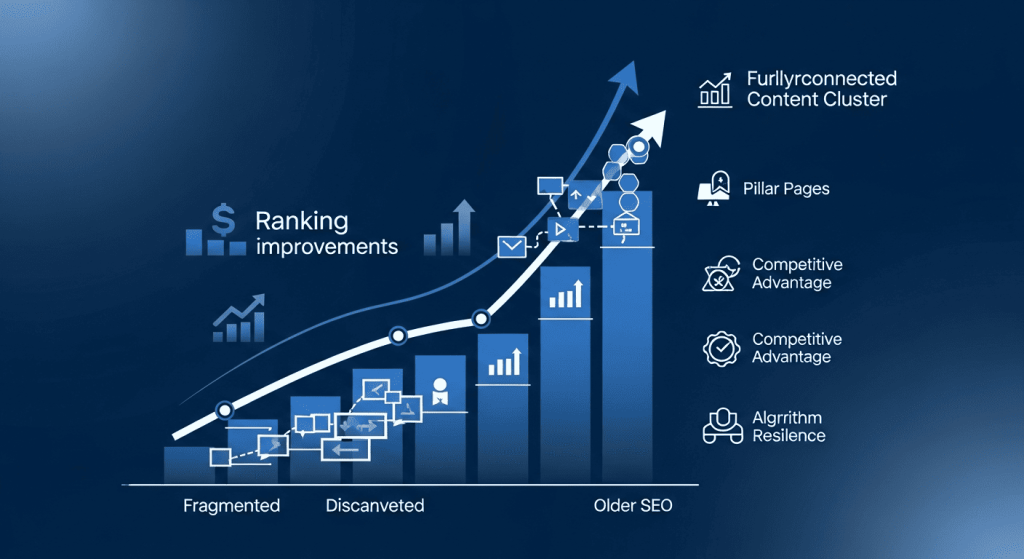
Understanding the “why” behind topical authority helps you commit to building it properly. Several interconnected benefits make it a game-changer for SEO:
Improved Keyword Rankings
Websites demonstrating topical authority rank higher for keywords within their area of expertise. Google’s algorithms evaluate how thoroughly a site covers a topic. When your content cluster addresses search intent comprehensively, search engines recognize this depth and reward it with higher rankings across the entire cluster—not just individual pages.
Enhanced Trustworthiness and User Engagement
Visitors trust websites that demonstrate consistent expertise. When users land on your pillar page and discover it links to a network of supporting cluster content, they perceive your brand as authoritative. This increased trust translates into lower bounce rates, higher engagement metrics, and improved conversion rates. Google monitors these behavioral signals and factors them into ranking decisions.
Competitive Advantage
Building topical authority creates a “content moat” that competitors can’t easily replicate. In saturated niches, comprehensive topical coverage differentiates your brand. New competitors entering your space must invest significant time and resources to match your topical depth, giving you sustained competitive advantage.
Resilience to Algorithm Updates
Websites built on topical authority principles tend to be more stable when Google updates its algorithms. Instead of relying on single pages ranking for specific keywords, you have a distributed network of content supporting your overall authority. This diversity makes your traffic less vulnerable to algorithm changes.
AI Overview Eligibility
With AI Overviews increasingly appearing in search results, AI search results optimization and strong E‑E‑A‑T-driven topical authority have become critical for sustained visibility. Studies show 52% of AI Overview sources come from the top 10 organic results, and content demonstrating strong E-E-A-T characteristics is more likely to be cited by AI systems across platforms, not just Google.
The Pillars of Topical Authority: Understanding E-E-A-T
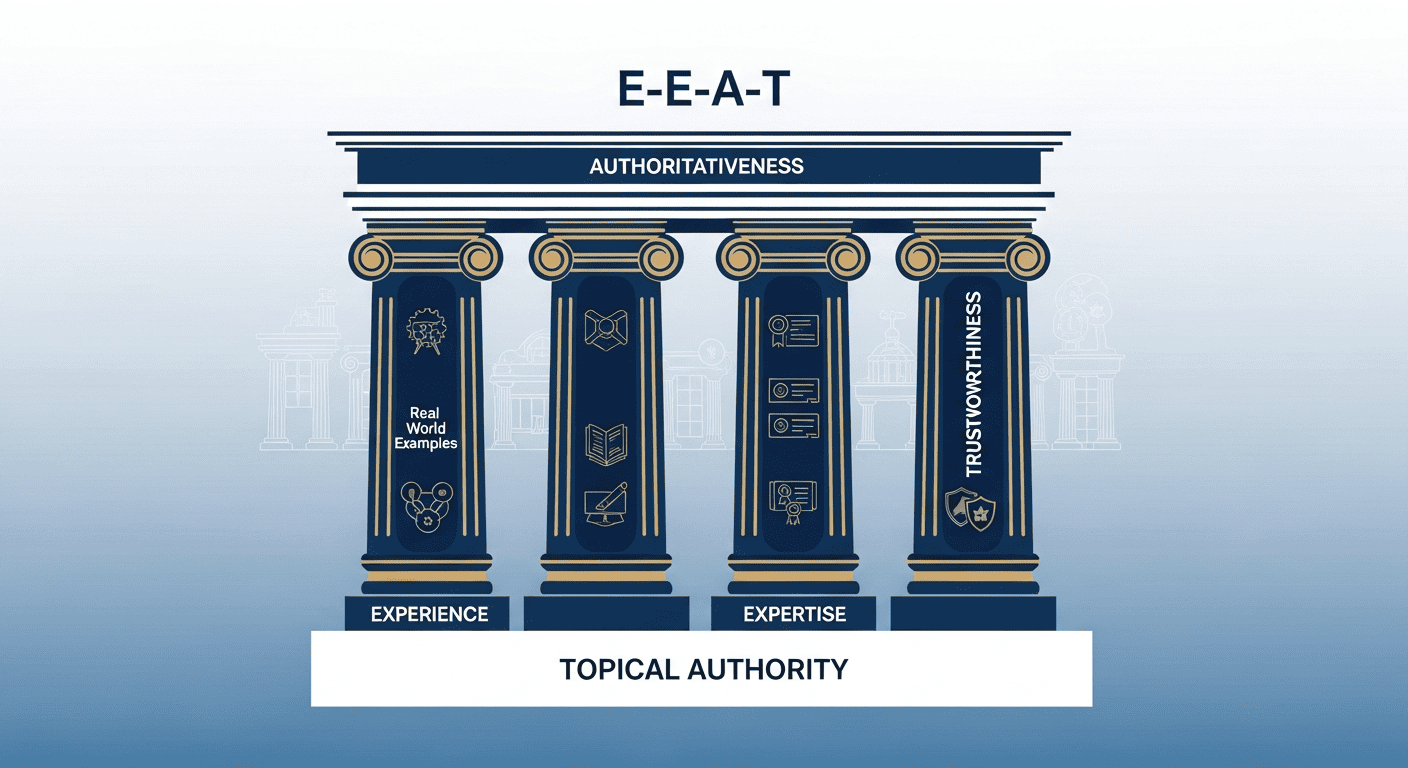
Google’s E-E-A-T framework—Experience, Expertise, Authoritativeness, and Trustworthiness—forms the foundation of topical authority evaluation. While E-E-A-T isn’t a direct ranking factor like page speed, Google’s algorithms are designed to detect and reward it.
Experience: Demonstrating Real-World Knowledge
The first “E” in E-E-A-T emphasizes genuine, first-hand experience. This means your content should reflect real-world application of concepts, not just theoretical knowledge. For example, if writing about “starting a freelance design business,” you should draw from actual experience launching and running a design freelance practice. Include specific examples, challenges you’ve overcome, and lessons learned.
Expertise: Showing Deep Knowledge
Expertise requires both formal credentials and consistent demonstrations of in-depth knowledge across your content cluster. AI systems evaluate this by analyzing knowledge consistency across multiple pieces of content, not just individual articles. Your cluster should use consistent terminology, build concepts progressively, and demonstrate nuanced understanding of your topic.
Authoritativeness: Building Your Reputation
Authority comes from recognition by others in your field. This includes citations from reputable sources, backlinks from industry-leading websites, and mentions by recognized experts. Your topical authority strategy should include efforts to earn mentions from complementary authorities in your space.
Trustworthiness: Creating Safe, Reliable Content
Trust is built through transparency, accuracy, and reliability. Maintain an HTTPS website, provide clear author information and credentials, include accurate contact information, disclose affiliations, and cite sources properly. Trustworthiness also means regularly updating content to ensure accuracy and removing outdated information.
Building Topical Authority: The Pillar-Cluster Model

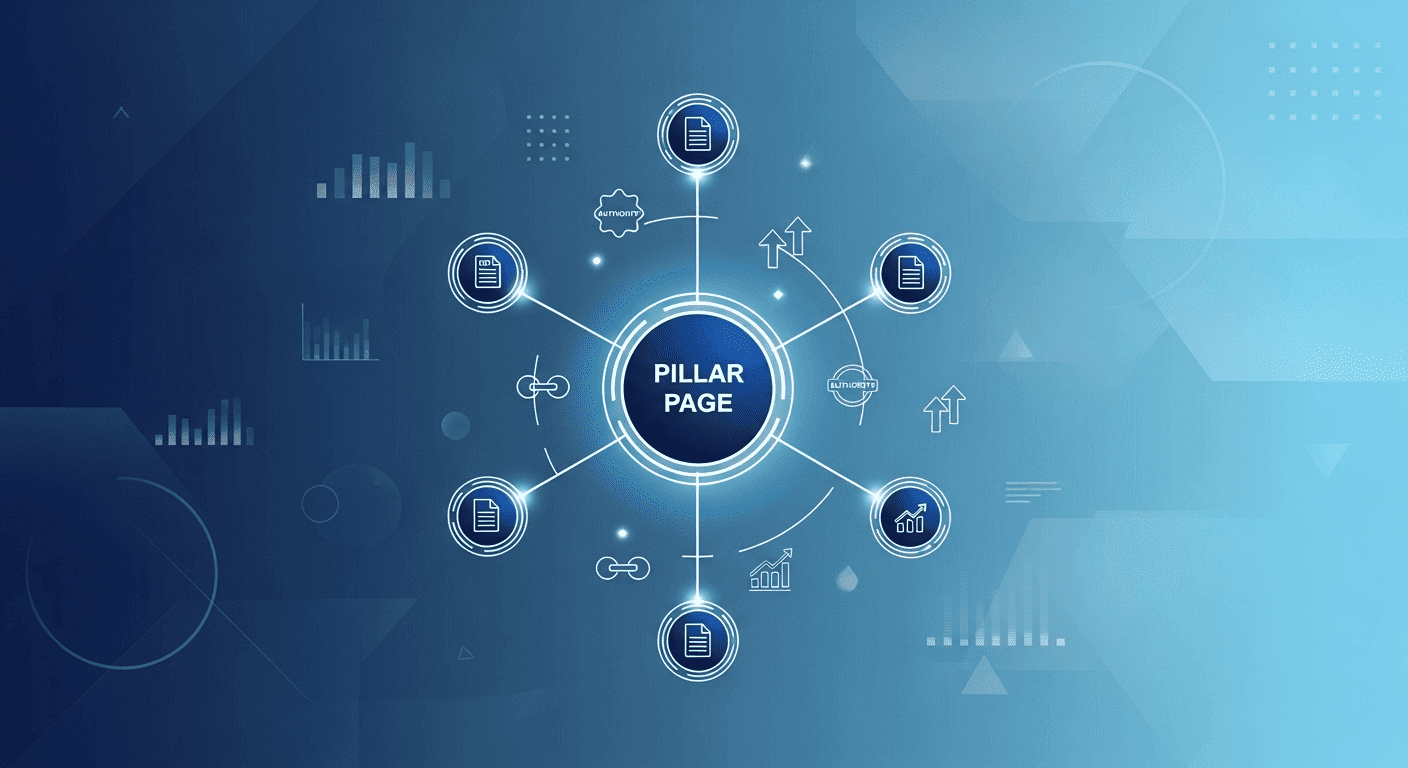
The most effective framework for building topical authority is the pillar-cluster content model. This approach organizes your content into a central pillar page supported by related cluster content pieces, all strategically interconnected through internal linking.
Step 1: Choose Your Core Topic and Define Your Niche
Start by identifying topics that align with your business, have significant search volume, and are broad enough to support multiple subtopics. Your core topics should be specific enough to establish authority but broad enough to support a content ecosystem.
For example:
- Too narrow: “Best coffee grinders under $100”
- Too broad: “Beverages”
- Just right: “Coffee brewing methods”
The topic should have enough depth to support 10-15 quality articles while remaining focused enough to position you as a genuine expert. Assess your business competencies, audience interests, and competitive landscape.
Step 2: Conduct Comprehensive Topic Keyword Research
Rather than searching for individual keywords, identify all talking points within your chosen topic. Use tools to discover:
- Core topic searches (e.g., “coffee brewing methods”)
- Subtopic searches (e.g., “pour over coffee,” “French press guide,” “cold brew process”)
- Question-based searches (e.g., “how to brew the perfect coffee,” “what’s the best coffee brewing method”)
- Comparison searches (e.g., “AeroPress vs French press,” “espresso vs pour over”)
- Long-tail variations targeting specific user intents
This comprehensive keyword research ensures you identify every angle of your topic, preventing content gaps competitors might exploit and feeding directly into a semantic keyword clustering guide that structures your future content.
Step 3: Create Your Pillar Page
Your pillar page serves as the central hub for your topic. It should be comprehensive yet scannable, covering the main topic broadly without overwhelming readers with excessive depth. Aim for 2,000-3,500 words.
Pillar page best practices:
- Write an engaging introduction that hooks readers and establishes the page’s scope
- Use clear H2 and H3 headings to organize information hierarchically
- Include a table of contents to aid navigation
- Provide high-level information about benefits, use cases, and quick tips
- Strategically place internal links to cluster articles throughout the content
- Use clear formatting and white space to improve scannability
- End with a strong conclusion summarizing key takeaways
Your pillar page isn’t meant to cover every detail—that’s what cluster content does. Instead, it provides a comprehensive overview while signposting readers toward deeper dives in cluster content.
Step 4: Develop Your Cluster Content Strategy
Cluster content consists of individual articles or resources addressing specific subtopics related to your pillar. Each cluster article should:
- Focus on a specific subtopic, question, or angle
- Be 1,200-2,500 words (substantial enough to rank independently)
- Link back to your pillar page in the introduction and conclusion
- Link to related cluster articles using contextual anchor text
- Provide in-depth, actionable information that fully satisfies search intent
For a pillar on “coffee brewing methods,” cluster articles might include:
- “The Complete Guide to Pour Over Coffee”
- “French Press Brewing: Step-by-Step Instructions”
- “Cold Brew Coffee: Everything You Need to Know”
- “AeroPress Coffee: Complete Brewing Guide”
- “Turkish Coffee Tradition and Brewing Method”
Each cluster article targets a specific subtopic while contributing to your overall topical authority.
Step 5: Implement Strategic Internal Linking
Internal linking is the connective tissue that transforms individual articles into an authoritative topic cluster, and it should be planned alongside your AI SEO blog writing workflow so every new post reinforces the cluster
Internal linking best practices:
- Link from pillar to all clusters: Your pillar page should link to every cluster article using descriptive anchor text containing relevant keywords
- Link from clusters back to pillar: Each cluster article should reference and link back to your pillar page in the introduction and conclusion
- Create cluster-to-cluster connections: Link between related cluster articles using contextual anchor text that makes sense for readers
- Use descriptive anchor text: Instead of “click here,” use keyword-rich anchor text like “comprehensive French press guide” or “best coffee grinders for espresso”
- Place links naturally: Internal links should enhance user experience, not feel forced or manipulative
- Avoid footer and sidebar links: Place important internal links within the body content where they receive more SEO value
- Deep link from homepage: Avoid linking only to your homepage; link directly to topically relevant pages
The goal is creating a clear hierarchy where Google understands which page is the central authority (your pillar) and how supporting content relates.
Step 6: Publish Consistently and Update Regularly
Building topical authority isn’t a one-time project. Search engines reward websites that demonstrate ongoing expertise through consistent content updates and publishing. Create a content calendar that includes:
- Regular cluster content additions (at least quarterly)
- Periodic updates to existing pillar and cluster content
- Fresh examples and statistics in established articles
- New cluster articles addressing emerging questions and trends
Aim for at least 10-15 quality articles in your cluster before expecting significant ranking improvements. Over time, as your cluster matures, rankings will improve across the entire cluster, not just individual pages.
Featured Snippet Opportunity
Question: “What is the most important element of building topical authority in SEO?”
Answer: The most important element is creating a comprehensive, interconnected content ecosystem around your core topic. This includes a pillar page covering your topic broadly, cluster articles diving deep into specific subtopics, and strategic internal linking connecting everything together. This structure signals to Google that your website is a complete, authoritative resource on that topic, leading to higher rankings and increased trust from both search engines and users.
Common Implementation Challenges and Solutions
Challenge 1: Determining the Right Cluster Size
Problem: Marketers often struggle deciding whether to create 5 or 50 cluster articles.
Solution: Start with 10-15 quality articles covering the main subtopics and questions within your niche. This provides sufficient coverage to demonstrate authority without becoming overwhelming. As you mature the cluster, add new articles addressing emerging questions and trends.
Challenge 2: Maintaining Content Quality at Scale
Problem: Publishing multiple cluster articles monthly while maintaining quality is resource-intensive.
Solution: Create clear content templates and style guides. Assign ownership to specific people or teams. Use content briefs to maintain consistency. Implement a review process ensuring all content meets E-E-A-T standards before publishing. Quality beats quantity in SEO—one exceptional article beats five mediocre ones.
Challenge 3: Balancing Breadth and Depth
Problem: Should cluster articles be relatively short and numerous, or longer and fewer?
Solution: Topic breadth (horizontal authority) refers to covering many related topics, while topic depth (vertical authority) means thoroughly exploring individual subtopics. Ideally, you develop both. Write comprehensive cluster articles (1,500-2,500 words) addressing each major subtopic. This combines breadth and depth, maximizing topical authority.
Challenge 4: Finding Natural Internal Linking Opportunities
Problem: Forcing internal links into content that doesn’t naturally support them.
Solution: Only link when it genuinely helps readers access related information. Plan your linking strategy before writing by mapping content relationships. During writing, add internal links where they provide context or deeper exploration. Remember: you’re writing for humans first; search engines second.
Measuring Topical Authority Success
Unlike domain authority, which has quantifiable metrics, topical authority requires tracking multiple performance indicators:
Key Performance Indicators (KPIs)
These KPIs don’t just reflect traditional rankings; they also indicate your AI search performance in AI Overviews and other generative search experiences.
Organic Traffic Growth: Monitor increases in search traffic to your entire cluster, not just individual articles. Strong topical authority typically shows 20-50% traffic increases within 6-12 months of full implementation.
Keyword Rankings: Track rankings for target keywords within your topic cluster. Look for improvements across multiple related keywords, indicating that topical authority is strengthening your overall cluster visibility.
Content Engagement Metrics: Analyze time on page, scroll depth, and return visitors. High-authority content typically shows higher engagement as users trust the content and explore related articles.
Internal Link Click-Through: Monitor whether users navigate between your pillar and cluster articles. If visitors arrive on a cluster article and click through to your pillar, this indicates perceived authority and content relevance.
Backlink Acquisition: Topical authority naturally attracts backlinks. Track new referring domains linking to your content. Websites recognized as authoritative on topics naturally earn more editorial links.
Conversion Quality: Measure whether traffic from your cluster converts better than traffic from individual standalone articles. Topical authority often attracts more qualified visitors with clearer intent.
Tools for Measuring Topical Authority
- Google Analytics 4: Track organic traffic, engagement, and conversion performance
- Google Search Console: Monitor keyword rankings, impressions, and click-through rates for cluster keywords
- Semrush or Ahrefs: Track keyword rankings across your cluster and monitor backlink acquisition
- Content performance tools: Track article engagement and internal link click-through rates
Frequently Asked Questions
Q1: How long does it take to build topical authority?
Building noticeable topical authority typically takes 6-12 months from publishing your first content cluster. Initial articles may start ranking within 2-3 months, but significant authority—where you rank on the first page for competitive keywords—usually requires 6+ months of consistent content publication and strategic linking.
Q2: Can a new website with good topical authority outrank an established high-DA site?
Yes. If your topical authority is stronger—meaning your content cluster is more comprehensive, relevant, and better optimized—you can rank above older, high-DA sites. This is increasingly true for AI search and generative engine optimization, where topical relevance trumps domain authority.
Q3: Do I need topical authority if I focus on one or two keywords?
No, but you’ll limit your growth potential. Topical authority is most valuable when you’re targeting multiple related keywords and search queries. If you truly only care about ranking for one specific keyword, traditional single-page optimization may suffice. However, building topical authority typically generates more traffic across related queries.
Q4: How many blog posts do I need to build strong topical authority?
Most SEO professionals recommend starting with 10-15 quality cluster articles. However, quality matters more than quantity. One exceptional 3,000-word guide beats five mediocre 1,000-word articles. Start with 10-15 articles covering your main subtopics; expand from there based on performance and emerging questions.
Q5: What’s the relationship between topical authority and backlinks?
While topical authority is built primarily through content clustering and internal linking, external backlinks support it. Backlinks from authoritative websites in your niche signal to Google that your content is credible and worth citing. However, strong topical authority makes earning these backlinks easier—recognized authorities naturally attract editorial links.
Q6: Can I build topical authority in competitive niches?
Absolutely. Competitive niches often have the highest value, making topical authority investment worthwhile. The key is finding a specific angle or sub-niche where you can establish authority before competing directly with larger brands. Once you establish authority in your segment, expanding to broader competitive queries becomes easier.
Q7: Should I focus on topical authority or individual page optimization?
Both work together. You need strong individual page optimization (clear headings, good on-page SEO, fast loading) for each article while organizing those articles into topic clusters that build topical authority. It’s not either/or; it’s both/and. Strong topical authority without individual page optimization won’t rank. Individual page optimization without topical authority limits your potential.
Conclusion: Your Topical Authority Roadmap

Topical authority represents a fundamental shift in SEO strategy from targeting individual keywords to building comprehensive expertise in specific subject areas. This approach aligns with how Google increasingly evaluates content quality and relevance, particularly with the rise of AI-powered search and the emphasis on E-E-A-T signals.
Building topical authority requires commitment—planning your content ecosystem, creating comprehensive pillar pages and supporting cluster content, implementing strategic internal linking, and consistently publishing new material. However, the payoff justifies the investment. Websites demonstrating strong topical authority experience higher rankings, increased organic traffic, improved user engagement, and greater resilience to algorithm updates.