

Over 300 million people use ChatGPT weekly, making it a critical visibility channel for modern businesses. Yet most marketers overlook a fundamental shift in search: ChatGPT SEO optimization isn’t just about ranking in Google anymore—it’s about earning citations in AI-powered answer engines.
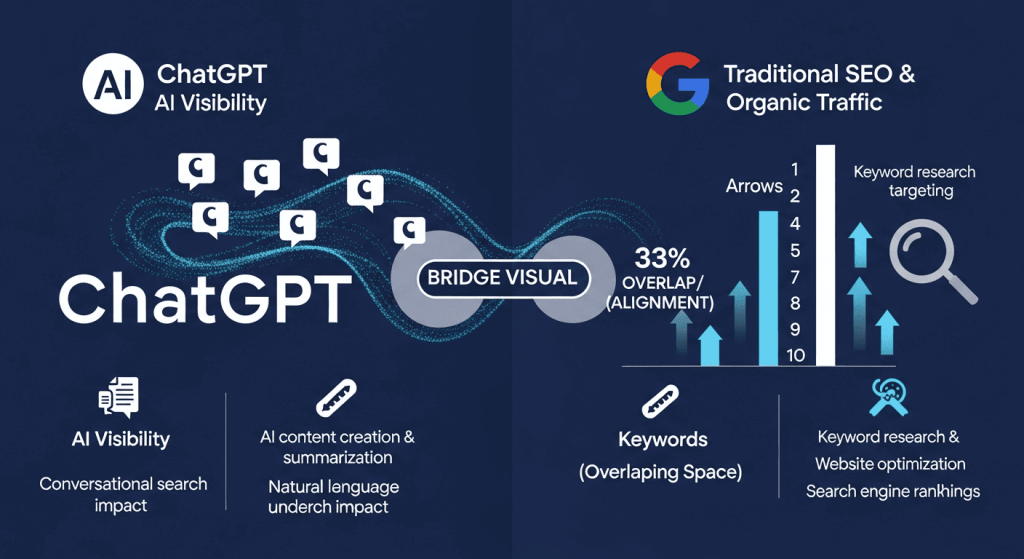
ChatGPT SEO optimization involves two critical strategies: optimizing your content to be cited in ChatGPT responses and using ChatGPT itself to enhance your SEO strategy. This dual approach matters because ChatGPT’s search results share 33% similarity with Google’s SERPs (as of July 2025), and that alignment continues growing. Content that ranks well in traditional search increasingly appears in AI answers, but the optimization strategies differ significantly.
This guide covers everything you need to master ChatGPT SEO optimization: how to structure content for AI extraction, leverage keyword clustering, strengthen E-E-A-T signals, and use ChatGPT as a strategic SEO tool. Whether you’re competing for AI overview citations or building visibility across multiple search channels, these proven tactics will help you dominate both traditional and AI-powered search results.
1. Understanding ChatGPT SEO Optimization
What is ChatGPT SEO?
ChatGPT SEO optimization refers to the practice of making your content discoverable and citation-worthy in AI-powered platforms while using ChatGPT to accelerate your overall SEO strategy. Unlike traditional SEO—which focuses on ranking positions in Google’s search results—ChatGPT SEO aims to secure mentions and citations in AI responses.
The distinction matters. A website doesn’t “rank” in ChatGPT; instead, it gets cited or referenced when the AI generates an answer. This means visibility depends less on position and more on being recognized as an authoritative, credible source that AI models trust enough to quote.
Why ChatGPT SEO Matters Now
Three data-driven reasons explain why ChatGPT SEO optimization has become essential:
Market adoption is accelerating. With over 300 million weekly active users, ChatGPT commands an audience comparable to major search engines. As AI answer engines become mainstream, traffic from these platforms represents a significant growth opportunity.
Google’s alignment with ChatGPT is shifting. Research from July 2025 shows ChatGPT’s citation sources now overlap 33% with Google’s search results—up from just 12% in April 2025. This “citation flattening effect” means content ranking in Google’s top 10 has a much better chance of appearing in AI answers than traditional click-through rates suggest.
AI overviews are reshaping search behavior. Google’s AI Overviews now appear at the top of many search results, citing 3-5 sources for each answer. Being cited in an AI overview doesn’t just increase visibility—it drives qualified traffic from users seeking authoritative information. One case study showed a client achieving 2,300% monthly AI referral traffic growth by optimizing for AI citations.
2. The Connection Between ChatGPT and Traditional SEO
How ChatGPT Aligns with Google Search
The most important insight for ChatGPT SEO optimization is this: traditional SEO best practices now have double value. Since ChatGPT’s search results share significant overlap with Google’s rankings, optimizing for one platform increasingly benefits the other.
Key overlapping practices include:
- Accessible website architecture with clear hierarchy and fast load times
- Authoritative backlinks from high-reputation domains
- Content depth and comprehensiveness that thoroughly answers user questions
- Topical authority through topic clusters and internal linking
- User experience optimization including mobile responsiveness and readability
The difference is emphasis. Traditional SEO rewards position and click-through rates; ChatGPT SEO rewards extractability and trustworthiness. Content structured with clear answers, short paragraphs, and proper headings has a higher chance of being cited by AI.
The “Citation Flattening Effect”
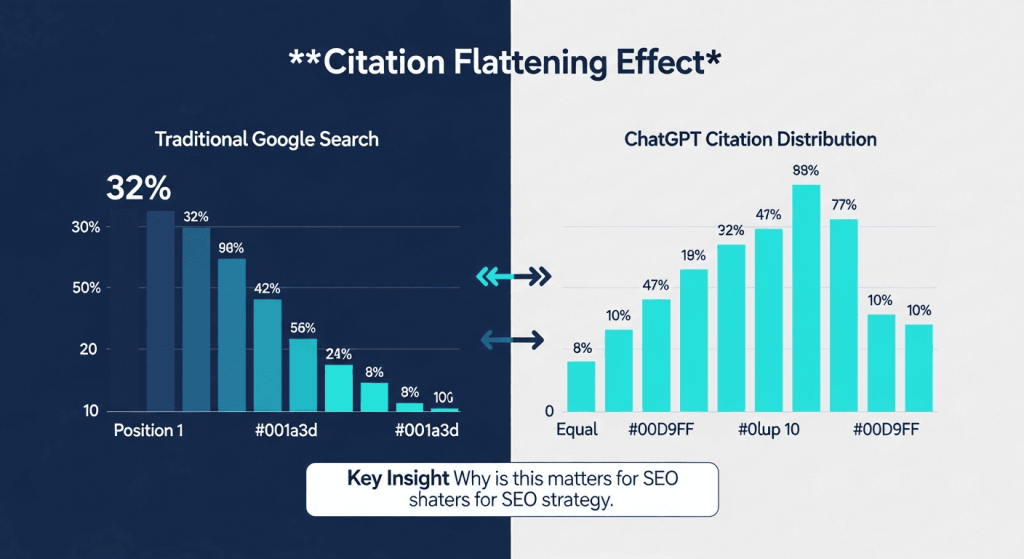
Traditional search heavily favors position one (roughly 32% of clicks go to the top result). ChatGPT, however, distributes citations more evenly across Google’s top 10 results, meaning you don’t need position one to be cited in AI responses.
This is significant for competitive keywords. While you might not crack position one in Google, being anywhere in positions 2-10 gives you a reasonable shot at AI citations—something that rarely happened in traditional search.
3. ChatGPT SEO Optimization Tactics
Optimize Content Structure for AI Extraction
AI systems pull content in specific ways. To maximize ChatGPT SEO optimization potential:
Use answer-first paragraphs. Start sections with 40-80 word “answer nuggets”—complete thoughts that answer the user’s question before elaborating. This structure makes content extractable and citation-ready. For example, rather than building to an answer over three paragraphs, state it immediately:
“ChatGPT SEO optimization improves visibility in AI-powered answers through three core methods: strengthening E-E-A-T signals, structuring content for extractability, and building topical authority through semantic keyword clustering. Unlike traditional SEO, AI platforms reward trusted sources and clear answers over position rankings.”
Organize with hierarchical headings. Use H1 for the main topic, H2 for major sections, and H3 for subsections. This structure helps AI understand content relationships and improves extractability.
Keep paragraphs scannable. Short paragraphs (3-4 sentences maximum) increase readability for both humans and AI systems. Break up long explanations with bullet points when listing multiple items.
Use descriptive subheadings. Avoid vague headings like “More Information.” Instead, use specific descriptions: “How Keyword Clustering Improves ChatGPT SEO Rankings” clearly signals content topic to AI systems and helps them understand relevance.
Build Topical Authority with Keyword Clustering

Keyword clustering is one of the most powerful—yet underutilized—tactics for ChatGPT SEO optimization. Rather than creating individual articles targeting single keywords, cluster-based strategies group semantically related keywords into comprehensive content pieces.
Here’s how to implement keyword clustering effectively:
Step 1: Gather your raw keywords. Compile 30-50 keywords related to your main topic using research tools or ChatGPT itself.
Step 2: Use ChatGPT to organize clusters. Feed keywords into ChatGPT with a structured prompt:
“Organize these keywords into 5-7 semantic clusters based on shared search intent and relationship. For each cluster, identify the main informational entity and suggest a potential content type (pillar, supporting article, FAQ). Keywords: [paste list]”
ChatGPT excels at understanding semantic relationships humans might miss. It can identify that “how to use ChatGPT for content” and “ChatGPT content marketing strategy” belong in the same cluster despite using different keywords.
Step 3: Map content to clusters. Create pillar content that addresses the entire cluster, then supporting articles targeting specific long-tail keywords within the cluster. Link everything internally to create a topic hub structure.
Why this works for ChatGPT SEO: Topic clusters demonstrate comprehensive expertise. When AI systems see an entire cluster of interlinked, authoritative content on a topic, they recognize your site as a trusted authority worth citing. This “topical authority signal” heavily influences AI citation selection.
Strengthen E-E-A-T Signals
Experience, Expertise, Authoritativeness, and Trustworthiness (E-E-A-T) aren’t just Google factors anymore—they’re foundational for ChatGPT SEO optimization. Research shows 52% of AI Overview citations come from the top 10 search results, and these results are heavily filtered by E-E-A-T quality signals.
Demonstrate Experience. Share real-world examples, case studies, and first-hand insights. Rather than theoretical advice, show how a strategy worked for your clients or business. Include specific results: “Our AI SEO case study generated 2,300% monthly traffic growth” is more extractable than “AI SEO works well.”
Showcase Expertise. Build visible author credentials. Include comprehensive author bios with:
- Relevant certifications or credentials
- Years of experience in the field
- Notable achievements or publications
- Social proof (speaking engagements, media mentions)
When citing sources in content, attribute expertise to real people with demonstrable knowledge.
Establish Authoritativeness. Create a comprehensive content ecosystem that reinforces expertise:
- Internal linking between related articles
- Original research or data
- Citations from authoritative external sources
- Industry recognition or awards
- Consistent terminology and concept usage across articles
Build Trustworthiness. Implement visible trust signals:
- Author bylines with credentials on every article
- Clear sources cited with proper attribution
- Updated publication dates showing content freshness
- Transparent corrections policy if errors are found
- Schema markup (Article, FAQ, or HowTo) that helps AI systems understand content type
The financial services industry provides a clear example: websites with strong E-E-A-T signals for financial content rank significantly higher in AI Overviews because AI systems (rightfully) prioritize trusted sources for money-related queries.
Use Visuals Strategically
AI systems increasingly cite visual content, especially for complex topics. Images, charts, and infographics serve multiple purposes:
- Improved extractability. Descriptive alt text helps AI understand image context
- Enhanced user engagement. Visual breaks improve readability and dwell time
- Citation potential. YouTube is cited in 11% of ChatGPT responses (more than any other platform), suggesting AI values multimedia content
When adding visuals to support ChatGPT SEO optimization:
- Include descriptive alt text (50-100 words when relevant)
- Add figure captions that explain key insights
- Implement image schema markup with ImageObject type
- Ensure images are relevant to the surrounding text
4. Using ChatGPT as an SEO Tool
ChatGPT isn’t just a target platform—it’s also a powerful SEO assistant. Leveraging ChatGPT effectively multiplies your optimization efforts.
Keyword Research and Semantic Analysis
ChatGPT excels at identifying semantic relationships between keywords. Instead of searching individually, you can:
Generate keyword variations: Prompt ChatGPT with: “Generate 20 long-tail keyword variations related to ‘ChatGPT SEO optimization’ that target different search intents (informational, transactional, navigational).”
Understand search intent: Ask ChatGPT to classify keywords by intent type, helping you match content to user needs. This prevents creating blog posts for transactional keywords or product pages for informational queries.
Identify content gaps: Feed ChatGPT a list of your covered topics and ask it to identify related topics you haven’t addressed. This reveals content opportunities where competitors may already rank.
Semantic clustering at scale: For larger keyword sets, ChatGPT can organize 100+ keywords into logical clusters faster than manual methods. This foundation speeds up your entire content strategy.
Content Planning and Structure
Before writing, use ChatGPT to create content outlines optimized for ChatGPT SEO. A structured prompt like this delivers actionable frameworks:
“Create a detailed content outline for an article targeting ‘how to optimize ChatGPT SEO.’ Include: H1 title (50-60 characters), meta description (150-160 characters), H2 sections addressing search intent, H3 subsections, key topics to cover, and a FAQ section. Ensure the outline follows E-E-A-T principles and includes sections for data, expert perspectives, and real-world examples.”
ChatGPT generates structured outlines that:
- Ensure comprehensive topic coverage
- Include natural keyword placement opportunities
- Address searcher intent throughout
- Provide sections for citations and social proof
- Create logical flow for readability
Meta Tag and Schema Generation
ChatGPT automates repetitive optimization tasks:
Title and meta description variations: Prompt: “Create 5 title tag variations (50-60 characters each) for an article about ChatGPT SEO. Each should include the primary keyword while emphasizing different benefits. Then create 3 meta descriptions (155-160 characters) using different angle approaches.”
Schema markup generation: Ask ChatGPT to generate FAQ schema, Article schema, or HowTo schema specific to your content. It can create clean, valid JSON-LD markup that search engines use to understand content context.
Internal linking recommendations: ChatGPT can analyze your outline and suggest which sections should link to other articles on your site, helping you build semantic relationships.
5. Advanced ChatGPT SEO Strategy
Optimize for Generative Engine Optimization (GEO)
Generative Engine Optimization (GEO) is the new frontier of visibility. Unlike traditional SEO that optimizes for position, GEO optimizes for AI citation.
Get listed in authoritative directories. AI systems cite sources from well-known directories, list sites, and aggregators. Being featured in industry directories significantly increases citation likelihood.
Pursue media mentions and backlinks. Major publishers and media outlets are cited frequently by ChatGPT. Guest posts and media coverage dramatically increase AI visibility.
Encourage positive reviews. User-generated content signals trustworthiness. Positive reviews, testimonials, and ratings are cited in AI responses, especially for local or commercial queries.
Monitor social sentiment. Mentions on trusted platforms like LinkedIn, professional forums, and industry communities reinforce authority signals that AI systems recognize.
Internal Linking for Semantic Authority
Strategic internal linking serves two purposes for ChatGPT SEO optimization: it helps AI understand topical relationships, and it distributes authority throughout your site.
Link using semantic anchors. Instead of generic “click here” links, use descriptive anchors that clarify the relationship: “learn more about ChatGPT keyword clustering strategies” is more extractable than “more information.”
Create topic clusters. Group related articles with internal links, creating hub-and-spoke structures. This architecture demonstrates comprehensive expertise and increases the likelihood of AI citation.
Optimize link distribution. Ensure important pages receive more internal links. AI systems, like traditional crawlers, follow link structure to understand page importance.
Implement breadcrumb navigation. Breadcrumbs help AI systems understand site hierarchy and content relationships, improving crawlability and extractability.
6. Common Mistakes in ChatGPT SEO Optimization
Avoid these pitfalls to maintain content quality and ranking potential:
Mistake 1: Mass-producing thin content. Publishing dozens of similar articles without unique insights violates Google’s helpful content guidelines. Quality matters more than quantity for ChatGPT SEO.
Mistake 2: Keyword stuffing. Forcing the keyword “ChatGPT SEO optimization” unnaturally throughout content harms readability and triggers spam flags. Aim for 0.5-1.5% keyword density using natural language.
Mistake 3: Neglecting fact-checking. AI can generate confident but incorrect information. Always verify claims, especially for YMYL (Your Money or Your Life) topics. Inaccurate content damages credibility with both AI systems and human readers.
Mistake 4: Ignoring user experience. Optimizing only for AI while harming human readability backfires. Conversely, optimizing purely for humans while ignoring AI structure reduces citation potential. Balance both audiences.
Mistake 5: Copying competitors without differentiation. Over-relying on top-ranking competitors as templates creates generic content that doesn’t stand out to AI systems. Add original insights, unique examples, or fresh data.
Mistake 6: Neglecting metadata and schema. While content is primary, metadata and schema markup help AI systems understand and extract content. Skipping these elements reduces visibility.
7. FAQ Section
Q1: Does Google penalize AI-generated content?
No. Google clarified in May 2025 that it doesn’t penalize content based on AI generation. The algorithm instead targets “scaled content abuse”—mass-producing low-value pages designed purely to rank. High-quality, original AI-generated content that provides genuine value ranks normally. The key is ensuring human review, fact-checking, and value-add before publishing.
Q2: How long does it take to see results from ChatGPT SEO optimization?
Results vary based on competition and existing authority. New websites typically see AI citations within 8-12 weeks of implementing optimization tactics. Established sites with domain authority may see results faster. Traffic from AI sources grows exponentially as your content builds authority—case studies show 2,300% growth in AI referral traffic after 6-12 months of consistent optimization.
Q3: Should I optimize for ChatGPT differently than for Google?
Partially. Core practices (E-E-A-T, technical SEO, content quality) overlap significantly. The key difference is structure: ChatGPT rewards extractable content with clear answers, hierarchical organization, and visible credibility signals. Optimize for both by combining traditional SEO best practices with AI-friendly formatting.
Q4: How important is keyword density for ChatGPT SEO optimization?
Maintain 0.5-1.5% keyword density using natural language. Keyword stuffing harms readability and triggers spam detection. ChatGPT understands semantic meaning, so using related keywords and natural language variations works better than exact-match repetition.
Q5: Can I use ChatGPT to write content for ChatGPT SEO?
Yes, but with conditions. ChatGPT generates drafts efficiently, but human review is essential. Add original examples, fact-check all claims, and infuse your unique expertise. AI-generated content that lacks human insights, originality, and accuracy underperforms. The best approach treats ChatGPT as a writing assistant, not a replacement for human judgment.
Q6: What’s the relationship between ChatGPT SEO and Google’s AI Overviews?
Strong E-E-A-T signals and AI-friendly structure that help with ChatGPT SEO also increase citation chances in Google’s AI Overviews. Since 52% of AI Overview sources come from Google’s top 10 results, ranking well in traditional search directly supports AI visibility. Optimizing comprehensively benefits both channels simultaneously.
Q7: How often should I update content for sustained ChatGPT visibility?
Update content at minimum quarterly, more frequently for fast-moving topics. Fresh content signals topical authority to AI systems. Major updates should include new data, recent examples, or emerging insights that differentiate your content from competitors.
Conclusion: Master ChatGPT SEO Optimization Today

ChatGPT SEO optimization represents a fundamental shift in how visibility works. With over 300 million weekly users and growing integration across search platforms, mastering AI visibility isn’t optional—it’s essential for staying competitive.
The good news: the tactics work. Companies implementing comprehensive ChatGPT SEO strategies report extraordinary results—2,300% to 4,162% traffic growth, placement as leading sources in AI responses, and significantly higher-quality traffic from informed users.
Here’s what separates successful ChatGPT SEO optimization from average attempts:
1. Structure content for extraction. Use answer-first paragraphs, hierarchical headings, and scannable formatting that helps AI systems understand and cite your work.
2. Build topical authority. Create semantic keyword clusters with internal linking that demonstrates comprehensive expertise, not just surface-level coverage.
3. Strengthen E-E-A-T signals. Showcase expertise, authoritativeness, and trustworthiness through author credentials, original data, proper citations, and consistent quality.
4. Leverage ChatGPT as a tool. Use AI to accelerate keyword research, outlining, and optimization tasks, freeing time for high-value strategic work.
5. Integrate with traditional SEO. Remember that ChatGPT’s citation sources increasingly align with Google’s top rankings. Optimizing for one platform increasingly benefits the other.
The window to establish dominance in AI search is open now. Most competitors still optimize exclusively for traditional search, creating a massive opportunity gap. Implement these ChatGPT SEO optimization tactics today to position your content as the go-to source in AI-powered answers.
Start with one action: Pick your most important keyword, create a semantic keyword cluster around it, and develop comprehensive pillar content that establishes topical authority. Implement E-E-A-T signals and AI-friendly formatting, then measure AI referral traffic in Google Analytics over the next 90 days.
The results will surprise you.