

Securing a featured snippet on Google is one of the most valuable opportunities in modern SEO. Also known as “position zero,” featured snippets appear at the very top of search results, above all organic listings. These prominent placements capture an impressive 67% click-through rate—far exceeding the 39.8% CTR for traditional first-position rankings. If you’re serious about driving organic traffic and establishing authority in your niche, mastering featured snippets optimization is not optional; it’s essential. This comprehensive guide reveals everything you need to know about featured snippets optimization, from identifying opportunities to implementing winning strategies that position your content in Google’s most coveted search real estate.
What Are Featured Snippets and Why They Matter
Featured snippets are concise, highlighted answers that Google extracts from web pages to provide immediate value to searchers. Rather than forcing users to click through to a website, Google displays a direct answer right on the search results page. This innovation serves both users—who get instant answers—and content creators who earn that premium “position zero” visibility.
Today, approximately 11.3% of all Google search results display a featured snippet, representing a massive opportunity for SEO professionals. Research shows that pages earning featured snippets receive a 60% average increase in pageviews compared to their previous performance. More impressively, featured snippets can generate a 30% traffic boost even without ranking in the top three organic positions, making them an exceptional strategy for newer or less-authoritative sites to gain visibility.
The real power of featured snippets extends beyond desktop search. Voice assistants—including Google Assistant, Alexa, and Siri—frequently read featured snippets aloud as their answer to voice queries. With 95% of voice searches happening on mobile devices, optimizing for featured snippets essentially optimizes for the future of search.
The Five Types of Featured Snippets
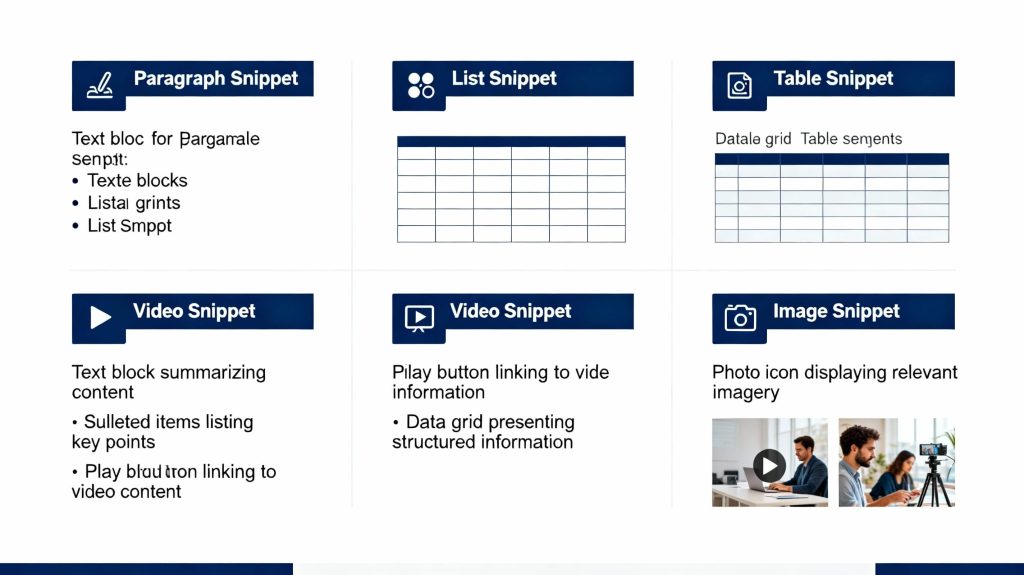
Understanding each featured snippet format is crucial for optimization success. Google displays different snippet types depending on search intent and content structure.
Paragraph Snippets (Most Common)
Paragraph snippets are the most frequently displayed format, appearing for roughly 60% of featured snippet queries. These snippets extract 40-60 words of relevant text directly from your content, typically answering “what,” “how,” “why,” “where,” or “when” questions. Google pulls a concise paragraph that comprehensively answers the user’s query without truncation.
Optimization tip: Ensure your opening sentences directly answer the question, followed by supporting details in 2-3 additional sentences.
List Snippets (Bulleted and Numbered)
List-format snippets account for approximately 30% of featured snippets. These appear when the query involves steps, processes, rankings, or comparisons. Google extracts either a bulleted list or numbered sequence from your content, making them ideal for “how-to” guides, top 10 lists, recipe ingredients, and multi-step processes.
Optimization tip: Structure your lists with clear items, short descriptions per bullet point, and logical ordering that matches user expectations.
Table Snippets
Table snippets represent roughly 10% of featured snippet opportunities and appear for comparative or data-driven queries. These snippets are particularly effective for presenting specifications, pricing comparisons, feature breakdowns, and statistical information. While less common than other formats, table snippets often command higher engagement because they efficiently organize complex information.
Optimization tip: Use clean, well-labeled tables with clear headers and consistent formatting. Ensure mobile responsiveness so tables remain readable on small screens.
Video and Image Snippets
While less common than text-based snippets, video and image results increasingly appear in featured snippet positions. Videos typically appear for how-to queries, demonstrations, and tutorials, while images show for visual queries like “what does an air fryer look like?”
Optimization tip: Include relevant, high-quality images with descriptive alt text and file names containing your target keywords.
The Business Impact: Why Featured Snippets Optimization Drives Results
The statistics surrounding featured snippets validate the effort required for optimization. According to comprehensive 2025 research, featured snippets generate a remarkable 67% click-through rate—nearly double the CTR of first-position organic results. This elevated performance occurs because featured snippets capture user attention, establish credibility through Google’s endorsement, and reduce friction by providing immediate value.
Featured snippets also capture considerable click share from voice search. Analysis of Google Home results reveals that approximately 41% of voice search answers derive directly from featured snippets. With voice search adoption accelerating—particularly on mobile devices—owning featured snippets positions your brand as the voice search answer in your industry.
Another critical benefit: featured snippets allow lower-ranking pages to achieve prominence. A page ranking in position 5 or 6 can still earn a featured snippet for a lower-volume keyword, effectively leapfrogging higher-ranked competitors. One education institution securing 17 featured snippets experienced a 60% average pageview increase for snippet-earning content, with one post achieving a 127% traffic increase compared to the previous two months.
However, featured snippet optimization comes with an important tradeoff. While winning a snippet dramatically increases visibility, it can reduce clicks to the #1 organic
position by approximately 5.3% because users receive their answer directly on the SERP without clicking through. This effect is balanced by the fact that featured snippet traffic typically exceeds what the #1 position would have received.
Keyword Research: Finding Your Featured Snippet Opportunities
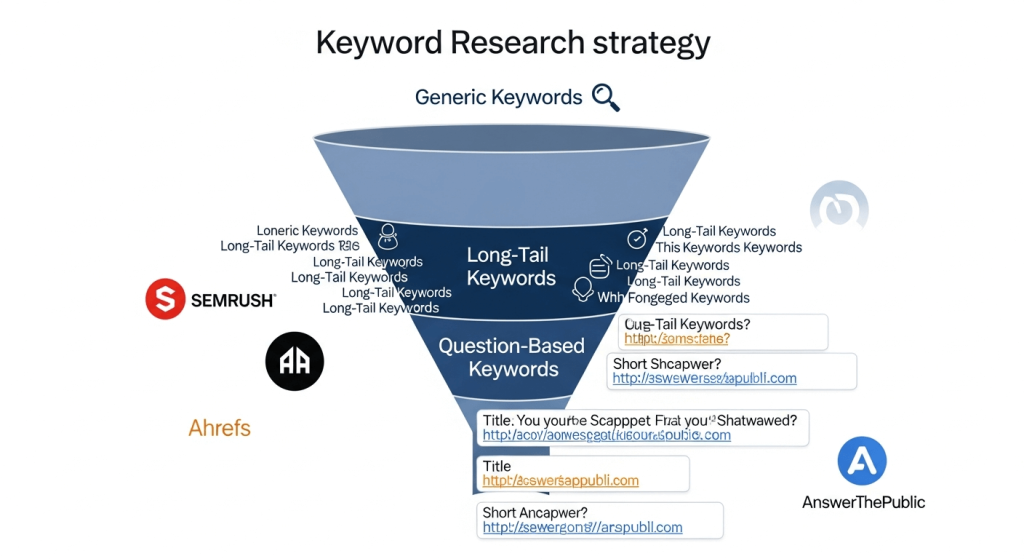
Successful featured snippets optimization begins with intelligent keyword research focused on identifying snippet opportunities. The most effective keywords for featured snippet optimization share specific characteristics that distinguish them from general keywords.
Target Long-Tail and Question-Based Keywords
Long-tail keywords—phrases containing three or more words—trigger featured snippets far more frequently than short, broad terms. Approximately 70% of all Google searches are long-tail queries, and these detailed searches often produce featured snippet results. More critically, long-tail keywords generally face less competition, giving you a realistic chance of winning the snippet.
Question-based keywords represent your highest-probability opportunities. Queries beginning with “how,” “what,” “why,” “where,” “when,” and “best” consistently trigger featured snippets. These query formats indicate direct information needs and align perfectly with featured snippet formats. Other high-value question modifiers include “how to,” “how many,” “how much,” “is,” “does,” “can,” and “should.”
Research demonstrates that long-tail keywords with monthly search volumes between 300 and 1,000 offer the optimal balance of traffic potential and achievable competition levels for featured snippet opportunities. Extremely high-volume keywords face intense competition and established featured snippets that are difficult to dislodge. Conversely, very low-volume keywords provide minimal benefit even if you win the snippet.
Using Keyword Research Tools Strategically
Several specialized tools efficiently identify featured snippet opportunities aligned with your business:
Semrush’s Keyword Magic Tool generates thousands of long-tail keyword variations from a single seed term. Filter results to reveal question-based queries, then examine which keywords currently display featured snippets. The keyword difficulty score indicates feasibility—prioritize keywords with moderate difficulty and existing snippets, as these represent proven opportunities with less competition than high-difficulty terms.
Ahrefs’ Questions Report specifically surfaces question-format keywords containing your target terms. The interface filters keywords that currently show featured snippets, accelerating your research process. Additionally, Ahrefs’ Site Explorer reveals which competitor domains own featured snippets, allowing competitive analysis to inform your strategy.
Google’s Free Tools provide valuable, cost-free insights. When you search your target keyword, Google’s “People Also Ask” section reveals related questions that frequently trigger snippets. Google’s autocomplete suggestions show real search queries users enter. These organic signals help identify natural question variations worth targeting.
AnswerThePublic visualizes questions people ask around your seed keyword, displaying queries in an intuitive map format. This tool excels at uncovering conversation-style questions your audience actually searches for, directly informing content gaps you can fill.
Prioritizing Snippet Opportunities
Not all featured snippet opportunities are equally valuable. Prioritize keywords where you already rank in the top 5 positions. Google’s algorithm demonstrates strong preference for extracting snippets from pages already ranking well for the target keyword. Attempting to rank position 1 and win the snippet simultaneously proves exponentially harder than optimizing an existing top-5 page for snippet status.
Additionally, research keywords where featured snippets already appear. Existing snippets validate that Google triggers snippets for the query, eliminating doubt about whether the keyword displays snippets. Many SEO tools falsely identify keywords as “snippet opportunities” based on searches that never actually show snippets. Targeting proven snippet keywords increases your success rate substantially.
Content Structure and Formatting for Featured Snippets Success
Google’s algorithm for selecting featured snippets rewards clear, well-organized content structured specifically for readability and extraction. Understanding proper content structure is fundamental to featured snippets optimization.
The Winning Content Architecture
Successful featured snippet optimization follows a specific hierarchical structure that Google’s algorithm recognizes and rewards:
- Question-Based H2 Heading: Begin with an H2 heading that includes your target keyword and mirrors the user’s question format. For example: “How to Optimize for Featured Snippets” or “What Are Featured Snippets?” This heading signals to Google that relevant snippet content follows.
- Direct Answer (40-60 words): Immediately follow your heading with a concise answer paragraph containing 40-60 words, approximately 300-320 characters. This length allows Google to display your complete answer without truncation while providing sufficient detail for comprehension. Start with a clear definition or direct response to the heading question.
- Supporting Details: Expand on your direct answer with 1-2 additional paragraphs providing context, examples, and supporting information. Keep these paragraphs brief—3-4 sentences maximum—maintaining scannability and preventing dense text walls.
- Structured List or Table: If appropriate for your content type, include a bulleted, numbered list, or table that breaks down the information visually. This formatting increases snippet eligibility, particularly for list and table snippet types.
- Summary Paragraph: Conclude your snippet-targeted section by restating the main point in different language, reinforcing the core concept while providing fresh phrasing.
Leveraging Header Tags for Semantic Clarity
Google weighs header tag content heavily when determining snippet sources and importance. Include your target keyword and keyword variations within H2, H3, and occasionally H4 tags positioned near your snippet content. This header structure provides semantic signals about content organization and relevance.
Avoid keyword stuffing in headers; instead, use natural language that reads well for human audiences first. A header like “Featured Snippets Optimization Strategies” works better than “Featured Snippets Optimization Featured Snippets How-To.” Clear hierarchy—with H1 titles, followed by H2 main sections, then H3 subsections—helps both Google and users understand content organization.
Writing Style and Tone for Snippet Selection
Featured snippets require objective, neutral, fact-based language rather than promotional or brand-focused copy. Google’s algorithm favors authoritative, unbiased content. Avoid starting snippet content with phrases like “At [Company], we believe…” or “Our proprietary approach shows…” Instead, present information in clear, objective terms: “Featured snippets are…” rather than “We’ve discovered that featured snippets are…”
Active voice generally performs better than passive voice in featured snippets, as it communicates clearly and directly. “Google displays featured snippets above organic results” outperforms “Featured snippets are displayed by Google above organic results.” Short, declarative sentences optimize for readability on mobile devices where most voice searches and snippet views occur.
Conversational tone works well for instructional content and definitions but should remain professional and authoritative. Your writing should reflect genuine expertise—demonstrating knowledge through detailed explanations rather than simple keyword mentions.
Mobile-First Formatting Principles
Since over 50% of featured snippet views occur on mobile devices, formatting decisions must prioritize mobile readability. Break text into short paragraphs with generous whitespace. Use bold formatting to highlight key terms and conclusions. Employ bullet points generously, as scanning is the primary mobile interaction pattern.
Ensure images remain optimized for mobile viewing—large images that break mobile layouts damage your snippet eligibility. Use responsive image sizes that scale appropriately across devices. Tables must remain readable on small screens; if your table exceeds mobile width, consider restructuring into a list format for mobile devices while maintaining the table on desktop.
Matching the Existing Featured Snippet Format
One of the most powerful—yet underutilized—featured snippets optimization tactics is matching the current snippet format in your target SERP. This principle seems simple but yields remarkable results: if a paragraph snippet currently appears for your target keyword, your content should include a similarly structured paragraph. If a list snippet dominates, your page should feature a matching list.
This format-matching strategy works because it demonstrates to Google that your content perfectly aligns with how information for this query should be presented. Your content doesn’t need to be better than the current snippet—it just needs to be equally good but potentially with slightly fresher information or superior comprehensiveness.
Example: If “how to make sourdough bread” displays a numbered list featuring 7 steps, your content should also include a clearly numbered 7-step process. Rather than describing the process in paragraph form or providing 5 steps, match the existing format and structure precisely.
Competitive analysis forms the foundation of this optimization. Before writing or restructuring content, examine the current featured snippet carefully. Note its format, length, level of detail, specific information included, and how it’s organized. Replicate this structure while potentially adding slightly more depth or current examples that make your version more valuable.
Implementing Schema Markup for Featured Snippets Optimization
Schema markup—structured data that helps search engines understand content context—significantly increases featured snippet eligibility. Specific schema types have proven particularly effective for earning featured snippets.
High-Performing Schema Types
FAQ Schema ranks among the most effective schema types for featured snippets. FAQ schema markup signals to Google that your page contains questions and answers, a format Google frequently displays as featured snippets. Implementing FAQ schema on pages targeting question-based keywords increases snippet probability substantially.
HowTo Schema directly supports list-format snippets and instructional content. This schema type allows you to markup steps, durations, estimated costs, and images associated with your process. Pages with properly implemented HowTo schema receive significantly higher featured snippet rates for how-to queries.
Article Schema provides general structured data about your content, helping Google understand author, publication date, headline, and description. While less directly connected to featured snippets than FAQ or HowTo schema, Article schema remains valuable for establishing content context.
Product Schema supports featured snippets for product-related queries, allowing you to markup pricing, availability, ratings, and specifications. This schema type particularly supports table-format snippets comparing multiple products.
Implementation Methods
JSON-LD Implementation represents the easiest and most recommended approach, as it doesn’t require modifying HTML structure. JSON-LD code can be added anywhere on the page, typically within a <script> tag in the page header or footer. This approach works across all CMS platforms and integrates cleanly without breaking existing code.
WordPress Plugin Implementation simplifies schema markup for WordPress users. Plugins like AIOSEO, Yoast SEO, and Schema Pro provide visual interfaces for implementing schema without coding knowledge. These plugins generate and validate schema markup automatically.
Manual HTML Implementation allows direct markup integration for developers comfortable with HTML. However, this method requires more technical knowledge and introduces higher risk of implementation errors. Most modern implementations use JSON-LD instead.
After implementing schema markup, validate implementation using Google’s Rich Results Test (previously Structured Data Testing Tool). This free tool reveals implementation errors and confirms that Google recognizes your schema correctly.
Crafting Concise, Compelling Answers: The Art of Featured Snippets Optimization
The core challenge in featured snippets optimization involves providing answers that simultaneously satisfy Google’s extraction preferences and user information needs. This requires carefully balancing brevity with completeness.
The 40-60 Word Sweet Spot
Featured snippet paragraph length averages 40-60 words, approximately 300-320 characters. This length represents Google’s optimization for readability on both desktop and mobile displays. Answers shorter than 40 words often lack sufficient detail for comprehension. Answers exceeding 60 words frequently truncate on mobile, degrading user experience and potentially triggering Google to choose a different snippet source.
Example (52 words, optimal length):
“Featured snippets are highlighted answer boxes Google displays at the top of search results, above all organic listings. They extract concise information—typically 40-60 words—from web pages to provide immediate answers to user queries. Featured snippets increase click-through rates by approximately 67% compared to standard organic results, making them valuable SEO targets.”
Notice how this answer provides a comprehensive definition with context and benefit within the optimal word range. Every sentence contributes essential information without filler.
Using “Is” Statements as Snippet Triggers
Analysis of pages earning featured snippets consistently reveals heavy use of “is” statements in the opening sentence. Statements like “Featured snippets are…” or “Long-tail keywords are…” effectively communicate definitions and appear frequently in featured snippet content.
This pattern likely occurs because Google’s algorithm recognizes “is” statements as definitional content—exactly the format used in featured snippets. While not an absolute requirement, opening with “is” statements dramatically increases snippet probability for definitional queries.
Fully Defining Your Topic in 2-3 Sentences
Featured snippets must provide enough context for complete comprehension in their limited space. This means your opening 2-3 sentences must comprehensively define the topic or answer the question. Assume the user will only see your featured snippet and won’t click through to your full article—does your snippet still fully address their question?
This approach differs from traditional article writing, where you gradually build context through multiple paragraphs. Featured snippet optimization requires immediate completeness: definition, context, and relevance all within the opening 2-3 sentences.
Answering Searcher Intent Before Adding Supporting Details
User intent—the underlying need or question behind a search query—must drive content organization. Before providing supplementary information, directly address the core intent. A search for “how to reduce bloating” needs an immediate answer about bloating reduction before discussing food options, hydration, or lifestyle changes.
Understanding intent requires researching current featured snippets and analyzing search results. These provide direct signals about what information users actually need. Top-ranking pages for your target keyword provide additional context about priority information.
Optimizing for Different Featured Snippet Types
While fundamental principles apply across all featured snippet types, each format requires specific optimization adjustments.
Paragraph Snippet Optimization
Paragraph snippets require the direct answer structure previously outlined: question-based heading, concise definition, supporting details, and summary. Ensure your opening paragraph reads naturally while precisely answering the user’s question. These snippets serve informational queries where users need foundational understanding.
Include relevant keywords naturally throughout your paragraph without keyword stuffing. Google’s algorithms recognize keyword stuffing and penalize overoptimized content. Natural language incorporating semantic keywords (synonyms and related terms) typically outperforms artificially keyword-dense writing.
List Snippet Optimization
List snippets require clear, parallel structure. If presenting steps, ensure each step follows consistent grammatical structure: “First, prepare your ingredients. Second, preheat your oven. Third, combine wet ingredients.” This parallel structure makes lists scannable and helps Google recognize the content as list-format.
Limit list items to 5-10 entries for optimal readability. Longer lists sometimes require restructuring into multiple lists with subheadings or breaking complex topics into separate content pieces. Each list item should include enough detail (1-2 sentences) to be comprehensive without overwhelming readers.
Bulleted vs. numbered list format depends on content type. Use numbered lists for sequential processes, rankings, or any content where order matters. Use bulleted lists for non-sequential items, options, or benefits where order is arbitrary.
Table Snippet Optimization
Table snippets benefit from clear column headers, consistent data types within columns, and sufficient rows for meaningful comparison. Ensure columns directly compare relevant attributes and include data that would naturally appear in a table format (not just forcing paragraph text into a table structure).
Keep table width reasonable for mobile displays. Tables exceeding mobile screen width become difficult to read and may not appear as featured snippets. Consider alternative formatting or splitting information across multiple smaller tables when necessary.
Use headers and row labels consistently, employing clear terminology your audience recognizes. Vague or jargon-heavy headers damage scannability and reduce snippet eligibility.
Advanced Optimization: Going Beyond Basics
Moving beyond fundamental optimization requires deeper understanding of Google’s algorithm and emerging SEO trends.
Targeting Featured Snippet Gaps
Competitive analysis reveals gaps—keywords where content exists but featured snippets don’t currently appear, or keywords where weak featured snippets present opportunity for displacement. These gaps represent lower-competition opportunities where optimization effort translates directly to snippet acquisition.
Use tools like Ahrefs, Semrush, or SERP Robot to identify competitor featured snippet holdings. Note which keywords competitors dominate and which represent open opportunities. Create comprehensive content for underserved snippet opportunities where competition remains minimal.
Layering Long-Form Content with Featured Snippet Sections
The most effective featured snippets optimization integrates snippet content into larger, comprehensive articles rather than creating thin snippet-focused pages. Layer 2,000+ word articles with multiple featured snippet-eligible sections addressing different related questions.
This approach serves multiple purposes: it signals expertise through depth, provides multiple snippet opportunities within one piece (increasing traffic potential), and improves dwell time and engagement metrics through comprehensive value delivery.
Monitoring Competitor Snippet Activity
Competitive tracking reveals emerging opportunities and threats. When competitors win new featured snippets, analyze their content structure and approach. Similarly, when you lose snippets you previously held, investigate what changed—both in the search results and in your content.
Tools like Rank Ranger, SERP Robot, and SE Ranking specifically track featured snippet changes for your domain and competitors. Regular monitoring (weekly or bi-weekly) identifies trends and threats early.
Mobile and Voice Search Optimization
Voice search integration magnifies featured snippet importance—approximately 41% of voice search answers come from featured snippets. Optimizing for voice means using conversational language and long-tail, question-based keywords. Mobile optimization ensures your content displays correctly on smartphones where most voice searches occur.
Page speed optimization becomes critical for voice search: voice results load 52% faster than average, with a target load time under 3 seconds. Compress images, minimize code, enable browser caching, and implement Content Delivery Networks (CDNs) to achieve fast mobile loading.
Common Featured Snippets Optimization Mistakes to Avoid
Even well-intentioned optimization efforts fail when certain critical mistakes persist. Understanding these pitfalls prevents wasted effort and accelerates success.
Keyword Stuffing and Over-Optimization
Attempting to cram keywords unnaturally into snippet content backfires. Google’s algorithms recognize keyword stuffing and actually penalize such content. “Featured snippets optimization for featured snippets means optimizing your featured snippets content for featured snippets” fails because it’s unnatural and provides no value.
Write naturally for human readers first; keyword optimization second. Semantic keywords and natural language variants provide better results than repeating primary keywords excessively. Trust that comprehensive, well-written content addressing topics thoroughly will include relevant keywords naturally.
Ignoring User Intent and Search Context
Optimizing for keywords without understanding what users actually need wastes effort. Before optimization, research current search results, featured snippets, and People Also Ask sections to understand true user intent. Create content matching this intent precisely rather than assuming you understand user needs.
A search for “healthy bread options” may reveal user intent focused on calorie reduction, whole grain benefits, or gluten-free alternatives. Your optimization must address the actual need revealed by search results, not a different interpretation of the keyword.
Providing Incomplete or Overly Complex Answers
Featured snippet space constraints require answers that are complete yet concise. Providing vague answers that require further reading to understand fails—users should comprehend your complete answer without clicking. Conversely, overly complex answers using technical jargon alienate general audiences and violate featured snippet principles.
Test your snippet content: can someone completely understand and answer the target question based solely on your featured snippet? If yes, you’ve hit the right complexity level. If no, either your snippet lacks necessary detail or uses language too technical for your audience.
Dense Text and Poor Formatting
Featured snippets suffer from dense, poorly formatted text. Wall-of-text paragraphs, lack of subheadings, absence of lists where appropriate, and minimal whitespace all damage snippet eligibility and readability. Google’s algorithm increasingly rewards scannable, well-formatted content.
Use generous whitespace, short paragraphs, clear headings, and formatting tools like bold text for emphasis. Lists, tables, and images all improve formatting and increase snippet probability.
Failing to Match Current Featured Snippet Formats
This critical mistake undermines otherwise good optimization. If a list snippet currently appears for your target keyword and you only provide paragraph content, your content won’t match the expected format. Google prefers extracting content that matches the format already proven successful for the query.
Always examine current featured snippets before optimization. Match the format, approximate length, and information structure. Small format differences reduce displacement probability substantially.
Neglecting Featured Snippet Monitoring and Iteration
Set-and-forget featured snippet optimization rarely succeeds long-term. Search results, competitor content, and Google’s algorithm evolve constantly. Regular monitoring (at least monthly) reveals what’s working, when you’ve lost snippets, and when competitors win new ones.
When you lose a snippet you previously held, investigate immediately. Did competitors improve their content? Did Google’s algorithm shift toward different content? Did your content become outdated? Quick iteration prevents prolonged snippet losses and helps you regain position zero rapidly.
Tools and Resources for Featured Snippets Optimization
Numerous tools facilitate research, optimization, and monitoring of featured snippets.
Ahrefs provides comprehensive featured snippet analysis including competitor snippet tracking, questions research, and SERP data. The keyword explorer reveals which keywords show featured snippets, simplifying research prioritization.
SEMrush offers featured snippet identification within keyword research, competitive domain analysis, and SERP tracking. Their position tracking specifically monitors featured snippet changes for your tracked keywords.
Google Search Console provides free, critical data including impression data, click-through rates, and average position. Filter by query type to identify question-based keywords triggering impressions—these represent potential snippet opportunities.
Google Analytics tracks mobile vs. desktop traffic, bounce rates, and engagement metrics for snippet-earning pages. Identify pages with high bounce rates despite high impressions—these may need snippet optimization.
SERP Robot specializes in featured snippet tracking and competitor snippet analysis, providing dedicated focus on this specific SERP feature.
AnswerThePublic visualizes questions people ask around your keywords, providing qualitative keyword research insights that complement quantitative tools.
Google’s Rich Results Test validates schema markup implementation, confirming that Google recognizes your structured data correctly.
The Future of Featured Snippets: Emerging Trends and Opportunities
Featured snippets continue evolving as Google refines its algorithms and search behavior shifts. Several emerging trends warrant attention for forward-thinking optimization strategies.
AI and Multi-Answer Snippets
Google increasingly displays multiple featured snippets or enhanced snippets containing information from various sources. This shift suggests future optimization must address multiple interpretations and perspectives on topics rather than providing single, authoritative answers.
Video and Visual Snippet Expansion
Video and image snippets, currently less common than text snippets, will likely increase as visual search grows. Optimizing videos for transcription accuracy and creating high-quality, relevant images supporting your content prepares you for this shift.
Entity Recognition and Semantic Optimization
Google’s algorithms increasingly focus on semantic understanding and entity relationships rather than keyword matching. Featured snippet optimization is shifting toward comprehensive topic coverage and entity recognition rather than narrow keyword targeting.
Voice Search Integration
As voice assistants mature and voice commerce expands, featured snippet optimization for conversational queries becomes increasingly important. Content optimized for natural language and question-based search queries gains advantage over keyword-focused approaches.
Featured Snippets Optimization: Your Action Plan
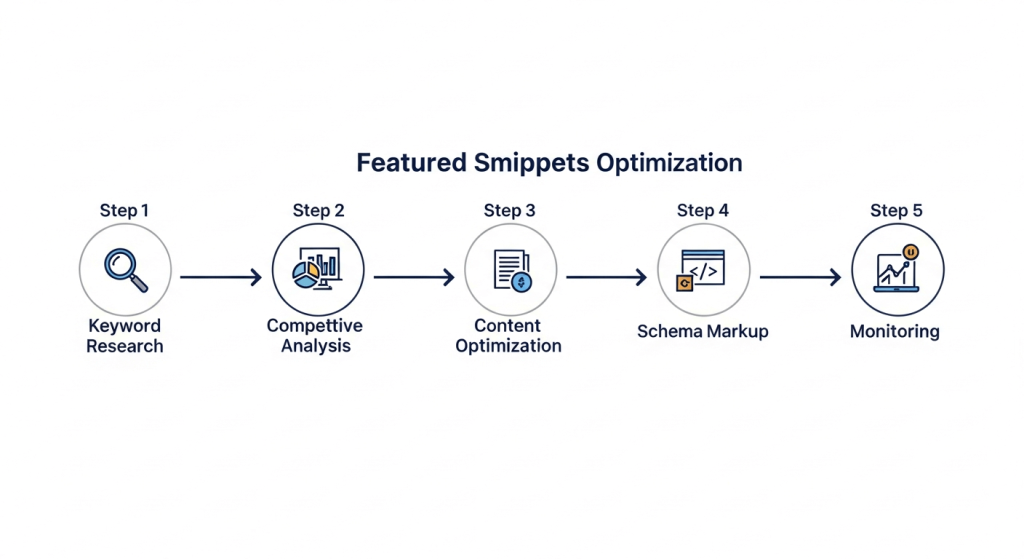
Implementing featured snippets optimization requires systematic approach combining research, content creation, technical implementation, and ongoing monitoring.
Step 1: Keyword Research and Opportunity Identification
Identify 15-20 high-potential featured snippet keywords using research tools. Prioritize keywords where you currently rank in top 10 and featured snippets already appear. Start with moderate-difficulty keywords rather than extremely competitive terms where displacement proves difficult.
Step 2: Competitive Analysis
Examine current featured snippets for your target keywords. Document format, length, information structure, and any schema markup. This analysis informs your optimization approach directly.
Step 3: Content Optimization
For pages already ranking well, restructure content around featured snippet principles. Add appropriate headings, concise answer paragraphs, supporting details, and formatted lists or tables. Ensure your content matches or slightly exceeds current snippet quality and comprehensiveness.
Step 4: Schema Markup Implementation
Implement relevant schema markup (FAQ, HowTo, Article) appropriate for your content type. Validate implementation using Google’s Rich Results Test.
Step 5: Monitoring and Iteration
Track keyword performance and featured snippet acquisition. Monitor competitor activity. When optimization efforts result in snippet wins, celebrate—then optimize additional keywords using lessons learned. When efforts don’t immediately succeed, analyze current snippets to identify refinement opportunities.
Conclusion: Featured Snippets Optimization as Core SEO Strategy

Featured snippets represent the most valuable real estate in modern search results. With 67% click-through rates, broad keyword coverage (11.3% of searches display snippets), and particular importance for voice search, featured snippet optimization cannot be relegated to nice-to-have status. It’s fundamental to modern SEO success.
Success requires moving beyond basic keyword optimization toward strategic content positioning. By understanding featured snippet formats, implementing proper structure and schema markup, conducting targeted research, and monitoring your performance, you create conditions where featured snippets become reliable traffic drivers rather than random wins.
Start with your highest-impact, moderate-difficulty keywords. Apply the principles outlined in this guide. Monitor results carefully and iterate quickly based on what you learn. Featured snippets aren’t guaranteed, but systematic optimization dramatically increases your acquisition rate.
The question isn’t whether to optimize for featured snippets—it’s when you’ll start. Your competitors are already claiming position zero. The time to begin your featured snippets optimization strategy is today.
Frequently Asked Questions About Featured Snippets Optimization
Q: Do I need to rank position 1 to win a featured snippet?
No. While pages already ranking well for a keyword have snippet advantages, lower-ranking pages frequently earn snippets. Pages ranking in positions 3-5 can win snippets for lower-competition keywords. Focus on format matching and content quality rather than assuming position 1 is prerequisite.
Q: How long does it take to appear in a featured snippet?
Timeline varies widely based on keyword competition, current ranking position, and content quality. Some pages earn snippets within weeks; others require months of optimization. Typically, optimizing existing top-10 content yields faster results than creating new pages targeting competitive terms.
Q: Can I influence which content Google selects as a featured snippet?
Partially. While you cannot guarantee Google selects specific content, optimization increases probability dramatically. Clear content structure, proper formatting, schema markup, and matching current snippet formats all increase selection likelihood. However, Google retains final decision-making authority.
Q: Should I worry about featured snippets stealing clicks from my organic results?
Featured snippets do reduce some clicks to lower positions, but the total traffic gained typically exceeds losses. Data shows featured snippet traffic far exceeds what organic positions beneath the snippet would have received. The 6.6-67% CTR for featured snippets justifies optimization effort.
Q: How do featured snippets interact with position zero and rich snippets?
Featured snippets are position zero results. “Rich snippets” is an older term describing search results enhanced with structured data (ratings, reviews, pricing). Featured snippets and rich snippets represent distinct Google features, though some overlap exists. Featured snippets represent the most visible, valuable SERP position available.
Q: Do featured snippet rankings carry over to other search engines?
No. Bing, DuckDuckGo, and other search engines display results independently. While optimization for Google featured snippets indirectly benefits other search engines (through improved content quality and structure), these platforms don’t use Google’s featured snippet algorithm. You may win snippets on other engines independently, but optimization should focus primarily on Google’s 92% market share dominance.
Q: How often should I update featured snippet content?
Maintain featured snippet content currency by reviewing at least quarterly and updating as newer information emerges. If your snippet remains accurate and current, minimal changes are necessary. However, if newer data, better examples, or improved approaches become available, updating content refreshes it and signals to Google that your page remains authoritative and current.
Q: What’s the relationship between featured snippets and E-E-A-T?
Featured snippets align directly with E-E-A-T (Experience, Expertise, Authoritativeness, Trust). Featured snippets appear prominently because Google trusts them as quality sources. To earn and maintain featured snippets, demonstrate clear expertise through detailed explanations, cite authoritative sources, showcase relevant experience, and maintain factual accuracy.