

In today’s fast-paced digital landscape, customers expect instant answers and seamless support around the clock. Artificial intelligence chatbots have emerged as a game-changing solution that transforms how businesses interact with customers, generate leads, and streamline operations. From e-commerce platforms to healthcare providers, organizations are rapidly adopting AI chatbots to stay competitive. The global AI chatbot market has exploded to reach $9.90 billion in 2025, with projections showing growth to $65.94 billion by 2032. But what exactly makes AI chatbots so valuable? Whether you’re a business owner considering implementation or simply curious about this technology, understanding the tangible benefits of using AI chatbots is essential. This comprehensive guide explores how AI chatbots deliver measurable results across cost reduction, customer experience, revenue generation, and operational efficiency.
The Business Case: Why Companies Choose AI Chatbots
The statistics tell a compelling story. Eighty-three percent of organizations that invested in AI solutions have already seen positive returns on investment. This isn’t surprising when you examine the concrete advantages these systems deliver. Businesses using AI chatbots have achieved 3.5 times greater increases in customer satisfaction rates compared to those relying solely on traditional support methods. More impressively, companies can reduce customer service costs by 30-40% within the first year of implementation.
The appeal extends beyond cost savings. With 87% of consumers rating their chatbot experiences as neutral or positive, and 80% reporting overall positive interactions, AI chatbots have fundamentally shifted customer expectations and business capabilities. Let’s explore why.
1. 24/7 Customer Support Without the Overhead
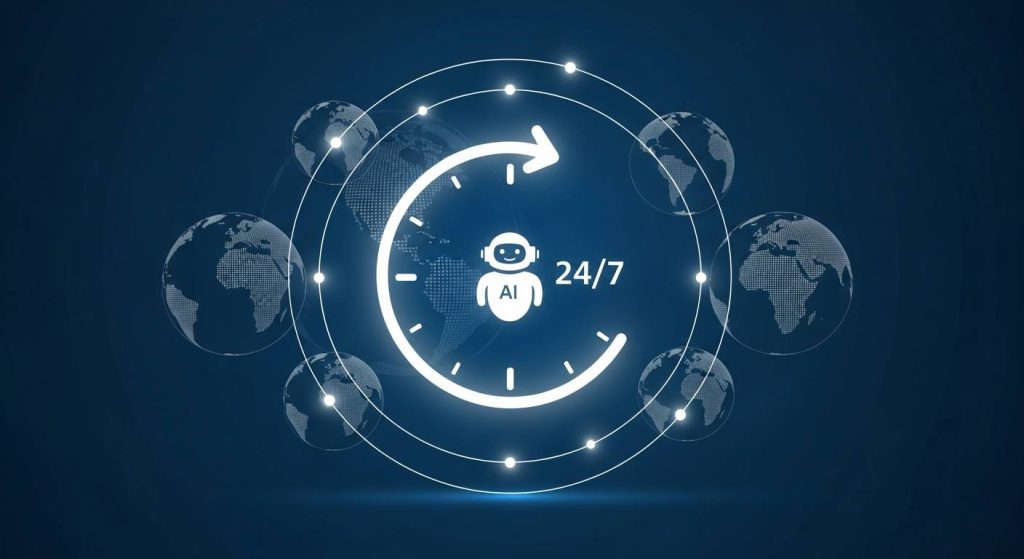
The Challenge: Traditional customer service operations face inherent limitations. Human agents need breaks, sleep, and time off. Holiday schedules, time zone differences, and staffing constraints create gaps in support availability.
The AI Chatbot Solution: AI chatbots provide round-the-clock support that never stops. Chatbots work 24/7/365 without fatigue, eliminating waiting times and ensuring customers receive immediate assistance regardless of when they reach out. This is particularly valuable for businesses serving global audiences across multiple time zones.
The impact is tangible. Research indicates that 69% of consumers prefer chatbots for quick communication with brands, specifically citing 24/7 availability as the most valued feature. For customers who demand answers immediately, chatbots deliver exactly what they need. Consider a simple scenario: A customer wants to track their order at 2 AM on a Sunday. Rather than waiting until Monday morning for human support, they get instant information from a chatbot, dramatically improving their experience and likelihood of remaining loyal.
2. Significantly Reduced Operational Costs
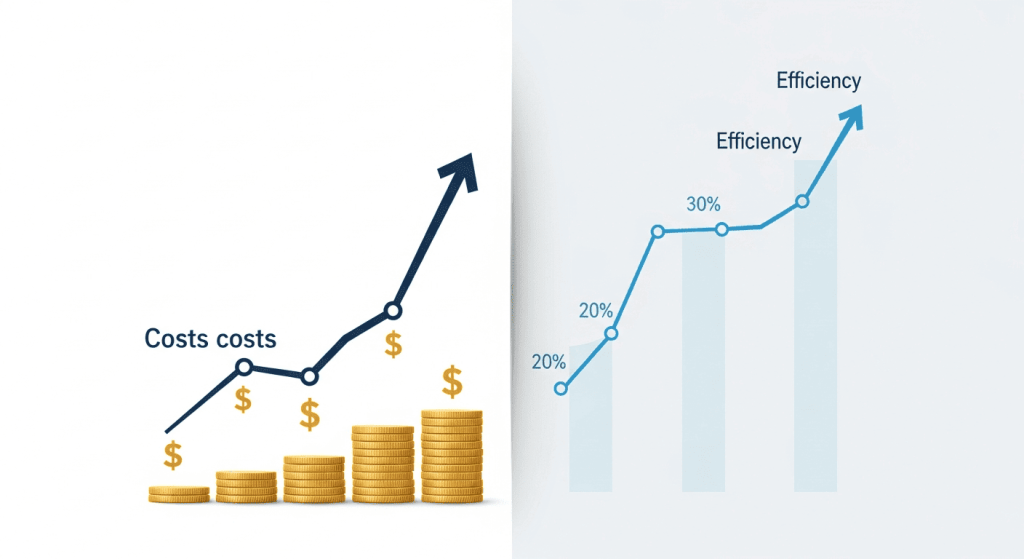
The Financial Impact: One of the most compelling benefits of using AI chatbots is their ability to slash operational expenses. Businesses that implement chatbots can handle 80% of routine customer questions automatically, dramatically reducing the workload on human teams.
The savings come from multiple angles:
- Reduced staffing needs: Chatbots handle volume spikes without hiring additional agents
- Lower training expenses: Automated responses eliminate repetitive training cycles
- Decreased overtime costs: 24/7 availability without labor cost increases
- Fewer infrastructure investments: Cloud-based chatbots scale efficiently
For a company spending $500,000 annually on customer support, a 30-40% reduction translates to $150,000-$200,000 in direct annual savings. When multiplied across an organization with multiple support channels, these savings become transformational. Beyond year one, businesses often achieve even greater savings as optimization improves and chatbot performance enhances.
3. Faster Response Times and Improved Efficiency
Speed Equals Satisfaction: Modern customers are impatient. Research shows that 53% of consumers find waiting too long for a response to be the most frustrating aspect of customer interactions. AI chatbots eliminate this pain point completely.
Instead of customers sitting in queue for 10-20 minutes waiting for a human agent, they receive immediate responses from chatbots. The average first-response time drops to near-zero seconds. This speed advantage translates directly to higher satisfaction scores.
Organizations implementing AI chatbots see impressive efficiency gains:
- 50% reduction in response times for certain query types
- 20-40% reduction in overall service time through automation
- 18% faster issue resolution compared to traditional methods
- 58% resolution rate for customer tickets handled by AI, with an 87% success rate
A travel company that deployed a multilingual chatbot experienced exactly these benefits, cutting response times in half while simultaneously boosting customer satisfaction. The chatbot handled routine questions, appointment scheduling, and information requests instantly, freeing human agents to focus on complex, high-value interactions.
4. Dramatically Increased Lead Generation and Conversion Rates
Turning Conversations into Customers: One of the most powerful benefits of using AI chatbots is their ability to convert website visitors into paying customers. Rather than forcing visitors into rigid contact forms, conversational AI engages them naturally while capturing valuable information.
The conversion metrics are striking:
- Websites with chatbots see 23% higher conversion rates than those without
- AI chatbots deliver 67% higher conversion rates than traditional lead capture methods
- Businesses achieve 3x better conversion into sales using chatbots compared to website forms
- Generative AI chatbots boost conversion rates by 2.5x in lead qualification scenarios
What drives these dramatic improvements? Chatbots ask qualifying questions naturally, guide customers through decision-making processes, and provide real-time product recommendations. They capture buying signals through conversational dialogue rather than intimidating forms. The result: higher-intent leads reach your sales team already qualified and warm.
In e-commerce specifically, conversion rate benchmarks typically range from 2-4%, but optimized conversational AI can increase this to 10% or higher. For B2B sales, chatbot implementation reduces customer acquisition costs by up to 30%.
5. Personalized Customer Experiences at Scale
The Personalization Advantage: Modern customers expect interactions tailored to their preferences, history, and behavior. AI chatbots deliver this personalization at scale—something humanly impossible for support teams.
Chatbots analyze customer data to:
- Remember past interactions and reference previous conversations
- Learn from behavior patterns to predict needs
- Deliver customized product recommendations based on browsing history
- Tailor responses to individual preferences and communication styles
- Provide contextually relevant suggestions without requiring customers to repeat information
This level of personalization drives measurable outcomes. A retail chatbot might remember that a customer prefers size medium and tends to buy athletic wear. The next visit, they receive tailored recommendations and exclusive offers that align with their history—creating a shopping experience that feels uniquely crafted for them.
The result: 27% improvement in customer satisfaction scores through personalized interactions, and higher customer lifetime value as personalized experiences build stronger relationships and loyalty.
6. Valuable Data Collection and Business Intelligence
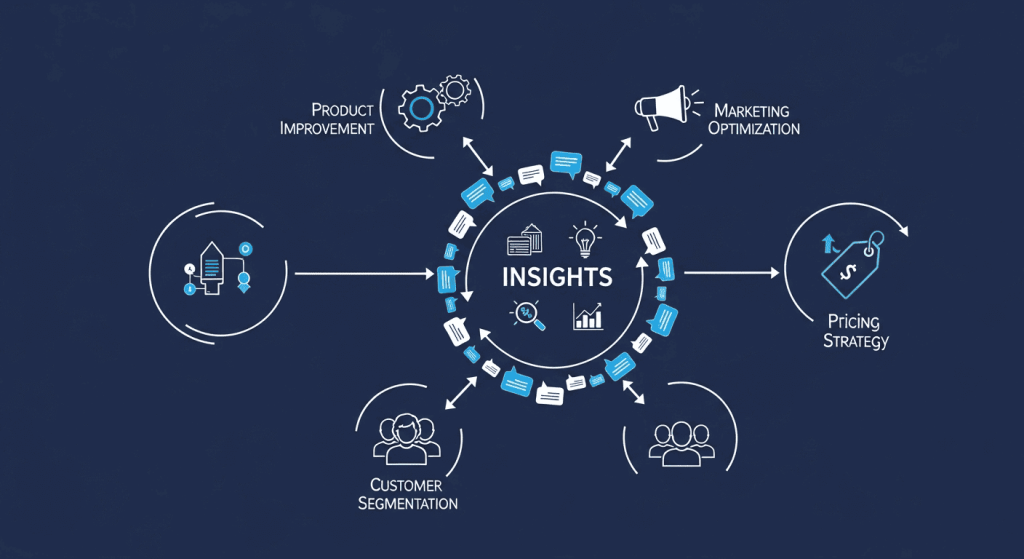
Insights Hidden in Conversations: Every customer interaction with a chatbot generates rich data about customer preferences, pain points, and behaviors. This information becomes a strategic asset for improving products and marketing strategies.
Chatbots capture:
- Customer preferences and browsing behaviors
- Frequently asked questions revealing knowledge gaps
- Product interest patterns showing trending items
- Sentiment and emotional signals indicating satisfaction levels
- Demographic information for audience segmentation
- Feedback on products and services without requiring surveys
Organizations use these insights to:
- Refine marketing campaigns with data-driven targeting
- Improve product development based on customer feedback
- Optimize pricing strategies based on customer interests
- Enhance overall customer experience by identifying friction points
- Make informed business decisions backed by real customer data
Unlike traditional survey methods that require active customer participation, chatbots collect this intelligence naturally through conversation. Companies gain a comprehensive understanding of their market without the cost and effort of traditional research methods.
7. Enhanced Scalability Without Proportional Cost Increases
Serving More Customers, Same Budget: Here’s the scaling paradox of traditional customer service: as your business grows and customer volume increases, you typically need to hire proportionally more support staff. This creates a direct cost-to-growth relationship that constrains profitability.
AI chatbots break this model entirely. One chatbot can simultaneously handle hundreds of conversations without any additional cost. If customer inquiries double, your chatbot handles the increase without needing doubling the investment.
This scalability advantage means:
- Businesses can serve significantly more customers without hiring additional agents
- Growth doesn’t trigger proportional cost increases
- Organizations maintain consistent service quality during high-volume periods
- Companies remain profitable as they scale operations
- Infrastructure adapts automatically to demand spikes
Consider a typical e-commerce site experiencing a surge during holiday shopping season. Instead of hiring temporary staff at premium wages, chatbots effortlessly handle the increased volume. Post-holiday, the infrastructure automatically scales back down without any disruption or additional layoffs. This flexibility would be impossible with human-only support teams.
8. Reduced Employee Burnout and Improved Job Satisfaction
Creating Meaningful Work: An often-overlooked benefit of using AI chatbots is their positive impact on human employees. Customer service agents frequently report dissatisfaction with repetitive, low-value tasks. Chatbots eliminate this frustration by handling routine inquiries, freeing agents for more meaningful work.
When chatbots take over simple questions—password resets, order tracking, account balance inquiries—human agents focus on complex issues requiring empathy, judgment, and creative problem-solving. This shift improves several critical metrics:
- Reduced employee turnover through more engaging work
- Improved job satisfaction as tedious tasks disappear
- Enhanced employee morale and workplace culture
- Better service quality as agents tackle challenging issues fresh and motivated
- Reduced cognitive burden from repetitive interactions
Organizations report that this shift significantly improves retention rates and reduces training costs associated with turnover. More importantly, creating work that feels purposeful improves overall workplace culture and employee engagement.
9. Multi-Channel Presence and Omnichannel Engagement
Meeting Customers Where They Are: Modern customers interact with brands across multiple platforms—websites, messaging apps, social media, SMS, and phone. Managing presence across all these channels typically requires separate systems and teams.
AI chatbots enable true omnichannel engagement by seamlessly operating across:
- Website chat interfaces
- Facebook Messenger and WhatsApp
- SMS and text messaging
- Mobile app integrations
- Voice assistants and phone systems
- Social media platforms
This unified approach ensures customers get consistent experiences regardless of platform. A customer might start a conversation on your website, continue via SMS, and complete their interaction on your mobile app—all with seamless context transfer.
The practical benefit: organizations concentrate resources on one intelligent chatbot rather than maintaining separate systems for each channel. This reduces technical complexity while improving customer satisfaction through consistency.
10. Competitive Advantage in Customer Experience
Standing Out in Crowded Markets: The accumulation of chatbot benefits creates a measurable competitive advantage. Organizations that provide instant, personalized, always-available support attract and retain customers more effectively than competitors still relying on traditional methods.
Key competitive metrics:
- Companies with chatbots see 34% average increases in customer satisfaction scores
- Eighty-nine percent of consumers are more likely to make another purchase after positive customer service experiences
- Organizations improve customer retention through superior service quality
- Brands build loyalty through consistent, responsive interactions
In markets where products and pricing have become commoditized, customer experience emerges as the primary differentiator. Businesses offering superior support through AI chatbots simply outcompete those still managing customer interactions manually.
Industry-Specific Benefits
Healthcare
In healthcare settings, AI chatbots streamline patient interactions by handling appointment scheduling, prescription refills, medication reminders, and symptom checks. Patients get instant answers to common questions, reducing pressure on clinical staff and improving access to care. The result: 24/7 availability, reduced administrative burden, and patients feeling more supported.
Retail and E-Commerce
Retailers leverage chatbots for personalized shopping assistance, product recommendations, return processing, and order tracking. The personalized experience drives higher conversion rates while the automated returns process reduces friction. Benefits include improved customer satisfaction, higher retention, and increased average order value through intelligent upselling.
Finance
Financial services use chatbots for account inquiries, fraud detection, transaction monitoring, and customer support. AI can analyze patterns and flag suspicious activity instantly. Real-time fraud detection, faster query resolution, and enhanced security create significant value.
Education
Educational institutions deploy chatbots for administrative tasks, virtual tutoring, enrollment assistance, and course information. Students receive instant answers to common questions, allowing educators to focus on personalized instruction. Benefits include enhanced learning experiences and time savings for educators.
FAQ: Common Questions About AI Chatbot Benefits
Q1: Do AI chatbots really improve customer satisfaction?
Yes, extensively documented research confirms this. Eighty percent of consumers report positive chatbot experiences, and 34% average increases in customer satisfaction scores are well-documented. Customer satisfaction improvements vary by implementation quality, but well-designed chatbots consistently outperform manual processes for routine inquiries.
Q2: Can chatbots handle complex customer issues?
Best-in-class chatbots are designed to identify when issues exceed their capabilities and seamlessly escalate to human agents. This hybrid approach provides the best of both worlds: chatbots handle volume, while humans focus on complexity. Around 86% of customers expect escalation options, and modern chatbots provide exactly this capability.
Q3: What’s the typical ROI timeline for chatbot implementation?
Many organizations see payback periods of 3-6 months, with ongoing ROI improvements. The fastest returns come from cost reduction (reduced staffing needs and infrastructure), while revenue improvements take slightly longer to materialize as conversion optimization occurs. First-year ROI typically reaches 100-200%.
Q4: Do chatbots work for B2B businesses?
Absolutely. B2B applications include lead qualification, sales support, customer onboarding, and internal employee support (HR questions, IT support, policy information). B2B chatbots often achieve higher-value outcomes because they help qualify complex, high-ticket deals.
Q5: How accurate are AI chatbots in understanding customer intent?
Modern AI chatbots powered by natural language processing achieve 70-80% accuracy in understanding customer intent on first contact. This accuracy improves continuously as the chatbot learns from interactions. For remaining unclear cases, escalation to human agents ensures problems get resolved.
Q6: What about data privacy and security with chatbots?
Enterprise-grade chatbots implement encryption, compliance frameworks (GDPR, HIPAA, etc.), and strict data handling policies. Organizations should vet chatbot providers for security certifications and compliance status, just as they would with any customer data system.
Q7: Can chatbots replace human customer service entirely?
Research suggests the optimal model combines AI and human agents. Around 88% of customer experience professionals believe AI will enhance, not replace, agents. Chatbots handle volume and routine questions, while humans provide empathy, complex problem-solving, and relationship-building for high-value interactions.
Conclusion: The Measurable Advantage of AI Chatbots

The benefits of using AI chatbots extend far beyond replacing human customer service representatives. These intelligent systems fundamentally transform how businesses operate across multiple dimensions: reducing costs by 30-40%, improving customer satisfaction scores by 34% on average, increasing conversion rates by 23%, and enabling 24/7 availability without proportional cost increases.
From lead generation and conversion optimization to employee satisfaction and competitive differentiation, AI chatbots deliver quantifiable value that businesses can measure and track. The $9.90 billion market size in 2025 reflects not hype, but practical recognition of these benefits by organizations across industries and company sizes.
Organizations that implement AI chatbots strategically—viewing them as partners to human agents rather than replacements, personalizing customer experiences, and continuously optimizing based on data—unlock their full potential. The question is no longer whether your business should invest in AI chatbots, but rather how quickly you can implement them to maintain competitive parity.
Ready to explore chatbot implementation for your business? Start by identifying your highest-volume customer inquiries, calculating potential cost savings, and researching chatbot platforms that align with your specific industry requirements. The financial case is clear, the technology is mature, and the customer benefits are proven. The competitive advantage belongs to early adopters who embrace this transformation today.